
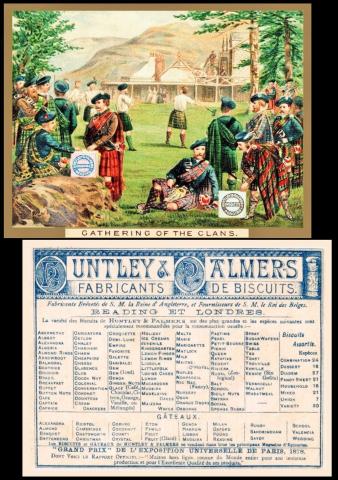
Here, if you look right in the centre of this card, we have one of the most popular of the field sports that take place at the Highland Games in Pitlochry, throwing the hammer
This event is one of the few, at least in athletics, that did not come down to us from Greece or Rome, for it seems to have originated in another Celtic land, Ireland. At the start, which is estimated to be about 1200 B.C., the item thrown was not a hammer, but not as you may be thinking, because the hammer had not been invented, for it had. in rudimentary form, and quite a while ago, archaeologists unearthing proof that such things were known, and regularly used, since at least 3000 B.C., and maybe before. In Ireland the event was not one of sporting prowess, but of strength, and maybe there was an element of impressing the ladies too, and they used to throw a cart axle, sometimes with a wheel attached. They called it "the long throw", and the basic action remains the same, though today it is more controlled than a test of pure strength.
It appears that the axle and the wheel were not replaced by the introduction of throwing the hammer, we think they existed together, and that maybe a budding athlete started with the hammer before going on to the axle, and only then adding the wheel, which made it an extraordinarily dangerous object to throw. The rules were pretty much non existent, too, and the thrower was also allowed to spin these items above their head, as many times as they liked, until they had lost all sense of direction and just let it go. This resulted in many tragic accidents at rural fairs, both to the thrower themselves, and to the people standing by merely watching. By that time the axle test was known as "throwing the bar" and the hammer one as "casting the sledge", but there was also another one, "throwing the coulter", which baffled me for a long while, but turned out to be part of a plough, but not the main blade, instead it is the one, sometimes shaped like a knife, which is fixed vertically in front and above it.
Slowly, safety became a concern, and especially with the hammer, and it was decided that the hammer was to be split into two weights, the standard one, used to break rock, and weighing over twenty pounds, and a lighter weight, usually wielded by blacksmiths and the like, for beginners and smaller sized competitors. This remains so to this day, hence the different classes at Pitlochry, these being sixteen and twenty-two pounds, but we know that this has altered because one of the earliest records for hammer throw, dating from 1826, speaks of a twenty-four pound hammer being thrown for forty foot. That was not at Pitlochry, it was at St. Fillan`s, in Lochearnhead, Perthshire.
Today, dare I say, these records have gone a lot further, and the current Pitlochry Highland Games record for the sixteen pound hammer is a hundred and fifty three feet and one inch, set in 1997, whilst that for the twenty-two pounder is a hundred and twenty five feet and six inches, set in 1998.
The biggest changes came in the 1870s, and most of them were set down by Mr. J.G. Chambers. It was he who first carved a hammer circle into the field, and restricted the thrower to standing in that spot, rather than allowing the former practise of running up and then letting their missile fly. However it took until 1908 for the circle to make an appearance in the Olympic Games.
Today, women also compete, but they had a tough fight; it was not until the 1980s that they were allowed to pick up the sport, and only first appeared at international level at the 1998 Commonwealth Games. Indeed, the first ever British Olympic medal for women`s hammer was not won until 2016
I have no idea of the other cards in this set, but I will attempt to plough through internet sites over the weekend and look for this rather distinctive blue back. That may give me some idea of whether it is a complete one-off, a one-off amongst a general interest set, or one of several sporting, or even Scottish subjects. And I will report back what I find.