
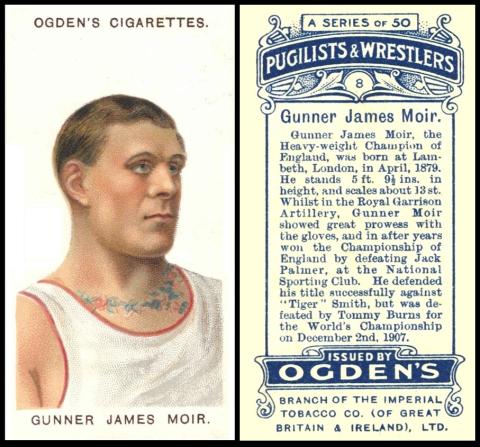
James Moir was born, in Lambeth, London, on the 17th of April 1879, and he started to box, as many did, during his service in the British Army, which was out in India. Perhaps he was lucky, for his instructor was a wrestler, Sidney Grumley, from Shepherds Bush.
We know that he must have been in some kind of artillery regiment, because of his use of "Gunner" and "Ex-Gunner" Moir
In 1904, he turns up as the exhibition partner, and trainer, for none other than George Hackenschmidt, during both of his Australian tours. He did not apparently do any fighting on his own back, he just appeared in the ring with Mr. Hackenschmidt. . It was only in 1905, on his return to England, that he started thinking of competing seriously, and he won the British Heavyweight Title, which he retained until 1907, when it was taken from him by the Canadian Tommy Burns.
It was at about this time that he appeared in three films, which show him boxing. Two of these, made in 1907, he appears briefly with other boxers, kind of a newsreel - but in the third, Ian Hague v. Gunner Moir, it is an actual match, filmed by Gaumont British, to be shown in cinemas. "Ian" Hague was not easy to track down, but he turns out to be James William "Iron" Hague, born in 1885 in Mexborough, Yorkshire, who was the British heavyweight champion between 1909 and 1911. In fact this film shows the fight for the English Heavyweight title on 19 April 1909, against Gunner Jim Moir, which Mr. Hague won in the first round, with a knockout in 2 minutes and 47 seconds.
As for Gunner Moir, he returned to Australia with Hackenschmidt in 1910, then toyed with the idea of staying out there, but for some reason this never happened and he retired. His last fight before he retired was against Bombardier Billy Wells, at the Canterbury Music Hall in 1913, who beat him.
He never boxed again after that, though he did maintain an interest and wrote several books on the sport, including "The Complete Boxer", which he kept on revising and republishing. And a couple of years after that he somehow turns up running the same venue, at the Canterbury Music Hall, as manager, or perhaps just as assistant manager, reports vary.
We know that by 1924 he had a wife and six children, and a temper. He had also been in trouble with the police over a slander case that seems much more to do with the fact that one of his sons got a job at the company he slandered and decided not to return home. James Moir lost the case, but could not pay the court fees and the amount he was ordered to pay, so he was declared a bankrupt. His wife seems to have stuck with him - and defended him in court.
He also became an actor, in the 1930s. His first role appears to have been in a crime caper, "Third Time Lucky" in 1931, and all of the films seem to be the low budget thrillers or crime stories, some of which he just appeared in, parhaps for pin money. One of them, "Excuse My Glove" seems especially poignant - this was a boxing film, made in 1936, and he appeared as himself.
There is a rumour he appears on postcards, and maybe trade cards, for Phospherine, a medicinal tonic. He also sold boxing gloves. But he died, in June 1939, aged just sixty.
This is yet another complex set, ably described in our original Ogden`s reference book, RB.15, published in 1949, as :
75. PUGILISTS & WRESTLERS. Fronts lithographed in colour Backs in blue, with descriptive text. Home issues, 1908-9
- 140. A Series of 50. Numbered 1-50. Issued in two separate groups of 25 -
Nos. 1-25 - cream matt backs
Nos. 26-50 - (a) cream matt backs (b) white, semi-glossy backs
- 141. Second Series. Numbered 51-75. Cream matt backs.
However, by the time of our World Tobacco Issues Index, a lot of this has gone, and the listing now reads :
- PUGILISTS & WRESTLERS. Sm. Nd. See RB.15/140 ... O/2-111
- "A Series of 50".
- "Second Series", Nd. 51/75 (25)
And in our updated World Tobacco Issues Index, the entry is even shorter :
- PUGILISTS & WRESTLERS. Sm. Nd. See RB.115/140 ... O100-446
- "A Series of 50". 2. "Second Series", Nd. 51/75 (25)