
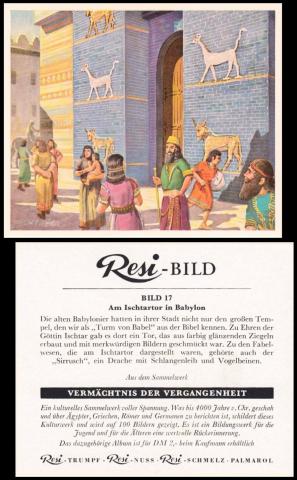
Here we have Babylon, and they were one of the first places, if not the very first, to combine fat with alkali (tallow with wood ash) and use the result for cleansing. The other two places claiming the honour are Sumeria, and Egypt - but at the moment the earliest evidence comes from Babylon, where a formula for the production of the material was discovered, dating to 2800 B.C. However, the text is written on a clay tablet, and the clay is Sumerian, so perhaps their claim is not quite over yet.
Now though the "soap" was not designed for cleaning hands, as such, it was for washing woollen clothing, but there is evidence that servant girls used to use it at the end of the day remove stains from their hands, after they had been working, which seems to point to our theme as well.
I originally said that I did not know much about "Resi", but suspected it may have been a brand, for along the bottom of our card it also says "Resi-Trumpf" (which is margarine), "Resi-Nuss" (nuts), "Resi-Schmelz (also margarine) "Palmarol" (palm oil?)".
However now I can share that yes, I was right, a reader has told me that it was a brand, belonging to Fritz Homann of Dissen (Teutoburger Wald).
And you can read more about them with our Card of the Day for the 24th of November 2024
There is a bit more info under the set title on this card, and that tells us the set covers 4000 years from the birth of Christ, through Ancient Egypt, Greece, Rome and Germany`s culture, and is complete in a hundred pictures. And that the album costs two deutschmarks.
Resi, the margarine, issued not just cards, but small plastic figures - houses, people, animals, trees and fences - which were in packed in the margarine. And at least one other set, not to my liking, called "Grosswildjagd in Aller Welt" [Big Game Hunting].
And if anyone would like to expand this, please do!