
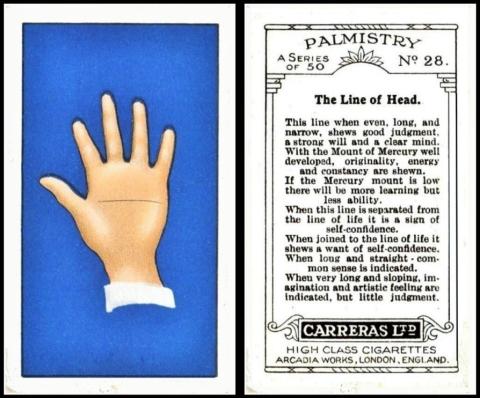
This card supplied the hand after all that washing. And I am surprised I have not used one of these before, as I really like the blue of the background. Though when I researched it I found a really intriguing twist that I had not expected.....
Now though this card was used to only show a hand, it is intriguing that it is yet another set on palmistry - just like the ones that were issued by Major Drapkin, in April 1927, which we featured as our Card of the Day for the 8th of March, 2023.
Palmistry is seen by many as a skill, even a science, and it aims to read the lines on the palm and from those determine the fortunes and future of the person whose hand is being examined. And it is not a new thing, we know that it was being done in ancient times, beginning in India, and then moving into Asia and the Middle East. It also had a brief but shining moment in ancient Greece, and Alexander the Great reputedly picked his warriors from the lines on their hands. The surprising thing was that it was strictly something for men, women`s hands were never read.
Then, in the fifteenth and sixteenth century, the practise was suppressed, and lots of early works destroyed.
It stayed a dark, forbidden art for almost three hundred years, and then in 1839, one of Napoleon`s soldiers, a Captain Casimir Stanislas D'Arpentigny, published a book about it, called "La Chirognomie". He claimed that whilst he was fighting the Peninsular Wars in Spain he had been taught to read palms by a young gipsy girl whose family had guarded the secret for centuries, but who seems to have taken a bit of a shine to him and furthered their acquaintance, shall I say, by offering to teach him the skill. He was certainly interested by the subject and made his own studies of all the hands he came in contact with, noting that the basic shape of the hands did often vary between people who were artistic and others who were scientific, the artists tending to have rougher squarer hands and the scientists having smoother hands. He would go on to develop this into six main hand types, and one called a "mixed" hand, where some of the pieces of the hand are of more than one type - and this system is still used today. Curiously he continued to perpetuate the belief that the shapes of the hand only counted for men`s hands, not women`s, they were dealt with in a separate part of his book. And he never seems to have done anything about the lines on the palms.
The book was a cult classic, though it took fifty years for any form of governing body to be founded. The first was called "The Chirological Society of Great Britain", and less than ten years later there was an "American Chirological Society".
The first attempt at making the craft more available to the general public came in 1894, with the Irishman William John Warner`s self-published "Cheiro's Language of the Hand". He also adopted the name of Cheiro as his own, which came from "cheirology", one of several names which palm reading became known. He had travelled widely through India, studying with several gurus, and then set up a palmistry centre in London. He soon attracted a massive following of celebrities all of whom would do anything to have him read their palm and tell their future, including people you would have thought not so easily swayed - Mark Twain, General Kitchener, Grover Cleveland, the President of America, and a Prime Minister, William Ewart Gladstone - as well as Joseph Chamberlain, the father of future Prime Minister Neville. And he had some amazing predictions that proved to be truths - the sinking of the Titanic, and the abdication of King Edward VIII, which is even more astounding as it happened slightly less than two months after Cheiro had died, in Hollywood, on October the 19th, 1936. In fact this story is even more interesting than this - for it was only on the 16th of November 1936 that King Edward called the Prime Minister Stanley Baldwin to Buckingham Palace and told him for the first time that he planned to marry Mrs. Simpson as soon as he could. Before that their relationship had been kept under wraps.
Sadly there is not much recorded about this set in our World Tobacco Issues Index, only :
- PALMISTRY. Sm. 69 x 40. Nd. (50) ... C18-63
And that text is repeated in our updated version, with only one change, a new card code of C151-355.

However, if you carry on to almost the end of the Carreras listing in this updated book, then you will find this set listed again, which makes it appear a re-issue, but it is not.
Those cards. and we show one here, were issued with "Black Cat" cigarettes in the late 1970s and are very different. Gone are the blue backgrounds and the actual hands, and in come very stylised hands, on different coloured backgrounds.
The first ten cards have mauve backgrounds and, harking back to Captain Casimir Stanislas D'Arpentigny; they deal purely with the shape of the hand, attempting to define the realist, the charmer, the power-seeker, the inventor or individualist, the introvert, the extrovert, the intellectual, the sensitive type, the single minded and ambitious and the easy-going, gentle type.
Then the other forty cards deal with the lines on the hand, but in combination, like we show here, three or four lines at a time in thick black ink. They are split into groups of ten, each of which have backgrounds in different colours, cards eleven to twenty being blue and covering the palm as it relates to career, cards twenty-one to thirty being red and covering love, cards thirty-one to forty being on green and covering money and success, and cards forty-one to fifty being back on mauve again and covering health.