
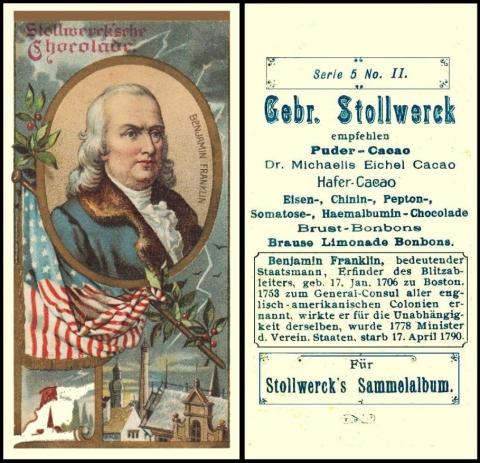
We move on now to Benjamin Franklin.
He was a keen exponent of making the most of the natural light, and is often connected with being the person who suggested moving the clock to get more light in the mornings. However, there are a couple of common misconceptions about this.
First of all, it is said that he wrote the slogan "Early to Bed and Early to Rise makes a Man Healthy, Wealthy, and Wise", but this is not only incorrect but undeniably proven by the fact that it first appeared in a book called "Paroemiologia Anglo-Latina", by John Clarke, which was printed in 1639, whilst Mr. Franklin was not born until the 17th of January 1706. However he liked the saying, and was very fond of using it, and probably most of his contemporaries had never heard of Mr. Clarke, let alone read his book. In fact what happened was that Mr.Frankin included the phrase in one of the book he printed and published on an annual basis, for twenty-five years, by the name of "The Poor Richard`s Almanack". This roundelay of little ditties and witticisms, and snippets on the weather, and predictions on the future, contained probably eighty-per cent of other people`s phrases, if not more, with the words slightly changed either in order or by swapping one word for another that meant the same. He also hid behind several pseudonymous writers and editors, starting with "Richard Saunders, Philomath", who "wrote" the first edition ever, published on the 28th of December, 1732. But that adds a layer of confusion, for it means that the general public would not have connected Mr. Franklin with the phrase at the time, the connection must have come later, and presumably closer to our time.
The second connection comes through his publishing a letter in the "Journal de Paris" in 1784, whilst he was an American Envoy to that city, which said that the residents of Paris ought not to waste money on candles when they could get out of bed earlier, as soon as the sun comes up., and use the time to work, then just go to bed when darkness came. This was a fairly reasonable thought, but the letter then went off on a rather strange tangent, asking the governments to get involved, to levy a heavy tax on candles and window shutters, and and to start the practise of waking everyone up by firing cannons and ringing church bells at the time the sun came up.
Unsurprisingly, none of this was ever seriously considered.
As for the third connection, it involves his time management schedule, which divided every day, irrespective of whether it was a weekday or a weekend one, into six blocks of time, and it started at the crack of dawn, rising with the sun, with personal hygiene, breakfast, and setting that day`s schedule of what he intended to accomplish on that day. Then for four hours either side of dinner at midday, he simply wrote "work", but he knew exactly what he was going to do when he sat down, he had planned it just that morning. And then at 6 p.m. he would lay down his tools, have supper, and pleasure, and then, when the darkness of the night started to prevent those things, he would go to bed. And after reading this, you do have more of an understanding of his rail against the Parisians, who laid so long abed, for he knew, full well, not just how more productive their lives could have been if they began it earlier, but how much pleasure they could have fitted in at the end of the day when all their work was put to bed.
As far as cards, it is universally agreed that Benjamin Franklin`s "Rookie Card" was issued in 1887 with "Lone Jack" Cigarettes, as part of the set called "Inventors and Inventions" (N.365). Our card was issued a decade after that, in a set which consists of
- I - Johann Gutenberg
- II - Benjamin Franklin
- III - James Watt
- IV - Werner v. Siemens
- V - Philipp Reis
- VI - Thomas A. Edison.
Most of these are quite well known but two may stump some of you.
Ernst Werner Siemens was born in Germany in 1816, but did not add the von which is represented by the "v." on the card until 1888, when he was in his seventies. He was a massive exponent of electricity and applied it to public transport as well as an electrically powered car. And his name lives on with the Siemens business today.
Philipp Reis was also born in Germany in 1834 and became the science master of the Institut Garnier, a boys boarding school near Frankfurt. And in 1860 he invented a way of communicating by wire from one classroom to another. It did work, and he actually exhibited it at a meeting of the Physical Society in 1861. However it seems that it was regarded as a mere trifle, too insignificant to be considered as part of science, and constructed of simple parts that anyone had laying about their works, hardly an invention at all. But some people now regard him, rightly, as the father of the telephone.