
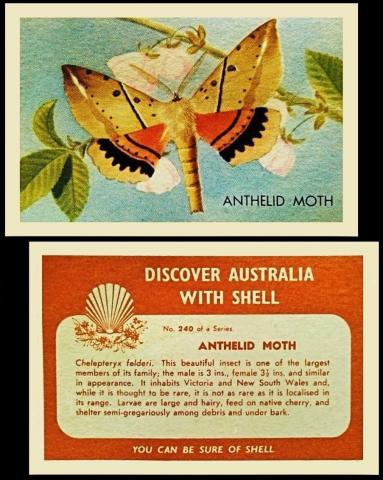
You are undoubtedly wondering what this moth has to do with the clocks going back and forth, so let me tell you the tale of George Vernon Hudson, a Londoner, born on the twentieth of April, 1867, who moved to New Zealand at the age of fourteen, with a growing collection of insects.
In New Zealand he worked on a farm and then at the Post Office in Wellington, where he rose to become the Chief Clerk. After work he would go out in the countryside as far as he could and study insects, but every year, with sadness, he would have to stop earlier and earlier due to the fading light, until it got to an time that it was dark even before he left the Post Office. This was even more of a nuisance after 1892, for in that year he had seen his book published, "An Elementary Manual of New Zealand Entomology - being an introduction to the study of our Native Insects".
He worked on a theory for some time, and in 1895 he presented a paper to the Wellington Philosophical Society proposing that the clocks be moved, by two hours, in order to give more natural light at night. Although the idea was met with some support, he thought that insufficient, and in 1898, the same year that his second book, "New Zealand Moths and Butterflies (Macro-Lepidoptera)", was published, he delivered another paper. However, it seems that even this did not inspire any action, and by then he was working on a third book, "New Zealand Neuroptera" (may-flies, dragon-flies, caddis-flies, and the like), which was published in 1904.
In 1907, almost certainly because of his books, he was part of the research team of the Sub-Antarctic Islands Scientific Expedition. Then in 1919 he was made the first ever "Fellow" of the Royal Society of New Zealand; and he was awarded the Hector Memorial Medal in 1923 and the Hutton Medal in 1929, both for his research in zoology.
There is a strange coincidence though, because in 1933 he was the joint first recipient of the Thomas Kay Sidey Medal - the other winner being Ernest Rutherford. Mr. Sidey had died earlier that year, he was a politician, but he was also a great advocate of daylight saving time, and had put forward a Private Member`s Bill that requested putting the clocks forward by one hour in summer every year from 1909. It was very nearly passed in 1915, and then passed in the House of Representatives in 1926 only to fall at the hearing before the Legislative Council. However it was finally approved, as the Summer Time Act 1927.
Not just that, but the medal was endowed from funds collected to commemorate the act becoming law. It seems that there was no connection to zoology, so Mr. Kay must have just remembered Mr. Hudson - or maybe they had stayed in touch without any fuss.
By the way. Mr. Hudson's collection of insects is still preserved in the Museum of New Zealand Te Papa Tongarewa, which was founded, in 1865, as the Colonial Museum. It is the largest collection in New Zealand and also still present are the three hand-written volumes belonging to Mr. Hudson, complete with his own, self-originated, coding system
And now an apology, for this moth is not amongst those books, it is only native to Australia. so we may have to change the card. And if anyone has a New Zealand moth from a set we have not featured before, please let us know!
The group, which may change, is listed in our original Australian and New Zealand Index, RB.30, published in 1983, under SHELL (Service Stations). It comes under group 1, "Issues in Australia - Inscribed "Shell" without full name", and our section is listed as :
- Discover Australia with Shell. 76-78 x 51. Four sets of 60. ... SH6-1.
1. Nos. 1/60, back vertical. Flora and Fauna. Two pictures at No.5 (Kangaroo Paw) - (1) flower with three stems (2) flower with two stems. Few copies of album known - it was probably withdrawn as it contains errors so that all cards do not fit the places provided.
2. Nos. 61/120, back horizontal. Shells, Fish and Coral
3. Nos. 121/180, back horizontal. Birds
4. Nos. 181/240, back horizontal. Butterflies and Moths
Using this set has led to a bit of a discovery, for though we title these four sets as "Discover Australia with Shell", and this is also on the cards, they actually fitted into an album which was titled as a "Project Card Album", and we know it is not a general album used wrongly because beneath the main title on the front is actually printed "Butterflies and Moths". However, this raises an interesting question, because in our Australian and New Zealand Indexes the cards are split into three groups, starting with four series of "Discover Australia with Shell", then two series of "Picture Cards" and only finally three series of "Project Cards". But looking at the album it appears that all the cards were intended to be Project Cards.