
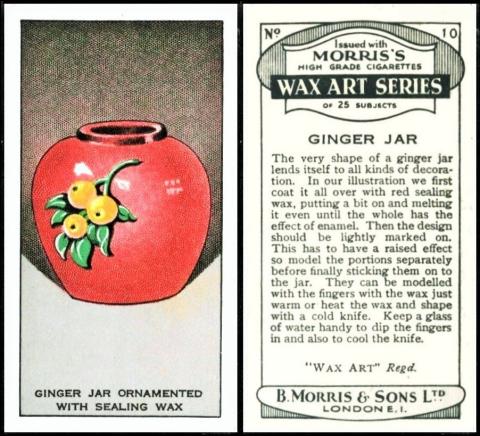
So here we have "ginger", which is often a rather mocking nickname, though it is true that girls, and boys, tease the ones they secretly like the most. I tried to find out more, but all I kept seeing was that it reflects the similarity in color between a ginger root, which can be reddish. I am not sure about that, there is only one ginger which is red, and it is only grown in the Pacific Islands. So it seems unlikely.
As far as wax art, I first imagined this started in the 1920s, I even found several books on the subject by Davids Bros. Inc of New York, who managed to get Woolworths to distribute the colours in their stores.
However, further research told me that the technique of painting with a melted wax is much more ancient, and it was well known enough to the Romans that they were using it to paint and embellish portraits of the dead by 100 A.D. The clue is in the word though, as it comes from the Greek, "enkaustikos", meaning to burn one substance into another, and we know that Greek ships were not only made waterproof with melted beeswax, but that many were embellished with spare wax, in patterns and shapes. Homer mentions just this, in the Iliad, in about 800 B.C.
Wax Art owes its origins to sealing wax, which was an early attempt at preventing anyone opening and reading your mail without you knowing. What you did was write your letter, melt a circle of wax across the flap of the envelope, and press your signet ring in the centre. Any attempt to open the letter would break the wax, which by then was set hard, and disturb your monogram.
The Romans did all this, using a blackish material akin to bitumen. The practise died out with their departure, but seems to have been rediscovered in the Middle Ages, especially within the Church, where it is said they used beeswax, but it is more likely they just used remnants of the candles, as they grew too small for the altar. And the Church were affixing what came to be known as "Papal Bulls" to documents relating to the Pope since the 12th century, these being seals of lead
The first coloured wax appeared in the sixteenth century, and this was red. It stood out much better on the letters, which were yellow or white, and so it was much easier to tell if there was only a crack to tell that someone had attempted entry.
As for our set, little is known. It appears in our original World Tobacco Issues Index as simply
- WAX ART SERIES. Sm. 67 x 36. Nd. (25) ... M142-35