
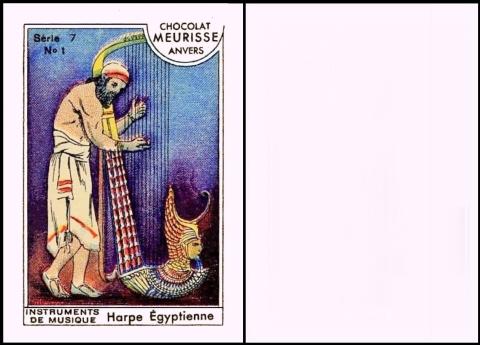
Now we have this card because the earliest surviving representation of a moustache is on a painted limestone statue of a man called Rahotep, who was an Egyptian prince, in about 2500 B.C.
The important word there, though, is "surviving" because the first ever man who roamed the earth would undoubtedly have been hairy, and probably as hairy as any bear, he just never thought to paint that fact - or maybe he did, and we just have yet to discover it.
However, if you look at this card, the player also has a moustache. That means that the wearing of such things must have been much more widespread, than just for royalty.
As far as the instrument ,which is called "Egyptian Harp" on this card, it is also known as an arched harp, or a bow harp, from its shape, which is basically a triangle but with only two sides, those which contact the player, leaving the side that is not against them open. Bow harp was the first name of all, and it referred to the military bow weapon, which this resembled.
However they did not start in Egypt, they arrived there from Mesopotamia, and they got them from Persia, who had them from around 3000 B.C. Strangely, at almost the same time, the Sumerians invented something similar, and theirs spread to Greece and the islands, before turning up in India.
We do not know how it got to India, and there is a theory that they actually invented it all on their own, as a third totally unconnected invention of exactly the same thing.
The cards in this set cover much ground. They are
- Harpe Egyptienne [Egyptian harp]
- Lyre Grecque [Greek lyre]
- La Flute [flute]
- La Trompette Thebaine [Theban trumpet]
- La Guitare [guitar]
- La Mandoline [mandolin]
- La Cornmuse [bagpipes]
- L`Accordeon [accordion]
- Le Cornet a pistons [cornet]
- La Contrebasse [double bass]
- Le Violon [violin]
- Le Piano a Queue [grand piano]