
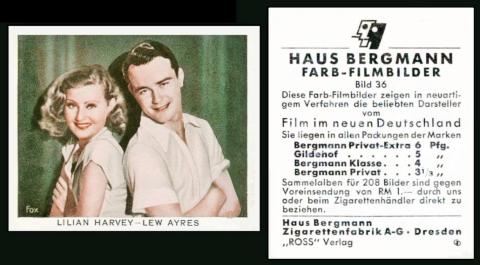
This card celebrates Lewis Frederick Ayres III was born in Minneapolis, America, on December the twenty-eighth, 1908. His parents divorced when he was still young and he moved to California with his mother and what are described as half-siblings, so maybe that is a clue to the divorce.
At first our man wanted to be a musician, in fact he worked with several big bands, and they sometimes supplied the music for films, which seems to have given him the idea to act, as well, for he seems to have never completely given up being a musician. Anyway he was reputedly spotted at a nightclub, perhaps whilst he was performing as a musician, and given a screen test to co-star with Great Garbo in "The Kiss", released in 1929. Two other films were released in that year, in which he was but an extra, and unbilled, which might at first suggest that these must have been made before his starring role - they were "Big News" and "Compromised". However, investigating "The Kiss" unearths the fact that he was not the star of that film at all, he played a teenager that she meets, quite innocently, at a dog show, though he did get fifth billing on the screen credits. And he must have been memorable, as from that film he was cast in one of his greatest roles.
That film was "All Quiet on the Western Front", released in 1930. He was billed as Lewis Ayres, and he played a German soldier, but it was very much an anti-war film, and the theme stayed with him - he was a conscientious objector throughout the Second World War, serving as a medic and chaplain`s assistant, though he still went out to the Pacific, where he was often under heavy attack. He also gave every penny of his war wages to the American Red Cross.
Immediately after "All Quiet on the Western Front" was made, he moved from Universal Studios to Fox, and it is whilst he was at Fox that he appeared in the film on our card, "My Weakness", released in 1933, and co-starring Lilian Harvey as a servant who he bets he can make into a lady and marry off to his bachelor brother. It is not very exciting, except for the fact that it was one of the first films to use the word gay in its modern meaning, though sadly the Studio Relations Committee censors wimped out and muted the sound at that point..
He then moved to Republic, because they offered him a chance as a director. But he soon left, for Paramount, and then to M.G.M., which he joined in 1938. There he was given the chance to bring Max Brandt`s very popular 1930s hospital novels to the screen, which he did, very successfully, for nine films, and then again in the 1950s on radio. The first of these was "Young Doctor Kildare", in 1938.
By this time he had been married twice. His first wife was actress Lola Lane, they were wed from 1931 until 1933, though by all reports they were seldom together. He then married Ginger Rogers, in 1934, but that only lasted two years, though they did not formally divorce until 1940.
After the Second World War he returned to films. and then to television. He was also offered the chance to bring Dr. Kildare to the small screen, but he refused. This may have been because he was offered the older man`s part, which would eventually be given to Raymond Massey, though there is another story that he was opposed to the cigarette advertising which was part of the show.
He did appear the small screen though, as a guest star on almost every big television show you could think of, right into the 1990s. And he also married again, in 1964, this time more successfully, to Diana Hall, to whom he remained wed until his death, aged eighty-eight years and two days, on December the thirtieth, 1996. They also had a son, his only child, born in 1968.
This set first appears in our original World Tobacco Issues Index as :
- FARB-FILMBILDER (Film Pictures). Md. 62 x 52. Nd. (208). See X21/262.B ... B60-10
The first thing there is that "Farb-Filmbilder" actually translates to colour film pictures, and as there is no mention of them being coloured in the entry, it suggests that they were not physically examined for the World Tobacco Issues Index, only sent in as word of mouth, with no picture. However the "X" code reveals that the set was not only issued by Bergmann, though being a German set you expect many more other issuers than you actually get, for it simply reads as follows :
- X21/262,. CINEMA STARS. This series of 208 was issued as follows : -
A. B.A.T. Brand issue, inscribed "Mascot Cigarettes". Unnumbered. Subjects listed under RB.21/262. Back with framelines measuring (a) 58 x 49 m/m (b) 50 x 42 m/m. Possibly vari-backed.
B. Bergmann. German language issue, titled "Farb-Filmbilder". Numbered.
The remarks under RB.21/262 about the inscription "Ross" below framelines are incorrect and should be deleted.
If you look back to B.A.T. in this book, their version is listed under section 2.M for "Mascot" Cigarettes. Includes brand issue, without name of firm. Issued period 1925-1930, possibly in Germany" with an entry of "CINEMA STARS - "FARB-FILMBILDER" (A). Md. 62 x 53. Unnd. (208) Brand issue. Possibly vari-backed. A. Back with framelines 58 x 49 m/m. B. Back with framelines 50 x 42 m/m.... B116-202"
Now when they appear in our updated World Tobacco Issues Index, there is no link at all to the B.A.T. Brand issue, all it says is :
- FARB-FILMBILDER (Coloured Film Pictures). Md. 62 x 52. Nd. (208). ... B317-325
However the B.A.T. version is still there, now listed under section 2.N, for "Mascot" Cigarettes. with the same heading and entry as above.