
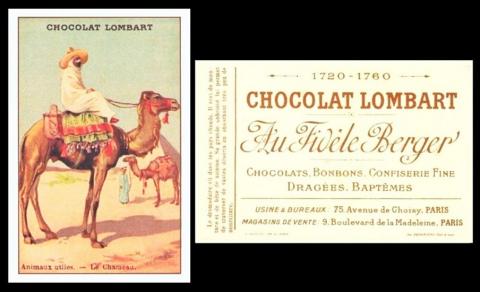
Chocolat Lombart is an unfamiliar name to a lot of collectors, but it is actually the oldest chocolate maker in France. However it is unclear why this card says "1720 - 1760" as it was not founded until the later of those dates. And we know that their Royal patents were only granted in 1814. In addition, their factory was not opened until 1860.
Equally curiously the first words below that are "Au Fidele Berger", which translates to "At the faithful shepherd". Maybe this was a trademark, for not all clients could read at that time, and a pictorial logo was the main way that they knew which shop to patronise.
Anyway next the card advertises their wares - "Chocolats, Bonbons, Confiserie Fine, Dragees, Baptemes" . A dragee is usually a nut covered in hard sugary chocolate, which you really need good teeth to enjoy. And actually baptemes are closely related to this as they are the little net bags which are given to the guests at christenings or baptisms, often containing dragees.
The card then gives two addresses, both in Paris - the "Usine & Bureaux : 75 Avenue de Choisy, Paris" and the "Magazines de Vente : 9 Boulevard de la Madeleine, Paris" - the first of which is actually the factory and offices, and the second the retail store.
Sadly, in the late 1930s the brand started to lose its popularity, almost certainly to it keeping with tradition, whilst others produced of more showy wares. In the late 1950s it was bought out by Chocolat Menier.
This is a very pretty set but for some reason suffers with a great deal of browning problems. And the advert on the reverse is in brown print. But eventually we got a back which was passable...
Each card looks the same on the back, but the section of text which is sideways on to the left hand side is pertinent to that animal.
Our text reads "Le dromedaire vit dans le pays chauds. Il sert du mouture et de bete de somme. Sa grande sobrietie lui permet de traverser des vastes desertes en absorbent tres peu de nourriture". That translates to : "The dromedary lives in hot countries. It serves as both a grind and a beast of burden. Its great frugality of need allows it to cross vast deserts while consuming very little food". The word "grind" actually represents the fact that if you harness the camel to a mill, you can grind corn or other kinds of food, whereas a beast of burden really means an animal which will carry goods or people.
The title, "Animaux Utiles" means useful animals, but not, as is usual, useful only to eat. And all three of our Christmas animals appear within it.
We are fairly sure it is a set of twelve cards, as I have also been unable to track down any more from any of my sources, and they are
- Chiens de chasse - hunting dogs
- L`Ane - the donkey
- L`Elephant - the elephant
- Le Chameau - the camel
- Le Cheval - the horse
- Le Chien de berger - the farmer`s dog
- Le Mulet - the mule
- Le Renne - the reindeer
- Les Boeufs - the oxen
- Les Chevres - the goats
- Les Poules - the chickens
- Les Vaches - the cows