
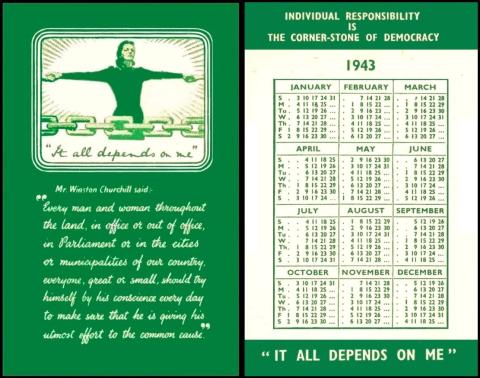
This is a very scarce calendar card indeed, and though we know it was issued by Ardath, their name does not actually appear.
There is also some confusion as to its listing in our original Cartophilic Reference Book - No.10 : The Cigarette Card Issues of W.A. & A.C. Churchman", published in 1948, which reads :
- 1941. 1. CALENDAR - "IT ALL DEPENDS ON ME". Size 2 3/8" x 3 7/8". Picture of a girl as link in a chain at top with quotation from Mr. Winston Churchill. Printed in dark green. Back a calendar for 1942. No maker`s name. Packed in flat 50 packings. Issued under the auspices of the M.o.I.
However, our calendar is for 1943, not 1941.
The "M.o.I", by the way, was the Ministry of Information. That is said to have been founded on the 4th of September, 1939, one day after the Second World War was declared, and its first minister, Lord Macmillan, took office on the 5th of September. It was announced in this way to show diligence and speed - but actually planning for it had begun years earlier, in October 1935. It was to be a ministry devoted on one hand to issuing propaganda in order to bolster the national morale, whilst on the other hand acting to censor news which would work against the national morale. And it had also functioned, briefly, for one week in late September 1938, after Germany occupied part of Czechoslovakia, partially because it was believed that this would see escalation towards war, and partially as a dry run of the way it would work when that war came. In actual fact that week was not a huge success, and the whole idea was almost abandoned, but most of that was due to a bit of a row over who controlled the news, which the Foreign Office was adamant was their responsibility, and they did not believe it should be censored. This was slightly resolved in January by the removal of the Director General of the M.o.I, and the group becoming part of the Home Office.
The whole Ministry of Information was an unwieldy one, often being divided into separate sections for "Home" and "Foreign" news, but not allowing the two to get together, which often resulted in one deciding to censor and the other not. This led to confusion amongst the public, and to anti-censorship campaigns in the daily papers.
In January 1940 Lord Macmillan was ousted and replaced by Sir John Reith, who had been the first Director General of the BBC. He did not last very long either, but mainly because Winston Churchill became Prime Minister when Chamberlain resigned, and put one of his comrades, Alfred Duff Cooper, in the job. Under his tenure, and also because the war in Europe was not going too well, it was decided that news from Europe would appear less, and more time and effort would be given to schemes concerning the home front, things that encouraged the general public to join together, and appear to be assisting the war by simple tasks like growing their own food, and donating paper and metal for the war effort.
Alfred Duff Cooper was also replaced, in 1941, by Brendan Bracken, another close ally of Winston Churchill, and his Parliamentary Private Secretary, who had pulled several strings to ensure Winston Churchill became Prime Minister in the first place. He stayed in the post until the end of the Second World War - and his tenure proved popular with the press as well because was one of them, having been a newspaper proprietor, publisher, and editor. After the War he would buy the Financial Times
In 1946, the Ministry of Information was closed down, and its staff and effects were moved to a new Central Office of Information, which handled peacetime information and ran campaigns on health and welfare.
These cards do not seem to appear at all under Ardath in our original World Tobacco Issues Index, not in our updated version. Maybe they are removed to the back. But I have not time to look there now.
I will tell you that the quotation, which is small, light, in mock handwriting, and also in italics, all of which make it hard to show up here, reads :"Every man and woman throughout the land, in office or out of office, in Parliament or in the cities or municipalities of our country, everyone, great or small, should try himself by his conscience every day to make sure that he is giving his utmost effect to the common cause".
But I have not yet tracked down when and where that was delivered, nor what it referred to