
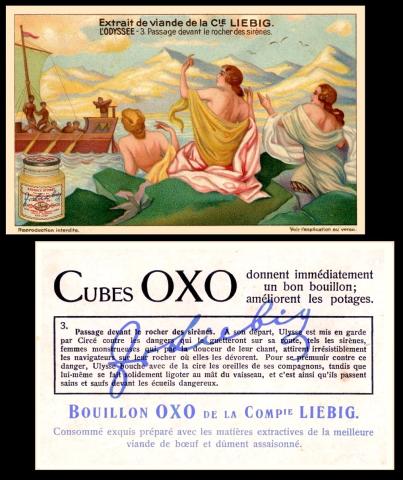
Here we have the sirens, known to all Greek sailors, and feared, for their song could drive a man so mad that his only chance was to tie himself to the mast of his ship so that he could not jump in the sea and swim to be with them. And yet not only did they not exist, there were variations of what they looked like, where they lived, and even what their song sounded like.
This card is especially apt, as it is the story of Homer`s Odyssey, and that was where the sirens first appeared in literature. It seems that he had heard the tales of them, but had no idea of what they were like, so he chose not to describe them. There is something very interesting though, because the root of the Greek word for sirens leads you back not to mean beautiful singing women, but to mean ropes, and bindings, such as Odysseus uses to tie himself to the mast, away from temptation.
Unfortunately you cannot see on this card, but the Sirens were not mermaids, with curving fish-like tails, at least not until things got a bit confused in the Middle Ages. At that time pictures of sirens and mermaids both had fish tails, but sirens were associated with sin and lustful temptation (an association the word still has today) and mermaids were associated with luring sailors to their deaths at sea.
Actually, in Ancient Greek and Roman accounts the sirens were beautiful ladies on the top half, but with a bird`s wings, legs and tail, and claws on their scaly feet, and, especially in Greece, that bird was an owl. Strangely, this bird woman also appears in other cultures, Indian, Russian and Persian - and the Russians even called her Sirin.
Both Ovid and Virgil said that they hung out on three small rocky islands that were therefore called Sirenum Scopuli. However it was never actually tied down as to where these islands were, other than somewhere in the Mediterranean, off the coast of Italy or Greece.
The cards in this set, at least in the French version, are :
- Fuite de l`ile des Cyclopes [Escape from the Island of the Cyclops]
- Hermes apportant l`herbe enchantee a Ulysse [Hermes bringing the enchanted herb to Ulysses
- Passage devant le rocher des sirenes [Passing by the Sirens' Rock]
- Ulysse construisant le radeau pour rentree dans son pays [Ulysses building a raft to return to his country]
- Ulysse sauve par Leucothee [Ulysses saved by Leucothea]
- L`epreuve de l`arc d`Ulysse [The test of Odysseus' bow]
it is also available in Italian, as L'Odissea