
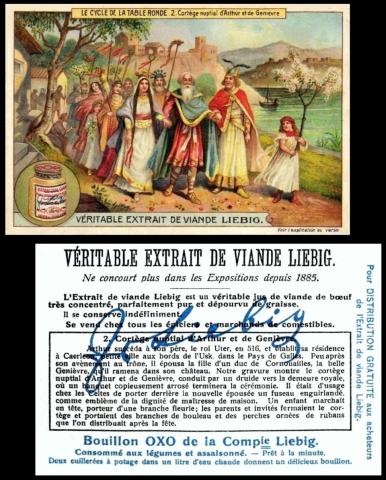
As a nation, we have long been inspired by the tales of King Arthur, his Round Table, his valiant knights, his love for the Lady Guinevere.
However there is very little fact to these epics, and though there had been several early works attempting to tell the story of this land, not one had mention of his name. There is a tantalising clue in one of these though, a work called "De Excidio et Conquestu Britanniae" (or On the Ruin and Conquest of Britain), for whilst it does not mention Arthur, and ascribes some of his deeds to several people, it does speak of a Romano-British leader called Ambrosius Aurelanius, nicknamed "Bear" from the bearskin he wore about him - and Bear, when translated to Latin, is arctus, though, in Celtic, it is a similar word, artos, and both of these are very close to Arthur.
The earliest mention of an Arthur is only in passing, it is a Welsh poem called "Y Gododdin", which tells of a warrior called Gwawrddur who was skilled, "but no Arthur". However it does not elaborate on this Arthur, nor tell us why he was more skilled. Then, in another Welsh manuscript, we suddenly hear of how, during the Battle of Badon, Arthur had been victorious, and stopped the Saxon progress - which brings us back to Ambrosius Aurelianus all over again, as he was one of the staunchest fighters at the battle of Mount Badon.
This Welsh connection is intriguing, though, and even reflected in our set, where card number one translates to "Arthur defends Wales, his Homeland".
Most of the things we think we know about King Arthur were not written down until the middle ages, when a cleric, Geoffrey of Monmouth, wrote a book called "Historia Regum Britanniae", which attempted to tell the stories of the Kings of England. And here is where we learn of Lady Guinevere, Lancelot, and the wizard Merlin, as well as his birth, at Tintagel, his famed castle, though named as Caerleon, not Camelot, and his trusty sword, here called Caliburn, not Excalibur. And it also tells of his death, and removal to Avalon, though where Avalon is is unclear.
As for the Round Table, that appears in a much later work, by Chrétien de Troyes, who also gave us the quest for the Holy Grail, in a separate poem, both written towards the end of the twelfth century This was expanded on by Thomas Malory, with his "Morte d`Arthur", published in 1486. He set Camelot in Winchester, and it was a very popular work, so much so that Henry VII`s new baby was christened Prince Arthur. It seems that Henry VII was much enamoured with the Arthurian legends, and told of them to both his children. Sadly his dream that Prince Arthur would become King Arthur was not to be, he died young - but we can tell of the effects that the tales had on his brother, Henry VIII, as he was obsessed with Edward III`s Round Table at Winchester, and not only had it repainted, but in doing so set an image of himself squarely at the top, where King Arthur would have sat.
It is possible that our cards were suggested by the success of a book, also published in 1910, called "Stories of King Arthur" by A. L. Haydon, with plates by Arthur Rackham. Sadly not much seems to be known of Mr. Haydon, and he died in 1910, quite young, for he had only been born in 1872.
The cards are :
- Arthur defend le pays de Galles, sa patrie (Arthur defends Wales, his homeland)
- Cortege nuptial d`Arthur et de Genievre (The wedding procession of Arthur and Guinevere)
- La Table Ronde (The Round Table)
- Arthur debarque en Irlande et exige un tribute (Arthur lands in Ireland and demands tribute)
- Perceval depart a la recherche d`aventures (Perceval sets off in search of adventure)
- Mort d`Arthur (The death of Arthur)
And they are also available in Italian, as "Il Ciclo di Artu".