
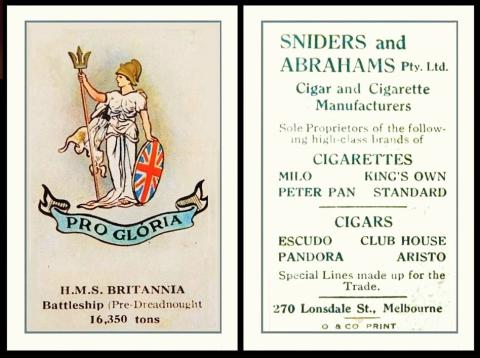
Here we have Britannia, the national symbol of England, so much so that she appears on our coinage.
We do not know why she was decided to be a woman, especially as she wears robes and a helmet, and carries the warlike, masculine tools of the shield and trident. But we do know that her first appearance on a coin was in 119 A.D, during the reign of Emperor Hadrian, where she is seated, but only holds a spear. There is a connection you may not realise though, for Britannia was the name that the Romans gave this land under their occupation, and it is also from where our calling it Britain developed.
Britannia was soon forgotten after the Romans left Britain, and only resurfaced in the time of John Dee, who resurrected her to stunning effect, kneeling before Queen Elizabeth I, begging that she strengthen the Navy, for an illustration in his book "General and Rare Memorials Pertayning to the Perfect Arte of Navigation", published in 1577. This contradicts the popular belief that James I added her connection to the sea by mistaking the rocks on which she stands as waves - though James II also used her, on coinage, at the time of the War against the Dutch in 1665, as well as on the medal struck to mark the end of that War in 1667, a medal which, for the first time, adds her shield. As for the lion that she often stands beside, this was added in the First World War, which is why there is no lion on this card.
As to who modelled for her, it is said to have originally been Frances Teresa Stewart, Duchess of Richmond and Lennox, who was well known at court, but not well known enough to Charles II, in his opinion, for she consistently refused to become his mistress. There is a theory that immortalising her on this coin was a further attempt to sway her, but that too failed.
The earliest twentieth century version, from 1901, was modelled from the Chancellor of the Exchequer`s daughter, aged just seventeen - but it was not popular, and ceased to be minted just ten years later. In 1936, when George VI came to power, Britannia returned, along with a trident, not a spear, and, rather incongrously, a lighthouse in the background. And today though she is not on the coins in general circulation, we do still have Britannia, on the bullion coins that bear her name.
This set first appears in our original Australasian Miscellaneouys Booklet, RB.20, published in 1951 as :
- 18. CRESTS OF BRITISH WARSHIPS (adopted title). Size 67 x 43 m/m. Fronts per Fig.18 in colour, grey background. Backs (type 5) in (A) Blue (B) Green, both colours found on matt and semi glossy board. Unnumbered series of 64. Each caption commences with "H.M.S" -
- Achilles (1907)
- Africa (1906)
- Agamemnon (1908)
- Albemarle (1903)
- Antrim (1903)
- Argyll (1904)
- Bellerophon (1909)
- Berwick (1903)
- Birmingham (1914)
- Black Prince (1908)
- Britannia (1906)
- Caernarvon (1905)
- Collingwood (1910)
- Commonwealth (1905)
- Conqueror (1912)
- Cormwall (1902)
- Defence (1909)
- Devonshire (1905)
- Dominion (1905)
- Drake (1902)
- Dreadnought (1906)
- Dublin (1913)
- Dukeof Edinburgh (1906)
- Essex (1903)
- Exmouth (1903)
- Glasgow (1910)
- Hampshire (1905)
- Hercules (1911)
- Hibernia (1906)
- Hindustan (1905)
- Indefatigable (1911)
- Indomitable (1908)
- Inflexible (1908)
- Invincible (1909)
- ron Duke (1913)
- Irresistible (1901)
- King Alfred (1903)
- King Edward VII (1905)
- King George V (1912)
- Lion (1912)
- London (1902)
- Marlborough (1914)
- Melbourne (1913)
- Monarch (1912)
- Natal (1907)
- Neptune (1911)
- New Zealand (1912)
- Princess Royal (1912)
- Queen (1904)
- Queen Elizabeth (1915)
- Queen Mary (1912)
- Roxburgh (1905)
- Shannon (1908)
- Southampton (1913)
- Spitfire (1912)
- Swiftsure (1904)
- Temeraire (1909)
- Thunderer (1912)
- Triumph (1904)
- Vanguard (1910)
- Warrior (1907)
- Weymouth (1911)
- Yarmouth (1912)
- Zealandia (1905
Dates in parentheses show when the ships were commissioned - this information does not appear on the cards. The latest is the "Queen Elizabeth", launched in 1913 and completed in 1915. Her crest would probably not have been decided until shortly before she was commissioned. The series obviously would not have included ships recently sunk, and several prominent ships sunk between September and November, 1914, are omitted. The series thus appears to have been issued early in 1915
Again this listing includes numbers when the cards are unnumbered, but I guess in this case it matters not.
By the time of our original World Tobacco Issues Index the set is slightly altered, and now reads :
- CRESTS OF BRITISH WARSHIPS (A). Sm. 67 x 43. Unnd. (64) See RB.20/18. ... S88-15
A. Back in blue
B. Back in green
And this remains identical in our updated World Tobacco Issues Index, save a new card code of S587-130