
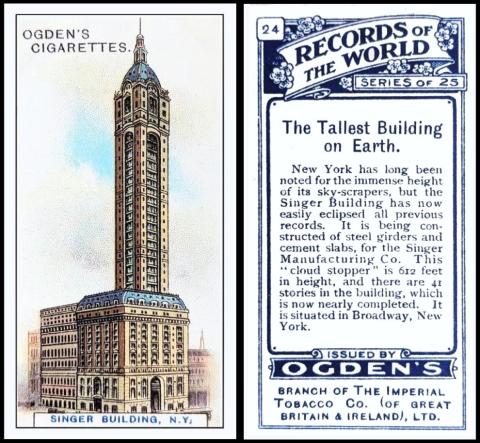
Our second clue card, was indeed a February set, and it seems to be a very little known one indeed, though the subjects are really interesting - and not all buildings, for there are trains, cars, and ships. The set is a short one though, just twenty-five cards, which seems odd, as there were surely at least twenty-five more to make it a fifty.
As to why we chose this card, it is because this is the Singer building, and, although not mentioned on the card, this was the Singer who made the sewing machines, and issued those lovely large format cards that many of us collect. It was built in New York in 1896 by architect Ernest Flagg, as the headquarters of that Singer Sewing Machine Corporation, and, thanks to an extension, a decade later, once the tallest building in America - at 630 feet - with only the Eiffel Tower being higher on a worldwide scale (984 feet). And it remained America`s tallest building from 1908 to 1909, when the Metropolitan Life Insurance Company Tower was topped out at 699 feet.
In fact our structure was two buildings in one, as you can see on our card - a bottom section, called the Singer Building, and the Singer Tower, with a lantern and flagpole on top, mainly to add to the height .
The tower was opened to the public on May the 1st, 1908. However, in 1921, the entire building was put up for sale. It was sold, in 1926, to a shadowy figure, said to be acting for the Utilities Power and Light Corporation, but this sale seems to never have gone through, and in 1961, when it was sold, to Webb and Knapp, a real estate firm, it was sold by Singer.
These new owners started people worrying, that the building would be radically altered, changing the skyline for ever, and petitions and campaigns began. These got it classified as an important building, but for some reason it was never registered on the list of New York City landmarks. In any event, Webb and Knapp, despite their business, made no attempt at developing the site, only stating that they hoped to interest the New York Stock Exchange to move there. But when this did not work out, by 1964 they sold the building, to United States Steel, which, quite wrongly, stopped the protests - for, in 1967, United Steel had it demolished, along with the City Investing Building, and replaced with an office block, known today as One Liberty Plaza.
This set first appears in our original reference book to the issues of Ogden`s Ltd, RB.15, published in 1949, as :
- 145, 25. RECORDS OF THE WORLD. Fronts lithographed in colour. Backs in blue with descriptive text. Home issue, 1908.
Its next entry is in our original World Tobacco Issues Index, where the description is altered, and slightly shortened, to :
- RECORDS OF THE WORLD. Sm. Nd. (25) ... O/2-112
And this is identically listed in our updated World Tobacco Issues Index, as :
- RECORDS OF THE WORLD. Sm. Nd. (25) ... O100-450