
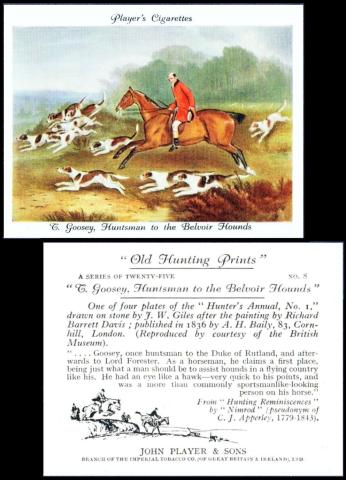
This is one of the sets that I am not fond of, but this scene of the huntsman with his hounds could be innocent enough, and I will just hope that every fox they hurtled after that day managed to get away and laugh from the safety of their lair. And I was also able to write it up to tell the story of the painting, which I found very interesting, and I hope you will too.
But I still say this is a very dated set to have been issued as late as 1938, unless it was as a lament for the country ways in general, which were already dying out, and were set to disappear entirely with the coming of yet another war.
There is something very unusual about this card, for the image is much lightened up from the original, which you can see as part of the government`s art collection. Actually, as it tells us on the back of the card, it was "One of four plates of the "Hunter`s Annual, No.1", drawn on stone by J. W. Giles after the painting by Richard Barrett Davis : published in 1836 by A. H. Baily, 83, Cornhill, London (Reproduced by courtesy of the British Museum)".
John West Giles specialised in painting sporting and animal subjects, but very often, as in this case, they were copies of contemporary works. We think he was related to, perhaps even the brother of, James William Giles; both lived together in Aberdeen, in the late 1820s, early 1830s and the similarity of the initials is also often a clue. However our man was in London by the end of the 1830s, and though we know he did return, he never again used an Aberdeen address. We also know that he knew Richard Barrett Davies, the artist of the original work, quite well, as the two collaborated on "The Hunter`s Annual, No.1".
Richard Barrett Davis was born in Watford, which was, at that time, very rural. His father was a huntsman with George III`s pack of hunting harriers, and that is probably how George III saw some of our man`s art and placed him with a succession of art tutors, ending up at the Royal Academy, where he first had a painting exhibited in 1802. Then, in 1831, he was appointed Animal painter to the Royal Household, originally for King William IV, and later for Queen Victoria. Our painting was drawn for, and perhaps commissioned by Lord Forester, and more about him later.
The other name mentioned above is "A. H. Baily, 83, Cornhill, London". They were printers and publishers, and are best known today for their publication of "Baily`s Monthly Magazine - Sports and Pastimes" which began in 1860.
The only person who is rather sketchy is the subject T. "Thomas" Goosey. All it says on this card comes from a book called "Hunting Reminiscences" by `Nimrod` (pseudonym of C.J. Apperley, who was born in 1779 and died in 1843). The quotation is "...Goosey, once huntsman to the Duke of Rutland, and afterwards to Lord Forester. As a horseman, he claims a first place, being just what a man should be to assist hounds in a flying country like his. He had an eye like a hawk - very quick to his points, and was a more than commonly sportsmanlike-looking person on his horse."
From the front we know he was attached to the Belvoir Hunt. This was in Leicestershire, and was run under the control of the Dukes of Rutland. Thomas Goosey joined the Belvoir in 1817, and stayed until 1841, and he was succeeded by Will Goodall, who took over in the following year, staying until 1859. The only time, right up until 1896, that a Duke of Rutland was not in direct control was between 1829 and 1859, when a nephew, Lord Forester, was appointed - and it is for that Lord Forester that this painting was done.
This set, or rather this pair of sets, first appears in our original John Player reference book, RB.17, as :
- 140. 25 "OLD HUNTING PRINTS" . Large cards. Fronts in colour. Backs in grey, with details of print and quotations in view. Issued February 1938.
A. Home issue, with I.T.C. Clause
B. Channel Islands issue, without I.T.C. Clause
By the time of our original World Tobacco Issues Index, in 1955, these two were no longer together.
The home issue is recorded under section 2 of the Player listings, for "Issues with I.T.C. Clause" and sub section B, for "Issues 1922-29, excluding cards with adhesive backs". And its entry reads :
- "OLD HUNTING PRINTS" . Lg. Nd. (25). See RB.17/140 ... P72-117
The Channel Islands issue is recorded under section 3 of the Player listings, for "Export Issues without I.T.C. Clause" and sub section C, for "Issues 1935-39. Chiefly in Channel Islands and Malta. Small size 67-68 x 35-36, large 79 x 82 m/m". And its entry reads :
- "OLD HUNTING PRINTS" . Lg. Nd. (25). See RB.17/140 ... P72-225
The above remains the same in our updated World Tobacco Issues Index, with the two issues remaining apart, but the reference to RB.17 being omitted in both cases, and the card codes having changed, to P644-242 on our home issued set and P644-682 on the Channel Islands version. There is also one more alteration, as after 1965 John Player again began to issue cards, and they were listed before the export issues, hence the Channel Islands version is now listed under section 4, and sub-section C