
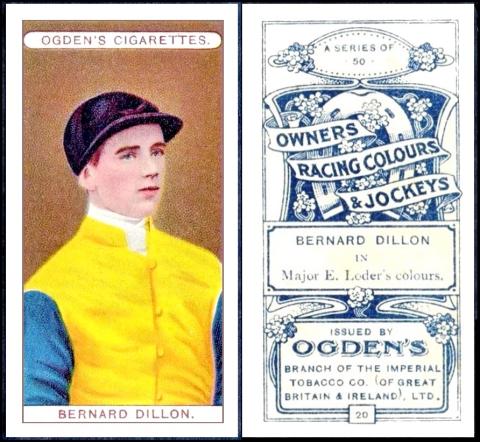
I am delighted to be able to feature this card of someone we mentioned before, and give him a face instead of just a name. For this is Bernard DIllon, the third husband of Marie Lloyd, the music hall star. However he was also a very famous jockey in his own right, having won the Derby in 1910, on a horse called Lemberg.
He was born on the 7th of September 1888, on a farm in Tralee, County Kerry, in the south west of Ireland, and started his racing career in 1901 when he joined his older brother Joe as an apprentice jockey at Druids Lodge, near Amesbury, in Wiltshire, England, run by Lord Cunliffe. His first major win came in 1904, on top of Uninsured, for Druids Lodge; and at that time he had the advantage of being very light weight, just over five stone. However we know that by 1905 he had filled out, as Taddy`s "Famous Jockeys", issued in that year, tells us that he weighed eight stone nine pounds, and was riding for Gilpin`s and Lewes stables. He was shown in the pink and black silks of Mr. Forester.
The following year, Cohen Weenen`s "Owners Jockeys Footballers Cricketers" series two, gives a bit more back story, and describes him as "B. DILLON, winner of many big Handicaps, including the Lincoln with "Uninsured" and the Kempton Park Jubilee Stakes, two years in succession, with "Ypsilant". He is first jockey to Major Loder." And the silks he is wearing on this card are indeed those of Major Loder.
Our set appeared the same year and he is in it four times - our card, number 20, which describes him as "Bernard Dillon in Major E. Loder`s colours" - card 25 as "Bernard Dillon in Mr C. Hibbert`s colours" - number 33 as "Bernard Dillon in Mr. W. B. Purefoy`s colours" - and card 38 as "Bernard Dillon in Mr. E. A. Wigan`s colours"
He met Marie Lloyd in 1910, apparently at a racecourse, whilst her current husband, Alec Hurley, was off placing bets. She was eighteen years his senior, and seems to have moved herself in with him not long after.
In 1913 it was discovered that he was entangled with gambling, placing bets using inside information, and, so rumours go, on himself to lose. The Jockey Club want as far as taking him to court, so we know it was not innocent gaming. His punishment was to have his racing licence revoked, on which he resigned from the Jockey Club. By this time he was openly living with Marie Lloyd, and she took him to America where she had bookings for work. This caused more trouble, for they went there using the (false) names of Mr. & Mrs. Dillon. In fact when the truth broke they were charged with crime of moral turpitude, and briefly detained at Ellis Island, until they could pay for their release.
They were not actually married until 1914, two months after Alec Hurley`s death, of pneumonia, just two months before, at a public house, Jack Straw`s Castle, in Hampstead, London, though it is not as quite as bad as that sounds, for he was also living there. The marriage, his first, her third, took place in Oregon, America, but it was doomed from the start; Bernard Dillon already being abusive, depressed, and jealous of his wife`s success.
Around this time, also in 1914, Bernard Dillon appears on the anonymous and untitled set known as "Jockeys & Owners Colours" with a playing card inset on each one. It was actually issued overseas through British American Tobacco. The horse is unidentified, but he is shown in white silks with orange sleeves, and the caption top right is "Jockey : Bernard Dillon / Colours : Mr. Fairie" Mr. Fairie was a pseudonym for Alfred William Cox, a racehorse owner and breeder of Scottish descent, who was born in Liverpool, and one of his horses was that Derby winner Lemberg.
He also went off to war, but apparently most of his service was in England, at the Machine Gun Corps training depot at Belton Park. His service was marred by his often getting into trouble, going absent, and not helped at all by his wife frequently turning up, which generally ended in rows. However when he returned to her home things got much worse, and she was forced to take him to court for continued abuse. In June 1917 he was sent to prison for assaulting her whilst under the influence of alcohol, blackening her eye. When he was released, she took him straight back, and they remained together, until 1920, when they separated, briefly, but she fell into a great depression and took him back. They were still in a state of back and forth when she died on the 7th of October, 1922,, three days after collapsing on stage at the alhambra Theatre in London.
In 1923 he appears as card 16 of Godfrey Phillips "Derby Winners and Jockeys", in a bit of a retrospective, for the text reads : "Has retired from the saddle for some years. Was first jockey for Clarehaven Lodge stable, succeeding Willie Lane, was associated with the peerless Pretty Polly in several of the victories scored by the late Major Loder`s wonderful filly. Won the One Thousand Guineas on Flair, owned by the late Sir Daniel Cooper, in 1906, the Derby on Lemberg, in 1910, for Mr. Fairie. Bernard Dillon rode the winner of many of the biggest handicaps, one of his most powerful finishes being on Hammerkop in the Cesarewitch of 1905."
In fact card 15 of this set shows Lemberg, who is immortalised as : "Lemberg, owned by the late Mr. Fairie, made his first appearance as a two-year-old when winning the New Stakes as Ascot in 1909. His great rival as a three-year-old was Neil Gow, owned by Lord Rosebery. Few will forget the great finish for the Two Thousand Guineas at Newmarket in 1910, when Lemberg lost to Neil Gow by a head. His revenge came in the Derby which he won easily with B. Dillon up. Neil Gow (D. Maher) being unplaced. Lemberg failed in the St. Leger, being beaten by Lord Derby`s Swynford. Has been a great success at stud."
Bernard Dillon faded from the headlines and the high life. He died on the 6th of May, 1941, whilst at work, as a night porter at South Africa House in London, aged just fifty-two.
He was buried at West Norwood cemetery, far away from home.
Bernard Dillon is on the following cards
- Taddy "Famous Jockeys" Blue Letterpress - unnumbered (1905)
- Cohen Weenen "Owners Jockeys Footballers Cricketers" series 2 - unnumbered (1906)
- Ogden "Owners, Racing Colours & Jockeys" - number 30 in yellow and blue silks (February 1906)
- Ogden "Owners, Racing Colours & Jockeys" - number 38 in white silks (February 1906)
- Smiith "Derby Winners" - number 48 (1913)
- Anonymous / British American Tobacco "Jockeys & Owners Colours" - untitled - the nine of clubs (1914)
- Godfrey Phillips "Derby Winners and Jockeys" - number 16 (1923)
- John Player "Derby and "Grand National Winners" cards - number three (1933)
- John Player "Derby and "Grand National Winners" transfers - number three (1933)
His brother also appears, as part of Cohen Weenen`s "Owners Jockeys Footballers Cricketers" series 3 -issued in 1907, where he is described as "J. Dillon (brother of the well known flat race jockey Bernard Dillon) is one of the many able Jockeys that Ireland have given us. He is as clever over the sticks as his brother is on the flat"
As to our card, there turns out to be two sets with this same name, and both are described together in our original reference book to the issues of Ogden`s Ltd, RB.15, published in 1949, as :
75. OWNERS, RACING COLOURS & JOCKEYS. Fronts lithographed in colour. Backs without descriptive text. Home issues.
- 129. "A Series of 50". Jockeys in colours on fronts, blue backs with Jockey and Owner`s names. Issued 1906
- 130. "A Series of 25". Jockeys in colour and Owners on fronts. Green backs. Issued 1914.
By the time of our original World Tobacco Issues Index, in 1955, the two are still together, but entered as :
- OWNERS RACING COLOURS & JOCKEYS. Sm. Nd. (50). Back in blue ... O/2-108
- OWNERS, RACING COLOURS & JOCKEYS. Sm. Nd. (25). Back in green ... O/2-109
And these two listings remain both identical, and together, in our updated World Tobacco Issues Index, save for having new card codes - our blue back issue now being O100-440, and the green back version being O100-442