
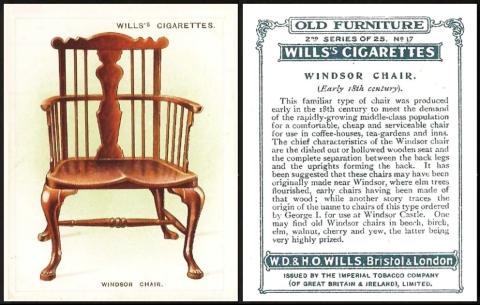
Here we have a chair which at one time was very familiar, but these days seems to have faded from fashion, like most chairs with hard wooden seats, for today comfort is the watchword, and even with a cushion, it is hardly a place to lounge long-term, when you could sink into a sofa. However they do regularly turn up at auctions and in antique shops, the first of which being, naturally, the cheaper option, should you be looking to purchase one for your home.
There are several theories as to why these are called "Windsor" chairs. Two of them are even mentioned on our card.
The first theory is that the "Windsor" part of the name refers to them having been "made near Windsor, where elm trees flourished". This may be true, but not where the style originated, for we know that this style of chair, with a solid wooden seat into which the back and legs are plunged, were made as far back as ancient times, primarily, at first, in the Land of the Pharoahs, Egypt.
As for the second theory, that they were "ordered by George I, for use at Windsor Castle", this fact is undoubtedly true, but the chairs were made in England long before George I was even born, and that they were also known as Windsor chairs.
However, they were not made in Windsor, but in Buckinghamshire. At first, in the 1700s, it was a rural craft, made by one or two men in a certain area for their village, and often these could mend the chairs as well. A century later, it seems that the chairs were High Wycombe`s major industry, and, by the 1840s, its largest employer, for it was very much piece work, one man turning the spindles, another making the seats, and another collecting and constructing the parts to make the chairs. Once assembled, they would go off to market, especially in Windsor, and hence that geographical name became attached to them.
As to why High Wycombe became the centre, it was purely through geography. The Chiltern Hills were primarily beech, ash and elm. And that brings us neatly back to the card, where it states that they were "made near Windsor, where elm trees flourished".
By 1860 there were hundreds of chair workshops across the town of High Wycombe, and within twenty years almost five thousand chairs a day could be assembled. This was mainly due to the employment of former farm hands and rural workers, who were enticed in by higher wages and made the town`s population almost double by the turn of the twentieth century.
To our card, and there seemed something odd about this chair, because I was not, at first, sure it was a "Windsor" chair at all. You see traditionally the back spindles of the "Windsor" chair start at the base and slant to the head bar, like a fan, and none at all are straight, whereas our chair only has straight spindles. Not just that, but the wide centre bar is also not a feature commonly seen on a "Windsor chair". But after research I found that in the time of George I and George II that central spline was indeed part of the design, and the spindles did also rise straight to the top bar. I also now know that there are over 1500 different types of "Windsor" chair. So I have learned much tonight !
This set, and its younger sibling, were first catalogued in our Wills reference book part IV, as
OLD FURNITURE. Large cards, size 79 x 62 m/m. Fronts printed by letterpress in colour. Backs in grey. With descriptive text. Home issues.
- 278. “1st Series of 25”. Issued 1923
- 279. “2nd Series of 25”. Issued 1924
Series one had rather a short run, being issued in October, with Series 2 arriving in February, just four months later.
Our original World Tobacco Issues Index describes the pair as :
- OLD FURNITURE. Lg. Nd. … W62-161
1. “1st Series of 25”.
2. “2nd Series of 25”.
It is further shortened in our updated version, which combines the two series on to a single line. And the code is changed, to W675-202