
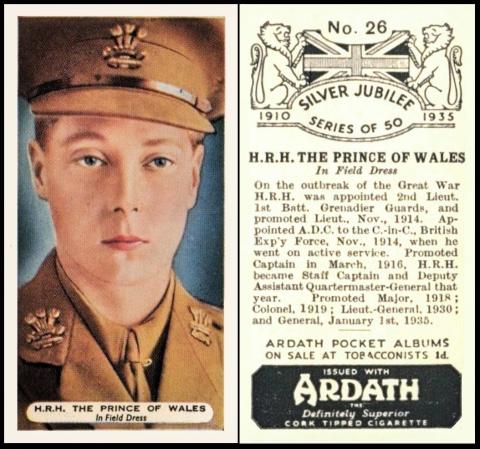
The original March connection here was that Edward VIII gave his first radio broadcast as King on March the 1st 1936. He had technically become King on the 20th January 1936, on the death of his father, but he was never crowned, for though his Coronation was scheduled to be on May the 12th, 1937, he decided to give up any idea of being King on December the 10th, 1936, in order to marry the woman he loved, the American divorcee Wallis Simpson.
However if you look at the card there is another March Mention, for it says "On the outbreak of the Great War H.R.H. was appointed 2nd Lieut. 1st Batt. Grenadier Guards..... Promoted Captain in March 1916." This card shows him in uniform, but the badge is curious, because it is not of the Grenadier Guards. Many collectors, seeing the Prince of Wales feathers, think it to be of the Royal Welsh Regiment, which would fit in with his title, but the badge is wrong, for the first part of the motto, the wording "Ich Dien", or I Serve, drops away from the crown, whilst this badge has that wording, or something, moving upwards.
A bit of detective work proves that it is the badge of the Welsh/Welch Regiment. In this badge the Prince of Wales feathers extend below the crown, and the "Ich Dien" is split between a pair of upwards curving banners, one word on each. Originally, on the banner below these said "The Welsh", but that only dates from 1881, when The Welsh Regiment was formed from two Regiments of Foot, the 41st (Welch) and the 69th (South Lincolnshire).
The first of these was originally formed, in a total coincidence to our theme, on the 11th of March, 1719, by Edmund Fielding (the father of the novelist Henry Fielding). It was a regiment for invalids, which sounds odd, until you discover that "invalids" at that time meant veterans of earlier wars or of earlier, now defunct regiments, who could be relied upon as extra men in time of need. In 1741, Edmund Fielding died, and his regiment was renamed The Royal Invalids. Ten years after that, it was renamed to the 41st Regiment of Foot, and in 1787 it was decided to change that, slightly, to add "(Invalids)", in brackets, behind the word Foot. However that only lasted for three years, and then it was quietly dropped. The next renaming came in 1831, when it was named The 41st (Welch) Regiment of Foot.
This all changed with the Cardwell Reforms of the 1870s, named after Edward Cardwell, Secretary of State for War, who pretty much updated the entire military system, including dividing the British Isles into sixty six districts based on counties and populations, in which all line infantry regiments were paired, sharing one home base and recruiting coverage area. One of the pair would serve overseas, whilst the other trained, and then they would swop over. If there was a local paramilitary, or private army, in that area, it would join forces with whichever needed them at any given time.
In July 1881, as part of the Childers Reforms, all these regiments were numbered, and our force was linked, as we said above, with the 69th (South Lincolnshire) Regiment, to form the Welsh Regiment.
However it was not until 1921 that the spelling of the Welch Regiment was again used, possibly to distinguish itself from any other. So when the Prince of Wales joined the army, on the outbreak of war, this badge would have said "Welsh", not "Welch"
As for our set, it first appears in our original Ardath reference book, RB.6, issued in 1943, as :
- March 1935. 50. SILVER JUBILEE 1910 - 1935. (titled series). Size 1 7/16" x 2 11/16". Numbered 1-50. Fronts printed in four colours from half-tone blocks, varnished. Backs printed in grey, with descriptions, adhesive. Pocket album issued, price 1d. Issued with Ardath Cork Tipped Cigarettes. Also issued April, 1935, in New Zealand. Printed by Bemrose and Sons, Derby.
Now often there is a different brand on the New Zealand issues, as we found out earlier in the week, but it is not listed here, and there only being one version seems to be backed up by our original World Tobacco Issues Index, which does not mention a second version at all. However it is less effusive, only recording it as :
- SILVER JUBILEE. Sm. Nd. (50). Special album issued ... A72-36
And that is the same wording that goes on to appear in our updated World Tobacco Issues Index, save a new card code, of A745-480