
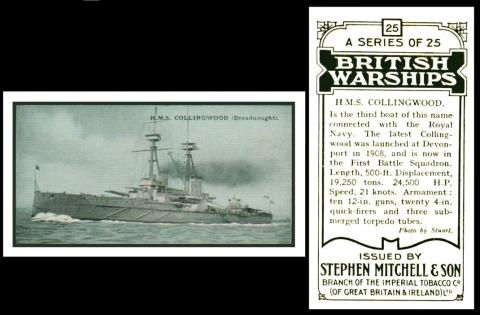
This H.M.S. Collingwood has two ancestors, or maybe three, if you count the Admiral, Cuthbert Collingwood, whom she was named for. He was a long serving Naval Officer, born in 1748, who joined the Royal Navy at the age of thirteen and left it just one day before he died, in 1810, aged sixty-one - and he took part in the American Revolutionary War, the French Revolutionary Wars, and the Napoleonic Wars, where he became very good friends with a certain Horatio Nelson. In fact on the death of Admiral Nelson, he took over command of the Mediterranean Fleet.
The first ship to bear his name was built in 1841, with sails, and converted to more modern screw propulsion twenty years later. However she only lasted six more years and then she was sold. After that there seems no record of who bought her or where she went.
The name was reused in 1882, for another fairly short-lived ship, but very different from her predecessor as she was an ironclad battleship. However she had a lengthy build and rebuild, and was only completed in July 1887. She was involved in a collision with H.M.S. Curacao in 1899, and though reports were that it was just a minor incident, just four years later she was decommissioned, just five years after that, in 1909, was sold for scrap.
Our ship was actually built before that, being ordered in October 1907 and laid down in the February of the following year at the Royal Naval Dockyard at Devonport. However she was not completed until April 1910, by which time her predecessor namesake was no more. At first she was used as part of the Home Fleet, and performed very well, apart from a rather embarrassing moment when she struck a rock off Spain (though to be fair the rock was not on any charts), and the damage was minor, just four months later she took part in the Coronation Review for King George V at Spithead. She remained with the Home Fleet until May 1912, when she became the flagship of the 1st Battle Squadron. However, after that she seemed to play host to several members of the Royal family, and in June 1914 was actually, briefly, used for pleasure alone. This all came to an end just one month later, when she was mobliised for war, whilst a month after that she found herself at Scapa Flow, and a month more saw her as part of the Grand Fleet, supporting Vice Admiral Beatty`s squadron. That led her to Jutland, on the 31st of May, 1916, where she saw much action. However with the end of the war she was transferred back to Devonport and became the flagship of the Third Fleet, before she was used for training purposes. Then, on the 12th of December, 1922, she was sold, for scrap.
As for a March connection, we could only find that on the 25th of March, 1915, Rear Admiral Hugh Evan-Thomas flew his flag aboard her for a couple of weeks, until the 14th of April of that year.
That was not the end of the name though, as to this day there remains an H.M.S. Collingwood. That was built in 1940, at Fareham, near Portsmouth, and it is an on-shore training establishment for new Naval recruits, as well as the Royal Naval Volunteer Cadet Corps.
This set is from the second period of Stephen Mitchell`s card issuing story, after they joined the Imperial Tobacco Company in 1902. It is a complex set, listed in our original World Tobacco Issues Index as :
- BRITISH WARSHIPS. Sm. 63 x 35. Black and white, bluish-green background. .. M122-13
1. "A Series of 25". 27 subjects known - Nos. 1/25, two subjects for No.3, ("H.M.S Fearless" and "Torpedo Boat 110") and No.10, ("H.M.S. Harpy" and "H.M.S. Liberty")
2. "Second Series, Nos. 26-50.
This is reduced somewhat in our updated World Tobacco Issues Index, to
- BRITISH WARSHIPS. Sm. 63 x 35. Black and white, bluish-green background. .. M757-250
1. "A Series of 25". Nos. 1/25, two subjects for No.3 and No.10
2. "Second Series, Nos. 26-50. (25)
I tend to find that the first series cards are a bit greener to the fronts than the seconds.
The ships in the first set are as follows :
- H.M.S. Iron Duke
- H.M.S. King George V
- H.M.S. Fearless / Torpedo Boat No.110
- H.M.S. Prince of Wales
- H.M.S. Birmingham
- H.M.S. Naiad (Mine Layer)
- Past and Present (H.M.S. Victory and Australia)
- H.M.S. Lord Nelson
- H.M.S. St Vincent
- H.M.S. Harpy / H.M.S Liberty
- H.M.S. Inflexible
- Submarine E.6
- H.M.S. Superb
- H.M.S. Audacious
- H.M.S. Orion
- H.M.S. Hercules
- H.M.S. Princess Royal
- H.M.S. Antrim
- H.M.S. Edward VII
- H.M.S. Dreadnought
- H.M.S. Queen Mary
- H.M.S. Centurion
- H.M.S. Shannon
- H.M.S. Forward
- H.M.S. Collingwood
Looking into the substitutions, I imagine that they could have been done to update the flotilla, for "H.M.S. Fearless" was built in June 1912, but "Torpedo Boat 110" ten years earlier. As far as the other pair, "H.M.. Harpy" was built in 1902 as well, and though "H.M.S. Liberty" was but a rename of an earlier boat (H.M.S Rosalind) her rename came just fifteen days after her launch on the 15th of September, under orders by the Admiralty, adding her to what would become the "Alphabetical Classes", each being a number of destroyers with a single initial letter. And in her class, the "L" Class, were Laertes, Laforey, Lance, Landrail, Lark, Lassoo, Laurel, Laverock, Lawford, Legion, Lennox, Leonidas, Liberty, Linnet, Llewellyn, Lochinvar, Lookout, Louis, Loyal, Lucifer, Lydiard, and Lysander. All of these ships had earlier names, and most of them were laid down in 1912, the two exceptions being Lassoo and Lochinvar, which were laid down in 1915.