
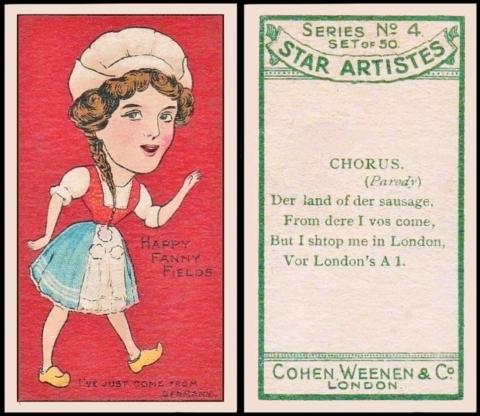
Our lady of today, billed as "Happy Fanny Fields" was born Fanny Furman, on September the 15th, 1880, in New York. Her parents were Jewish, of both Polish and German extraction, and there was theatrical blood too, with her brother becoming an actor, and her sister`s husband, Joseph Fields, being part of Gallagher and Fields, and yes, that is from where she took her stage name.
We know that she started on the stage very young, she says she was thirteen, but there is some evidence that it was earlier. She did it simply to help her parents, whose business, importing fruit, took a tumble. However she soon found she enjoyed it, and went off touring with a succession of companies. Then she came back and got a permanent gig as a Dutch girl in a play called "A Hired Girl".
In 1901, her mother died, and she decided to move to England, where she soon became a favourite. And she toured around the country, picking up new fans. She was billed as "The girl who is always laughing", and that led her, in 1905, to her first pantomime, "Mother Goose" at the Prince`s Theatre, Bristol. She played Mother Goose`s servant, Gretchen - and Mother Goose was played by another character from this set, Wilkie Bard.
This pantomime was important not just because it was her first, but because it gave her the grounds for her solo act, and new stage persona, Gretchen, a very naive young lady, with a most indecisive sweetheart called Schultz. Gretchen was, once more, Dutch, but Schultz was German, hence a lot of her verse, including the one on this card, seems to poke fun at the Germans, but it is in no way a war reference.
It seems that this card also shows Gretchen, but by the time the set was issued she had developed her act to include other characters, and she was a talented musician, and clog dancer, too. in 1906 she gained considerable notoriety (from her male audience) and praise (from the ladies) with a song called "The Suffragette", exhorting women to "stand up for your rights"
She continued to perform the length and breadth of Britain, and even appeared in a short silent movie, called "Happy Fanny Fields and the Four Little Dutchmen", in 1913. However in October 1913, she made her last stage appearance at the London Coliseum, then retired. In fact, it was not so much a retirement as a new life, as she got married, in New York, to gynaecologist Dr Abraham J. Roginsky, two years her senior, who, as Dr. Rongy, specialised in maternity and called for the legalisation of abortion. She became deeply involved in medical fundraising, even after her husband`s death in 1949. And she stayed in New York, dying, aged eighty, in 1961.
As for the personalities, this set has rather a unique claim to fame, because it contains both Marie Lloyd and her then husband Alec Hurley, in what appears to be his only cartophilic appearance. She met him in 1894, married him in 1906, and deserted him for Bernard Dillon in 1910, though she remained legally married to him right until his death in December 1913, and only after that decided she may as well marry Bernard Dillon. It also contains many other notable music hall and vaudeville stars, including Chirgwin, Harry Lauder, Little Tich, George Robey, Eugene Stratton, Vesta Tilley and Vesta Victoria.
This set is actually from a curious little group, just six sets, issued between 1904 and 1909, and all prefixed by "Series 1" to "Series 6" - but "Series 1" was not their first ever issue, because the company had been issuing cards since 1897 - and they would issue other sets, after "Series 6", without the "Series" or the number, continuing right up to 1926. It also leads to a spot of confusion because the top of every card says "Series No....", and a lot of people think this is the number of the card.
The group appears in our original World Tobacco Issues Index together. At the moment the only other one we have featured is Series No.5, so today`s card, being issued earlier, inherits the mantle of being the home page for the entire group. However once we feature series 1 this information will relocate there, and this and the other pages will only record the details specific to that set. By the way, they are not dated individually in the World Tobacco Issues Index list, we have added that. We will also include links in this list to the various sets, as we feature them, clicking which will whirl you to their page.
The group is therefore recorded as :
4. SERIES 1 TO 6. Issued 1904-09. Small size 63 x 35 m/m., unless stated.
- SERIES No.1 - NAVAL AND MILITARY PHRASES. Sm. 63 x 37. Unnd, (40). See H.14 ... C102-31 [1904] ... C102-31
- SERIES No.2 - OWNERS, JOCKEYS, FOOTBALLERS, CRICKETERS. Sm. Unnd. (50). See H.98 [1906] ... C102-32
- SERIES No.3 - OWNERS, JOCKEYS, FOOTBALLERS, CRICKETERS. Sm. Unnd. Inscribed "Set of 50", 20 only issued. See H.99 [1907] ... C102-33
- SERIES No.4 - STAR ARTISTES. Sm. Unnd. (50). See H.102 and Ha.102 [1907] ... C102-34
- SERIES No.5 - FOOTBALL CAPTAINS, 1907-8. Sm. Unnd. (60). See H.94 [1907] ... C102-35
- SERIES No.6 - WONDERS OF THE WORLD. Sm. Unnd. (30). See H.104 [1908] ... C102-36
This is slightly altered in our updated World Tobacco Issues Index, and now reads :
4. SERIES 1 TO 6. Issued 1904-09. Small size 63 x 35 m/m., unless stated.
- SERIES No.1 - NAVAL AND MILITARY PHRASES. Sm. 63 x 37. Unnd, (40). See H.14 [1904] ... C633-320
- SERIES No.2 - OWNERS, JOCKEYS, FOOTBALLERS, CRICKETERS. Sm. Unnd. (50). See H.98 [1906] ... C633-340
- SERIES No.3 - OWNERS, JOCKEYS, FOOTBALLERS, CRICKETERS. Sm. Unnd. Inscribed "Set of 50", 20 only issued. See H.99 [1907] ... C633-350
- SERIES No.4 - STAR ARTISTES. Sm. Unnd. (50). See H.102 and Ha.102 [1907] ... C633-360
- SERIES No.5 - FOOTBALL CAPTAINS, 1907-8. Sm. Unnd. (60). See H.94 [1907] ... C633-370
- SERIES No.6 - WONDERS OF THE WORLD. Sm. White border. Unnd. (30). See H.104 [1908] ... C633-380
If we look at the "H" codes, the first H.104 sends us to the handbook, which at the time of the original World Tobacco Issues Index was produced by the London Cigarette Card Company, and the entry for our set reads :
- H.102. STAR ARTISTES. (titled series). Fronts in colour ; front and back illustrated in "Notes and News", Volume 1, No.2. Issued by Cohen Weenen, inscribed "Series No.4". Unnumbered series of 50.
20 - with Stage backgrounds
1. Charles Bignell
2. Chirgwin
3. Whit Cunllffe
4. T. E. Dunville
5. Fred Earle
6. Daisy James
7. Neil Kenyon
8. Harry Lauder
9. Queenie Leighton
10. Marie Lloyd
11. Annie Purcell
12. Harry Randall
13. Phil May
14. Ada Reeve
15. Arthur Roberts
16. George Robey
17. Ernest Shand
18. Mark Sheridan
19. Little Tich
20. Vesta Tilley
30 - Plain backgrounds
21. Ben Albert
22. Wilkie Bard
23. George Bastow
24. George Brooks
25. Harry Champion
26. Dan Crawley
27. Leo Dryden
28. Gus Elen
29. George Elliot
30. Will Evans
31. Happy Fanny Fields
32. Harry Ford
33. George French
34. Hector Grant
35. Alec Hurley
36. R. G. Knowles
37. Geo. Lashwood
38. Sam Mayo
39. Victoria Monks
40. George Mozart
41. Michael Nolan
42. Pat Rafferty
43. Arthur Reece
44. Arthur Rigby
45. Austin Rudd
46. Ryder Sloan
47. Eugene Stratton
48. Nat Travers
49. Vesta Victoria
50. Charles Whittle
Their 1950 catalogue, uniform with the handbook, also tells us that they valued the two types, above, differently too, and sold them as separate sets, the catalogue entry actually reading :
- 50 Star Artistes - Series No.4 - Handbook Ref. H.102
20 With stage background, odds from 5/- to 15/- each, complete sets £15
30 No stage, plain background, odds from 2/6 to 7/- each, complete sets £12
The curious thing about this is that though our updated World Tobacco Issues Index still carries a Handbook reference of H.104, that number does not appear in our own updated handbook, it skips from H.103 "British Admirals, British Warships and Admirals" straight to "H.105 Boer War Celebrities - STEW"