
If we stayed on our road into Peru we would find it instantly renamed to the Ruta Nacionale, or PE-1, and, under those names, it takes us the whole length of the country, more or less along the coastline, some 2,661 kilometres - though it is split into PE-1N and PE-1S, those letters standing for North and South. Again it is sometimes tolled, and moves from two lane to four lane highways, sometimes seemingly at random.
Most of its traffic is commercial and industrial freight but the road is sold to drivers, especially those from overseas, as a way of boosting tourism.
Building this section came quite quickly after the 1923 Pan-American Conference in Chile, thanks to a far-sighted President, Augusto Leguia, who realised that a large road would increase trade with its neighbouring countries and also lead to modernisation of his own. And it also helped with unemployment, for the road was a manual task that required a huge workforce. After him, the road was more or less abandoned; it was only the military leadership of the 1970s and 80s that realised the road was key to their defences, and they started a radical programme of upgrades and new sections, both in length and width. And the next real improvements to the road did not come for another twenty years, after the disastrous Pisco earthquake, and its associated aftershocks, which led to much rebuilding with more stringent earthquake protection systems, many of which were severely tested, and even broached by a succession of devastating El Ninos.
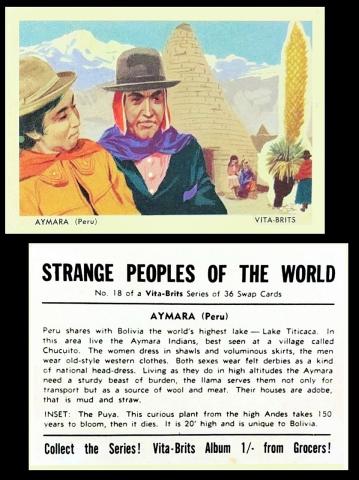
Our card shows two Peruvians outside their adobe dwelling, who probably had little to do with our road, and whose mode of transport was almost certainly the llama. The back tells us that these are Aymara Indians, and that the house is in a village called Chucuito. That is some distance from the Pan-American Highway. It is believed that the Aymara people could date back to the late Mesolithic period, and are largely unaltered. In fact, we also know that they were one of the few peoples who fought back against colonisation by the Incas, though this led to savage punishment. And under the Spanish rule which followed they almost disappeared.
As for their headwear, yes, it is a bowler hat. Apparently this started in the 1920s, when a shipment of these hats was sent out for European railway workers to wear in order to protect their heads from the sun. These hats then became part of local costume, but there are many theories as to why. Some say that any which were too small for the workers were given to local children, whilst others believe that one Aymaran managed to get hold of one of the hats and sported it with gusto, then acquired more for anyone that wanted one for themselves, and they became a bit of a fashion.
Another question revolves around the issuer of this set.
Some say it was Cereal Foods, and other put it under the Nabisco brand. The answer depends on the date, for in the early 1920s a company called Cereal Foods Ltd. was created purely to compete with Sanitarium, it was founded by selling shares, at one dollar each. However in the mid 1930s it was liqudated, and arose once more in November 1935 as Cereal Foods Pty. Ltd. That then acquired the assets of the former Cereal Foods Ltd, which included their best selling brand, Vita-Brits. The brand was later sold to Purina and in 1960, when Purina was bought out by Nabisco, they acquired it. Nabisco suddenly stopped selling in Australia in the late 1980s, and they sold the brand to ICM Australia Pty. Ltd. Shortly after that the Vita Brits brand became attached to one of their subsidiaries, "Uncle Toby`s". That was bought out by Nestle in 2006, but in 2020 they decided to stop production of Vita Brits and contract it out. This cannot have worked too well, as in 2025 Nestle sold the Vita Brits brand to Sanitarium.
The only problem is that I have not been able to find out the year that Purina bought the Vita Brits brand from Cereal Foods Ltd, so, in 1958, when this set was issued, it might have been either of them.