
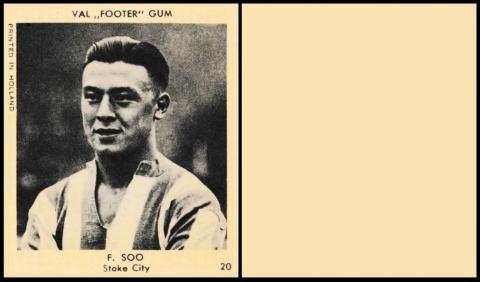
Our week began with this man, Frank Soo, who was the first Chinese footballer in the English Football League. It seemed fitting that we did so, not because his is a tale that much deserves the telling, but because China gives us the birthplace of tea, and also its biggest producer - and it was Chinese scholar, Chen Entian, who set up the International Tea Day, in 2019, with the first coming in 2020. Though research proves a form of International Tea Day had been celebrated in Asia and Africa since 2005, albeit in December.
Frank Soo was the son of a Chinese sailor and an English girl. They had married in 1908, in Manchester, and relocated to Fairfield, near Buxton, a short while later, with their son, Norman, where they opened a laundry. Frank was born on the 8th of March, 1914, and when he was six they moved to Liverpool. There the family expanded, ending up with seven children. Frank had a liking for football, and played for three of the local teams, Norwood, West Derby Boys Club, and West Derby proper. There he was spotted, and offered a trial by both Everton and Liverpool but he turned them down and got a proper job, as a clerk, to help support his family. This may have been at British Insulated Cables, in Prescot, as he started playing with kind of their works team, The "Cables", in 1932, when he was eighteen. His play was such that a scout came down to watch from Stoke City, and seems to have convinced him that he could support his family and still play football, because he signed for them in January 1933. He had to wait a while for his first match, right until November of that year, against Middlesborough, but that was a pretty important match, even though Stoke lost, by six goals to one, as it brings him the honour of being the first player of Chinese parentage to ever play for the British Football League.
By the mid 1930s he was playing for the reserves, and scoring most of their goals. He was also sidelined through injury, after he broke his leg in 1935, during pre-season training. And he started a relationship with the owner of a hairdressing salon, whom he had met when she asked for his autograph; this led to marriage, in 1938, and is probably why he turned down the offer of moving to Brentford F.C.
He had plenty of other offers, Stoke City were all set to tour Germany and Poland the following year, and he was also hopeful of getting the nod to play for England.
However, neither the tour nor the England match ever took place, due to the outbreak of the Second World War, though he did play in several unofficial England wartime matches. Perhaps he imagined that this would lead to getting an official game, after the end of the war, but it was never to be. And the war brought other changes too, including the sudden death of his brother, Ronald, whilst serving in the Royal Air Force.
In 1945 Stoke City let him go, whilst he was still serving in the Royal Airforce, and he moved to Leicester City, where he did not play a single match, possibly because he had not yet finished his military service. They sold him, to Luton Town, in July 1946, only two months after he was demobbed, where he stayed for two years, before ending his playing career, in 1950, at Chelmsford City,
In 1949 he had started a second career, as a manager, which he did successfully, and worldwide, starting with teams in Finland, and Italy. It was about this time that his marriage started to show signs of fracture, though they did not officially separate until 1951. Then another shock, for his ex-wife died, and not so long after, through an overdose of barbiturates, in March 1952.. At that time he was in Italy, with Padova, but came back to England.
What raised him from his despair was an offer to coach the Norwegian Olympic football squad, and that brought him back to managing again, starting with a Swedish team called Eskiltuna, and moving to several other teams in the same country, right until 1959, when he was given the chance to come back to England and manage Scunthorpe United. Sadly that only lasted less than a year, and he returned once more to Scandinavia, where he practically saw out the 1960s. There was an offer of going to Hong Kong in the 1970s but it never happened, for various reasons, including the fact that it was to be for no longer than a single year.
The next decade saw him back in Stoke, and I have no idea what he was doing, until he is reported as having died, of dementia, on the 25th of January 1991.
Some time later, his importance seems to have been realised, and in 2016 he was immortalised with a Foundation which aims to promote the story of his life, and encourage more Chinese and Asian footballers into the game. He was also added to the Stoke-on-Trent Sporting Hall of Fame in November 2023 and the National Football Museums Hall of Fame the following year. And in 2025, after much lobbying, his participation in those so called "unofficial" wartime England matches led to his being posthumously presented with an honorary England cap.
Sadly, he appears on relatively few cards.
His "rookie" card is the 1934 double-sided set of "Run for the Cup", which is a kind of game, issued with D.C. Thomson`s "Adventure" magazine, starting on Monday March the 5th. He was not in that batch though, only the first thirteen cards being included. Two years later saw him in colour for the first time, on the "Topical Times" long card set of "Footballers". And two years after that comes his cartophilic claim to fame, his only cigarette card, number 41 of Churchman`s "Association Footballers", which is also the first to have a descriptive text on the reverse, namely :
For five years, Frank Soo has been one of the most consistent and valuable members of the Stoke City team, being one of those players of whom it is said that they never let their side down. Born at Buxton, he played as a youth with Prescot Cables. He soon gained a place in the Stoke side, making his first appearance in November 1933, on the same day as Tutin. At this time, however, Soo was a forward. He displayed clever craft in this position, but later became a wing half and, with the knowledge of the support a forward requires, he has been very successful. Strong in tackling, he is also a tireless worker throughout the whole game.
Our card was issued the following year, in Holland. It came in a wrapper titled as "VAL "FOOTER" Chewing Gum, and there seems to be an English connection which I am still investigating - suffice to say that the wrapper says "VAL CHEWING GUM MADE IN ENGLAND", and that there is a redemption scheme in which if you collected a whole set you could exchange them for free footballs or table tennis sets, the submission address being "VAL 19, Bridge Street, Manchester 3".
The tale of tea begins in China, too. It is where the plant that gives us tea originated and where, probably unsurprisingly, the drink was first mentioned in a written text. However, at first, it was consumed for its health benefits, and not because it tasted great; the first record of it being drunk for pleasure was in the 3rd century A.D. It spread to Europe by way of Portuguese traders in the sixteenth century, and then slowly, to the British Isles. And the British East India Company is supposed to have taken it to India.