
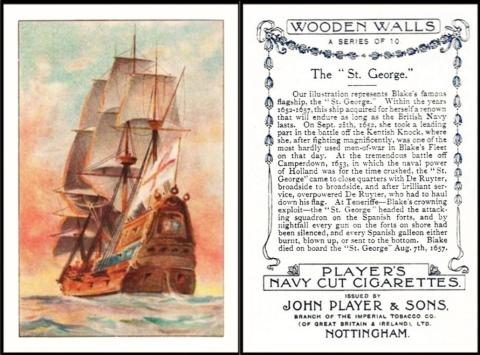
Our third card has a difference of opinion as to the date. I have it in the London Cigarette Card Company catalogue for 1950 as May 1908, whilst in our original Player reference book it appears as February 1908. Sadly I have no card magazines for that date, so I can`t check it out in the New Issues column.
Anyway, this is the St. George, the flagship of Admiral Robert Blake, on which he actually died.
We know little about Admiral Blake, and for that you can blame the Stuarts, for he was Oliver Cromwell`s favourite, and many of his exploits were expunged from official records in order to hide his truth. However, we still know that the modern navy owes a lot to him and his changes, and that some claim him to have been a better sailor and tactician than even Admiral Nelson.
He was born in 1598, we known not when, but he was baptised on the 27th of September 1598, which is oft quoted as his birthdate. However it must have been no more than a week earlier as his parents were good religious folk. He attended school, and then Wadham College, in Oxford, but he left when his father died, and he took over the estate. In 1640 he was elected as the MP for Bridgwater in Somerset, but then the English Civil War broke out and he joined the Parliamentarians. They installed him as the MP for Taunton in 1645, and he remained MP of both places on and off until 1656, when he went back full time to his great love, the sea.
He had already been closely involved with the building and maintenance of the English Navy, and in 1649 had written and published what is considered to be the first ever Navy Manual, "The Laws of War and Ordinances of the Sea". It is to him we owe courts martial, and the single line battle formation, as well as our readiness to attack unremittingly despite opposing fire, both from the coastline and other ships.
In March 1655 he had written his will, we are not sure why. That left £100 to each of the towns at which he had been the MP, for poor relied, and money to his brothers, one of whom also was to take over the estate. At the time he also owned a diamond ring, given him by Cromwell, but this seems to have disappeared.
His death came on the 7th of August, 1657, but not in the heat of battle, for it is recorded that he simply died "of old wounds", on board this very boat, his favourite. And he was buried at Westminster Abbey, with Oliver Cromwell looking on. Unfortunately, after that, when King Charles II took over the throne, he was dug up, and in 1663 the remains were uncovered and transported to St, Margarets, along with twenty other Parliamentarians, who seem to have been tumbled in together, and are recorded only by a carved stone plaque, erected quite recently, by the Cromwell Association.
Now this card, unlike our previous two cards. was issued only as a large sized set, it was never reduced to a standard one. And I am not sure why, as the paintings are superb.
There is another puzzle too, for the name does not suggest shipping to me, and it is seldom explained in catalogues that it is actually of that subject.
It is even described in our original John Player reference book, RB.17, issued in 1950, as simply :
- 202. WOODEN WALLS. Extra large cards. Fronts in colour. Backs in blue, with descriptive text. Home issues, February 1908
A. Thick card
B. Thin card
However, it turns out that "Wooden Walls" was actually a Naval name for the oak-built battleships, and that any sailor of the time would have known that. It would have only been to us landlubbers that the puzzle would have occurred. In fact there is a silent film. by the Hepworth Company, called "Wooden Walls of Old England", filmed in 1899, which can be watched, to this day, online, courtesy of the British Film Institute
By the time of our original World Tobacco Issues Index, the description is reduced, and there is not a word about the two thicknesses. All it says is :
- WOODEN WALLS. Extra-Lg. Nd. (10) ... P72-57
Whilst in our updated World Tobacco Issues Index, the text remains the same, only the card code is different, and s now P644-124
As far as the ten ships in the set, they are
- An Anglo-Saxon Ship
- The "Victory"
- The "Prince George"
- The "St. George"
- "The Last Fight of the "Revenge""
- The "Powerful"
- The "Henry Grace a Dieu"
- The "Sovereign of the Seas"
- The "Queen"
- The "Formidable"
Do note that the number is really hard to see, being right in the middle of the looped garland above the title.