
The Buttercup, which is one of the first plants to appear on an un-mown lawn, but be warned as its roots will spread right across your garden. It also has another problem for it grows along the surface, and can be hidden by other plants as they grow tall. But it is loved by butterflies, beetles and birds,
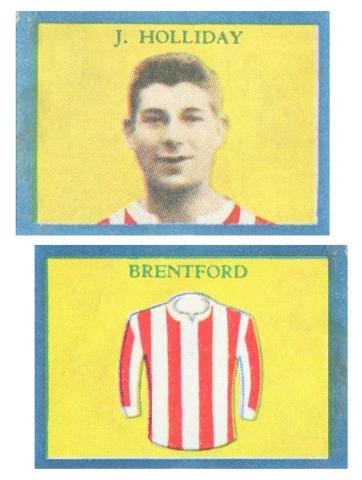
So we started with this card, not just with a buttercup coloured background, but of Brentford Football Club, who marked their first season in the Premier League (2021-22) with a new away strip which was named to be in "buttercup yellow" - shirts, shorts, and socks - in the hope that the team would seldom, if ever, turn up to an away game and have to change to a third strip. In fact there are a few teams with a yellow strip, including Norwich and Watford, and only this year Southampton played in one in the FA Cup semi final against Manchester City - celebrating and commemorating the F.A. Cup final of 1976, fifty years ago, when they beat another Manchester side, United.
As for our featured player, John William (Jack) Holliday, who was born in Cockfield, County Durham, on the 19th of December 1908. His first club, however, was Middlesborough, in 1930.
Football was in his blood, for his father had been very keen on the game, but sadly he was killed, during the First World War, on the 1st of October, 1918, whilst serving with the 6th Battalion of the Durham Light Infantry, when little John William was only nine years old, and been buried at the British Cemetery in Warlencourt, near Calais, along with three thousand, five hundred, and eleven other men.
Our man stayed at Middlesborough for two years,and then, with two teammates, William Reed "Billy" Scott and Herbert Leonard "Bert" Watson, he joined the Southern side of Brentford. Here all three flourished, and the team became the champions of the southern part of the Third Division in 1932-33. Our man also hit the record books, for scoring the most league goals in a single season, thirty-eight, and the most hat tricks in a single season too. And though the former has been beaten, the latter still has not at time of typing. But he should also be remembered for another astounding feat, the fact that he scored all five goals that held Luton Town to what must have been a thrilling 5 - 5 Score Draw on the first of February 1933.
His first cartophilic appearance, perhaps because of those feats, was issued in August 1934, card 38 of Ardath "Famous Footballers". The reverse tells us that he was a Centre Forward, and that he "Joined Middlesborough 1930. Chances were limited and Brentford secured his transfer in the summer of 1932. His goals - 36 in 33 games - did much to gain the club promotion to Division II. Born Cockfield."
Another candidate for his "rookie" card is number 45 of Carreras` "Famous Footballers", also issued in 1934, but we have no idea of the month, it may have been before, or after the Ardath. It has much the same text, "Joined Brentford from Middlesborough in 1932, and in his first season scored 36 goals in 33 games contributing greatly to their promotion to the Second Division. Has since played regularly as centre-forward, and in the 1933-34 season was second on the list of Division II`s goal scorers with 27." But it does tell us something else, and that is that he "Is, in addition, a keen cricketer and tennis player".
Another similar text comes on number 45 of Carreras` "Famous Footballers", the version issued in 1935, which reads "Born at Cockfield, J. Holliday, scoring 36 goals in 33 matches was the big factor in Brentford`a promotion to the Second Division last season. Before being transferred to Brentford he was with Middlesborough, but found little scope for his capabilities there and Brentford secured his signature in 1932. Scored 25 goals last season. A brilliant centre-forward. "
The same year we get quite a lot more information, courtesy of number 21 of W.D. and H.O. Wills` "Association Footballers", which tells us he was "Trained in the famous north-east coast nursery, Holliday was playing with Cockfield, a Durham amateur club, when he received his first professional appointment with Middlesborough. He acted as understudy to Camsell for some time, occasionally appearing in First Division matches, but it was not until he was transferred to Brentford in May 1932, with other members of the Middlesborough side, that he really came into prominence. In each of his three seasons with the London club he has been a marked success as the centre-forward, leading the attack well and scoring freely. He played a big part in helping to win the Second Division Championship in April 1935."
He seems to have kept playing for Brentford during the Second World War, but retired in 1944, albeit temporarily, as he turned up at Chelmsford City in 1945. This was short lived though, as he played two games only and then left as abruptly as he had come. He did stay connected with football though, as he became trainer at Brentford, and only left that job in 1961. By that time he had developed another sporting passion, bowling, and he was a valuable member of the West Ealing club; in fact he represented Middlesex County several times.
Sadly his death seems very sketchy, all I have is 1987, no month nor day, and I have found no site that adds either,
Despite the age of this set it does not appear in our original British Trade Index covering issues up to 1945, it waits until part two. The reason for that may have been that only after that date (part two being published in 1969) was it realised that the flags were issued loose, or rather in a sheet, until then it may have been thought that they were printed in the album, and then, suddenly, an empty album turned up. And maybe at that point they had not even seen a flag, loose. This is certainly suggested by the wording in British Trade Index part two, which reads :
- THE WINNER FOOTBALL FLAG BOOK. 36 page album, with spaces for pinning 62 flags. ... THO-108
This is expanded upon in our updated British Trade Index, issued in the year 2000, to :
- THE WINNER FOOTBALL FLAG BOOK. (S). 36-page album, spaces for pinning 62 flags, 30 x 22. Double sided, club one side, player representing the club other side. Cut from gummed sheets. The 62 represent all the clubs from the English First & 2nd Divisions, and the Scottish 1st Division . Unnd. ... THO-765
In fact the flags were very curious indeed. There were three sheets, each of 21 flags, with either red or blue borders, and they were issued with "The Skipper" boy`s magazine, starting with the edition of the 24th of February 1934 - one sheet a week. Then the fun began. Firstly the flags had to be cut out, folded exactly in half, have a long pin placed in the middle of the central border, and somehow manage for the two halves to be licked and pressed together so that both flags lined up without odd white bits showing on each side. If all that was accomplished, then you could get the album, gently pierce two holes on each page in the places which were indicated by small black dots, and stick the pin through.
Now I had a lot of help with that, and with the next bit, from Mr. Reeder, who actually has an album - and it`s one of his flags that we show here. The album has a coloured front cover showing a footballer kicking a ball high into the sky, and then the rest of the pages, when opened out, had an article printed on the left hand side, and space for your flags on the right hand side, each with a little box about that team.
The first page was only for two teams, but after that the pages on the right hand side had four boxes and took four flags - starting with
First Division :
- Arsenal (J. Dunne : S1) and Aston Villa (A. Cunliffe : S3)
- Birmingham (H. Hibbs : S1), Blackburn Rovers (J. McLean : S3), Chelsea (P. O`Dowd : S3), Derby County (D. Duncan : S3)
- Everton (W. Dean : S1), Huddersfield (R. Goodall : S2), Leeds United H. Duggan : S1), Leicester City (H. Adcock : S2)
- Liverpool (G. Hodgson : S2), Manchester City (M. Busby : S3), Middlesborough (G. Camsell : S1), Newcastle United (S. Weaver : S3)
- Portsmouth (J. Weddle : S2), Sheffield Wednesday (E. Blenkinsop : S1), Sheffield United (R. Barclay : S3), Stoke City (T. Sale : S1)
- Sunderland (R. Gurney: S1), Tottenham Hotspur (G. Hunt : S2), West Bromwich Albion (T. Glidden : S2), Wolverhampton Wanderers (A. Hetherington : S2)
Second Division :
- Blackpool (P. Watson : S3), Bolton Wanderers (J. Milson : S2), Bradford (J. Parris : S2), Bradford City (R. Bauld : S1)
- Brentford (J. Holliday : S3), Burnley (T. Douglas : S1), Bury (J. Vernon : S2), Fulham (A. Tootill : S2)
- Grimsby Town (J. Bestall : S1), Hull City (W. McNaughton : S2), Lincoln City (A. Horne : S2), Manchester United (E. Hine : S1)
- Millwall (J. Poxton : S3), Notts County (G. Walker : S1), Nottingham Forest (J. Graham : S3), Oldham Athletic (J. Pears : S3)
- Plymouth Argyle, (S. Black : S3), Port Vale (T. Rhodes : S3), Preston North End (E. Harper : S2), Southampton (E. Drake: S1)
- Swansea (H. Hanford : S2), and West Ham (V. Watson : S1) -
because though the four teams to a page continues, the bottom two are from the
Scottish League, First Division :
- Aberdeen (W. Mills : S2), and Airdrieonians (J. Shaw : S3)
- Celtic (J. McGrory), Clyde (J. Mayes : S1), Cowdenbeath (A. Robertson : S3), Dundee (L. Morgan : S1)
- Falkirk (J. Bartram : S3), Hamilton Academicals (D. Wilson : S1), Hearts (A. Massie : S1), Hibernian (D. Urquhart : S2)
- Kilmarnock (J. Maxwell : S3), Motherwell (J. McMenemy : S2), Partick Thistle (E. McLeod : S2), Queen`s Park (J. Crawford : S3)
- Rangers (R. McPhail : S1), St. Johnstone (J. Calder : S2), St. Mirren (J. Latimer : S1), Third Lanark (J. Warden : S2).
The last page in the book on that side is a bit more unusual, as it is for a flag of your own invention , for a team you made up, and whose logo you drew, and for this purpose there was a blank flag as the final flag of sheet three.