
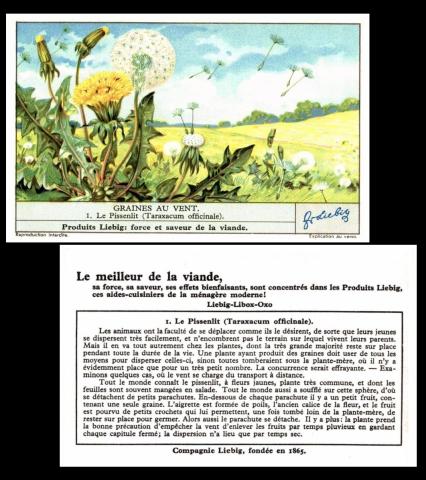
This is an excellent depiction of the dandelion flinging its seeds in all directions, though a lot of time they have help, from a passing dog, which I always thought would make a fun computer game.
The dandelion is like marmite, loved and loathed in equal measure. It is loved for its cheery yellow heads, but not for its far flinging seeds, nor for its tap roots, which wriggle themselves down into the soil for a very long way and have the ability to self generate another plant even if the most minute bit is left in the soil.
We chose a French card because the name dandelion comes from French, dent de lion, or the tooth of the lion, referring to its leaves. It has many names, and it is rather amusing how closely the French one on our card is so close to one of the English ones, namely "wet the bed". This is because it is nature`s equivalent to a water tablet, and if you go to a herbalist for such a thing you will end up with a powder which is heavily dandelion based - though doctors are on the fence, as it were.
The cards in this set, which I think may have only been issued in French, are :
- Le Pissenlit (Taraxacum officianale) - the dandelion
- La Linaigrette (Eriphorum vaginatum) - cotton grass
- L`Erable plane (Acer platanoides) - the Norway maple
- Le Frene (Frazinus excelsior) - the Ash tree
- L`Oseille sanguine (Rumex sanguineus) - wood dock
- Zanonia Macrocarpa - Javan cucumber
Actually the most interesting plant here is on card 6, and not only because it now goes under another name, of Alsomitra macrocarpa. Though its still commonly known as the Javan cucumber. The now extinct "Zanonia" name was given it in 1825 by its discoverer, Carl Ludwig Blume, who found it in Java. Then, in 1843 this name was revised by Max Joseph Roemer, who called it Alsomitra, and lumped it in with several other plants of what would turn out to be no relation to each other. And today, despite this, it is known as Roemer`s Alsomitra macrocarpa - even though in 1881 a man called Alfred Cogniaux refuted all those attributions and moved it over to the Macrozanonia family, which was a much better fit. Macro, of course, refers to size, and large at that, for the fruits are the size of a football, which springs open like a struck pinata and allows the seeds to fly away.