
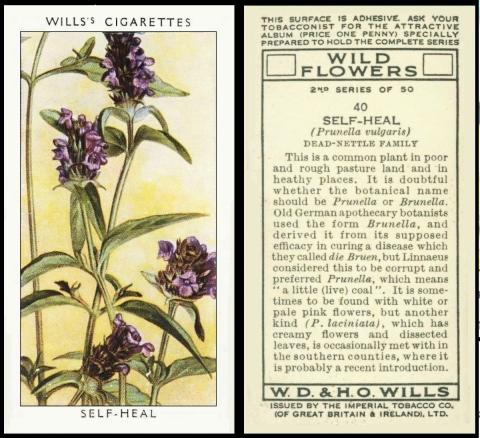
Our plant today is Self Heal, or Heal All, and it is actually in the nettle family. It is much beloved by bees and wasps, who plunder it ruthlessly for its nectar, and it pops up quite easily in an un-mown lawn, unless you have been using chemical treatments on it by way of weedkillers or growing assistance. In addition the lovely bluey-violet flowers appear from June to October, so you may be lucky to get some just at the end of your no-mow May, especially if you decide to leave it for another month and see what happens. And best of all, because it is a perennial, it will pop back up again next year too, especially if you take a couple of the purple seed heads and sprinkle them elsewhere.
The name Self Heal is a reference to the fact that this is a medicinal plant with many centuries of usage, especially in China, but it was also known to the Native Americans. Its major uses were for staunching bleeding, and helping the body to heal itself after it has been wounded, but it was also used as a drink to ease sore throats and mouth ulcers. Today it is being investigated as a treatment for heart disease, and studies have found it lowers cholesterol and high blood pressure.
As for its Latin name there is much debate, so much so that it even tells us on the back of the card that "It is doubtful whether the botanical name should be Prunella or Brunella [vulgaris]". The confusion comes from the fact that the Germans used it to cure a disease called "die Bruen" (but all my attempts at tracing this have failed), but when Linneaus came along he changed it to Prunella, which meant the colour of a coal just as it was smouldering to an ash.
More confusion now, as this is the later series of "Wild Flowers", not the grey backed version issued in 1923, and it is the second of two 1930s issues. Both of these 1930s series are described as a group in part four of our original reference book to Wills issues as :
WILD FLOWERS (1936-7). Fronts printed by letterpress in colour. Backs in grey, with descriptive text. Issued 1936-7.
- 346. 50. "Series of 50"
A. Home issue, adhesive backs. Special Album and I.T.C. Clauses.
B. Irish issue, non-adhesive backs. General Album and I.T.C. Clauses.
C. Channel Islands issue, adhesive backs. No Album or I.T.C. Clauses.
- 347. 50. "2nd Series of 50"
A. Home issue, adhesive backs. Special Album and I.T.C. Clauses.
B. Irish issue, non-adhesive backs. General Album and I.T.C. Clauses.
C. Channel Islands issue, adhesive backs. No Album or I.T.C. Clauses.
The 1923 issue leads to a bit of a problem, because it turns up first in our original World Tobacco Issues Index, and it has a second series, but only issued in Ireland, in 1937. That makes this entry appear to be ours, but it is not, if you keep reading past it you will find our set appears opposite under Section 2.C, for adhesive backed cards with I.T.C. Clauses. And it is recorded as :
- WILD FLOWERS. Sm. Nd. See W/346-A ... W62-202
1. "A Series of 50".
A. Home issue - back "This Surface ...."
B. Irish issue - back "Note : - This Surface ..."
2. "2nd Series of 50". Home issue
As far as the Channel Islands issue, you have to keep going still further forward to find that, all the way to Section 5.D. for "English language issues, 1935-39. Issued chiefly in Channel Islands and Malta." And there it is recorded as :
- WILD FLOWERS. Sm. Nd. Adhesive back. ... W62-504
1. "A Series of 50". See W/346.C
2. "2nd Series of 50". See W/347.C
The only change to this in our updated World Tobacco Issues Index is the card codes, W675-245 for the Home and Irish issues, and W675-719 for the Channel Islands pair