
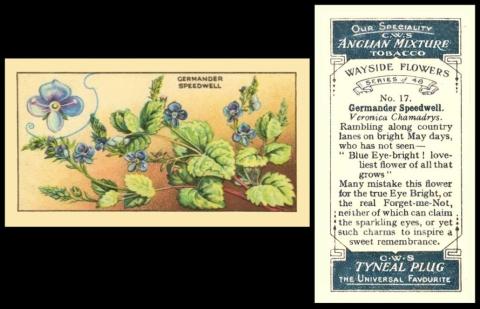
Here we have a plant that is already in lots of lawns and we don`t know it, for is sidles along the ground sinking its roots deep into the soil as it goes, and very often several clumps are actually just one plant, spreading out from a middle as yet undiscovered.
For such a hidden plant, it has several names. Our card only mentions three, Germander Speedwell on the front, and Veronica chamaedrys and Blue-Eye-Bright on the back, but it also known as Birds-Eye Speedwell, Cats-Eyes, and Gypsy Weed.
It is used medicinally to combat many different disorders. In Britain it gained a reputation for being able to ease gout, by making it into a kind of tea. That almost led to its extinction, which only goes to prove how prevalent gout once was.
To our card, it may have surprised you that the Co-Operative Wholesale Society sold tobacco. In fact they had a tobacco factory, all their own.
This set has a sibling, and both are described in our original World Tobacco Issues Index as :
CO-OPERATIVE WHOLESALE SOCIETY, Manchester, England
Known as "C.W.S." and many cards only identifiable through these initials. Some cards inscribed "C.W.S. Tobacco Factory". Trading, 1956. Series listed are inscribed with tobacco advertisements; the firm also issued cards advertising non-tobacco products All small size, 66-68 x 35-37 m/m unless stated.
- WAYSIDE FLOWERS. Sm. Nd. ... C130-15
1. Back in brown. (48)
2. Back in grey. (48)
I have to say it is a very greenish grey, sometimes almost blue.
They next appear in our updated World Tobacco Issues Index, with an identical listing and a new card code, of C792-360.
Strangely, in neither of these books is it mentioned that the two sets are not only different as to the colour of their backs, they are different sets as well, even though number 37 is a Cranesbill in both versions, blue meadow in the brown back and blood red in the grey-green.
| brown back | grey-green back | |
| 1. | - Campion | - Daisy |
| 2. | - Scarlet Poppy | - Dandelion |
| 3. | - Wild Pansy | - Clover |
| 4. | - Grass of Paruassus | - Primrose |
| 5. | - Field Knautia | - Comfrey |
| 6. | - Thrift | - Sweet Violet |
| 7. | - Carline Thistle | - Sootted Palmate Orchis |
| 8. | - Toadflax | - Tufted Vetch |
| 9. | - Yellow Balsam | - Snake-Weed |
| 10. | - Dropwort | - Wood Betony |
| 11. | - Meadow Sweet | - Sneezewort |
| 12. | - Woody Nightshade | - Hemp Agrimony |
| 13. | - Foxglove | - Broad Leaved Hawkweed |
| 14. | - Common Mallow | - Great Hairy Willow Herb |
| 15. | - Rose Bay | - White Dead Nettle |
| 16. | - Valerian | - Black Knapweed |
| 17. | - Giant Bell Flower | - Germander Speedwell |
| 18. | - Corn Cockle | - The Dog Rose |
| 19. | - Knapweed | - Scarlet Pimpernel |
| 20. | - Herb Robert | - Deadly Nightshade |
| 21. | - Golden Rod | - Creeping Cinquefoil |
| 22. | - Yarrow | - Buttercups |
| 23. | - Soapwort | - Wood Strawberry |
| 24. | - Water Mint | - Field Gentian |
| 25. | - Garlic | - Stitchwort |
| 26. | - Flag | - Chicory |
| 27. | - Cuckoo Pint | - Orache |
| 28. | - Water Lily | - Traveller`s Joy |
| 29. | - Blue Bell | - Rock Rose |
| 30. | - Marsh Marigold | - Bindweed |
| 31. | - Wood Anemone | - Great Mullein |
| 32. | - Bindweed | - Field Rose |
| 33. | - Lady`s Smock | - Rest Harrow |
| 34. | - Spear Plume Thistle | - Monkshood |
| 35. | - May Weed | - Loosestrife |
| 36. | - Cowslip | - Cornflower |
| 37. | - Cranesbill | - Cranesbill |
| 38. | - Welsh Poppy | - Perennial Flax |
| 39. | - Purple Orchis | - Oxytropis |
| 40. | - Centaury | - Ragged Robin |
| 41. | - Common Ragwort | - Lesser Celandine |
| 42. | - Corn Marigold | - Pasque Flower |
| 43. | - Great Burnet | - Cloudberry |
| 44. | - Ox Eye Daisy | - St. John`s Wort |
| 45. | - Hare Bell | - Water Crowfoot |
| 46. | - Marsh Woundwort | - Lesser Periwinkle |
| 47. | - Meadow Vetchling | - Groundsel |
| 48. | - Rose of Sharon | - Mountain Pansy |
Did anyone spot the mistake there? Its on card 4 of the brown backed version, where it says "Grass of ParUassas" not Grass of ParNassas - and it repeats it in the text, as "This chaste and lovely flower that loves the chill winds of upland heaths, whose blooms appear but tarnished pearls when Winter decks her earliest shroud of snow, became associated, in the poetic mind of ancient Greeks,with the grass of that snow-clad Mount Paruassas"