
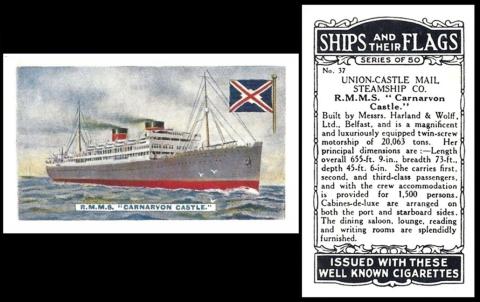
Now our final card is again a ship, and again the word "Castle" is in the title. However, the word in front is different to the Caernarfon which appears on the recent stamp, because the name of the town has changed, twice.
The first change came in 1926, just one year after our card was issued, and that saw the town name become slightly more Welsh, adding an "e" and making it Caernarvon, reflecting the fact that it was a fortress, which is what "Caer" actually means. This change was through petition, by the Borough Council, which is proof that if you get the right people involved most things are possible. However this means that you will only find the updated spelling in cards from 1926 onwards. Now this seems to have led to the strange situation that both names were used, and if you look at Cope`s Castles, which was issued in 1939, you will see that on card 23 the old name of "Carnarvon" is in the title box that juts into the frame, and "(Caernarvon)" is beneath it in the white border.
The second change came in 1975, again through the Borough Council , and that was to physically change the "v" to an "f", hence Caernarfon. Now this was an important change, because in the Welsh alphabet the letter `v` is not actually present, and so it was more a change for the English than it was for the Welsh, who had been calling it Caernarfon all along.
On to another strangeness. and you will see that this ship is called the R.M.M.S. Carnarvon Castle. Now this acronym differentiates between steam ships, which used R.M.S, and diesel ships, which used R.M.M.S., the additional "M" meaning "Motor-powered". The R.M. at the front, of course, denoted that this was a ship which carried the mail for Royal Mail, and technically it could only use it when it was carrying mail, at other times it had to change to S.S., for "Steam Ship".
Our ship belonged to the Union Castle Line, and she was launched on the 14th of January 1926. Like the Balmoral Castle, she was used on the Southampton to Cape Town run, and she served up until 1936, when she was deemed, by the revision of the contracts, to be too slow to carry mail. Then she went in for a refit which included allowing for more passengers, and removing the front funnel, which was actually a dummy, seemingly only for aesthetic purposes. On the 8th of September, 1939, whilst at Cape Town, she was requisitioned by the Royal Navy and re-equipped as an armed merchant cruiser. In this capacity, she saw much action, including a scrap on the 5th of December, 1940, with the German auxiliary cruiser "Thor" in which she came off badly, with the loss of four men and the wounding of over thirty, and she had to be strapped up at Montevideo, very quickly, for there was much grumbling from Germany, who objected to her being in a South American port, and also because of rumours that she was being mended with pieces removed, illegally, from the scuttled German ship Graf Spee.
In 1943, perhaps because of her war wounds, she was decommissioned, with the intention of converting her into an aircraft carrier, but this never happened. Instead of that she became a troop carrier, right until 1947, after which she returned to her South African routes. Despite all this, she was scrapped, in Japan, in September 1963.
Now whilst writing this, I discovered that she was not the first Carnarvon Castle. That vessel was built at Elderslie Dockyard, in Glasgow, in 1867, by Barclay, Curle & Co. and she was a three masted sailing ship, strangely intended to sail to the Cape and back. She was very highly thought of, and you can tell this because she was the first of their ships to be registered in London, as opposed to Liverpool. However, she was sold to Sinclair & Ellwood in 1889, and they sold her on in 1897, to a German company, Flugge, Johannsen & Libinus, of Hamburg, who renamed her the Nurnburg. They did not keep her long either though, and by 1906 she had been sold on to Sven O. Stray & Co. of Christiansand, in Norway. But then the story takes a dark twist, for she was abandoned at sea in January 1910. Now all I have been able to find out is that when this happened she was in the Atlantic Ocean, travelling back from the Peruvian island of Lobos de Tierra to Antwerp, laden with guano - and we have no idea what happened after that, whether she landed, or sank, and she was a big ship, almost seventy metres long.
This set is completely anonymous, but we know it to have been issued by Teofani, an issuer who seemed to enjoy hiding their light beneath a bushel, as many of their sets are not ascribed to them. In fact the entire ZA-7 section at the back of our original World Tobacco Issues Index, containing seven issues, starts with the header "overseas issues by Teofani". Our set is catalogued as :
- SHIPS AND THEIR FLAGS. Sm. 63 x 38. Back inscribed "Issued with these Well Known Cigarettes". Nd. (50). See Ha.602. ... ZA7-4
Now Ha.602 sends you off to the handbook, which at that time was published by the London Cigarette Card Company, though the work was a co-production between our Edward Wharton-Tigar and their Colonel Charles Lane Bagnall. And that tells you that there was another issuer of this set, namely :
- Ha.602 SHIPS AND THEIR FLAGS (titled series). Front in colour, numbered.
Phillips - Series of 25
Teofani - Series of 50. Anonymous cards, inscribed "Issued with these well known cigarettes"
Now I haven`t got time, at this late juncture of the night, to investigate that Phillips link, so that will be done over the weekend, along with more details of the twenty-five ships which were sadly scuttled from the Phillips set, or maybe excitedly launched to join the anonymous/Teofani version. Your guess, right now, being as good as mine, as to which came first.
What I do know, and very surprisingly, is that fifty years on, in our updated World Tobacco Issues Index, the set is still not restored to the Teofani section in the main book, it remains as an anonymous issue, and, in fact, another issue has come to join it, that being "Transport - Then and Now". Our set remains catalogued as :
- SHIPS AND THEIR FLAGS. Sm. 63 x 38. Back inscribed "Issued with these Well Known Cigarettes". Nd. (50). See H.602. ... ZA07-740
I`m not sure why it says H.602, because when you go to the modern handbook this code does not exist, it jumps from H.597 to H.604.
The most curious thing is that of these eight issues, only two use the same back inscription, as you can see from this quick list :
- "Cinema Celebrities" - "Presented with these well-known choice cigarettes"
- "Famous British Ships and Officers" - Issued with these High Grade Cigarettes"
- "Public Schools and Colleges" - "Issued with these fine Cigarettes" (as Zoological Studies)
- "Ships and their Flags" - Issued with these Well-known Cigarettes"
- "Sports and Pastimes" - "Smoke these cigarettes always"
- "Transport Then and Now" - Now being packed with these cigarettes"
- "Views of London" - "Issued with these World Famous Cigarettes"
- "Zoological Studies" - Issued with these fine cigarettes" (as Public Schools)