
Today we move on to another food which often provokes strong reactions, and that is fish and shellfish.
The first note of this in medical history came in a groundbreaking book called “Treatise on Dermatology”, by a man called Robert Willan, who became known as the father of dermatology, introducing many terms to the language that we still use today. He was born in Sedbergh, Yorkshire, on the 12th of November 1757, and he published the treatise between the years 1798 and 1808, dying, not too long after, aged just fifty-four, on the 7th of April 1812, whilst in Madeira. However, in this book he connected shellfish with the appearance of sudden rashes, and also in cases of unexplained deaths. And still, to this day the simple shrimp causes most of the shellfish allergies, worldwide. It can be mild, swellings to the mouth, face, and eyes, or rashes, but it can also cause discomfort to the stomach, and anaphylaxis, which can cause death. There is no cure or even a therapy, but lesser symptoms can be alleviated by a small device containing anti-histamines, which is called an epi-pen, and is injected into the sufferer. And worst of all is the fact that if a restaurant, etc, cooks shellfish in the same area as other food, the steam can come across the other pans, and contaminate the food in those, quite unwittingly, and sometimes unknowingly.
The story of shrimp is a long one, starting with the North American Indians, who made traps from branches, and soon discovered using a branch with lots of foliage and smaller branches caught more prey. Eventually this evolved into proper woven nets. In 1376, the British King Edward II was entreated to ban ships dragging nets across the sea bed because the practise resulted in the depletion of sea life - one of the first eco-friendly acts to be recorded. The practise was also banned in Holland, but not until 1583
Of course it was the infernal combustion engine that made matters worse, in every way. They led to larger ships, and smaller crews, throwing many former fishermen out of work. And as time brought us ever more advances, so fishing became motorised, computerised, and even more destructive.
Today, shrimp are mainly farmed, not caught in the wild. We can thank the fact that there have been many legal battles fought to preserve our seas, but the truth is that farming is easier and cheaper than going to sea, especially in countries that pay low wages and have no worker protection.
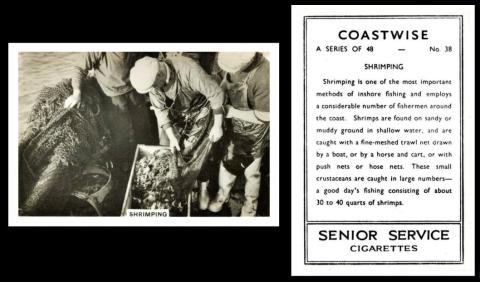
When I look at this card I do wonder at the fate of the people on it. The set was issued in 1939, and a great many shrimping and fishing vessels were drafted into military use, along with their crews. About three thousand boats were used to form what was known as The Auxiliary Patrol, sailing endlessly up and down the coastline looking for invaders, sometimes other ships, but often harder things to spot until it was too late, like torpedoes or periscopes. Others were used as minesweepers, which were basically small boats sent ahead of larger, more important ones so they found the sea-mines first, by running into them. And some became "Q-Ships", gunned up, and sometimes camouflaged with superficial panelling and false structures, so they looked like other, larger, craft, before being sent out as decoys in the hope they would encourage submarines to surface or big ships to attack.
Many good boats, and fine men, were lost. And its a story seldom told.
This set is listed in our original World Tobacco Issues Index as :
- COASTWISE. See Ha.564.2 ... P18-65
A. Small (28)
B. Medium (48) "Senior Service" brand issue. Two printings.
This is only slightly different in our updated version, which reads
- COASTWISE. See Ha.564.2.
A. Small (28) B. Medium (48) "Senior Service" brand issue. Two printings.... P246-685
Ha.564.2 leads us to the original handbook, which was published by the London Cigarette Card Company. It tells us that this set has other issuers too, the text in full reading :
GALLAHER GROUP. Four Photographic Series. Fronts glossy photographs in black and white. Four numbered series as follows :-
- 564.1 - Beautiful Scotland
- 564.2 - Coastwise
- 564.3 - Flying
- 564.4 - Our Countryside
Each series issued as follows :
- Gallaher - Medium Size, series of 48
- Illingworth - Medium Size, series of 48
- Peter Jackson -
A. Small size, series of 28
B. Medium Size, series of 48- Pattrieouex -
A. Small size, series of 28
B. Medium Size, series of 48, inscribed "SENIOR SERVICE CIGARETTES" without firm`s name. Captions in front in large or small letters