
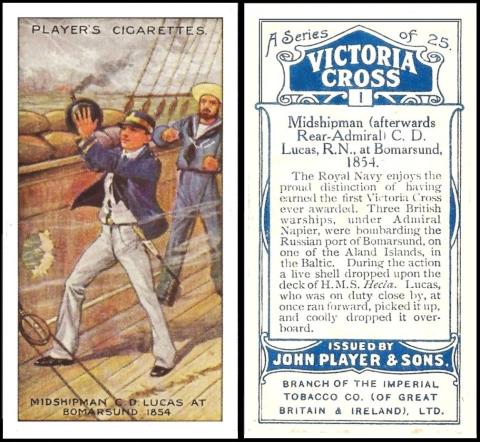
There is also conflict over the date that this set was issued - the 1950 London Cigarette Card catalogue for 1950 having it as June and our RB.17, published in 1950, as September - but there is no doubt that the first Victoria Cross was awarded on the 26 June 1857, to the man on our card, whose action was the first to be rewarded with that medal - which is why he is number one of the set. Though it must be noted that this first ceremony, in Hyde Park, London, saw Queen Victoria give out sixty-two of the medals, but that, for some reason, our man was not the first in line, but the fourth.
His name was Charles Davis Lucas, and he was Irish, having been born at Druminargal House, in County Armagh, on 19 February 1834. At the time of his bravery, he was a Midshipman, but he would end up as a Rear Admiral, and marry Frances Russell Hall, the daughter of Admiral William Hutcheon Hall, who had been the captain of the boat when, and where, his Victoria Cross was won.
Master Lucas enlisted with the Royal Navy in 1847, when he was just thirteen, and was placed on H.M.S. Vengeance. He did not see any wars at that time though, not until he was eighteen, when he went off to the Second Anglo-Burmese War with H.M.S. Fox and was on the field of battle during the captures of Rangoon (between the eleventh and the fourteenth of April 1852), Pegu (on the third of June, for which he received a medal, the India General Service Medal, with a clasp, saying "Pegu" to fit across its ribbon)
In 1854, on his twentieth birthday. he transferred to a new ship, the H.M.S. Hecla, though she was not a new ship in age. having been built in 1839. She was a four-gun, steam powered, wooden paddle sloop in the Hydra Class, who had two sisters, the Hydra herself and the Hecate. Two of these were the names of mythological beings, the hydra being a multi-headed water-monster slain by Hercules, and Hecate being a Greek witch. The odd man out was the Hecla, named after a volcano in Iceland, which was believed to be the gateway to Hell, and which had erupted in 1845, which suggests that a re-naming may well have taken place with our ship.
1854 would be a tumultuous year, and a marvellous one. The ship spent time in the Baltic, drawing up charts, and often met with Russian ships for a little sparring practice. Then she returned to Dover, only to receive orders to set to sea and join the Crimean War, one of the first vessels to do so. They soon met resistance, at the Aland Islands, and then went into action against the fortress of Bomarsund, and its vast arsenal of at least a hundred guns. The battle had no sooner commenced than a live shell landed on deck, and orders were immediately given to lie flat on deck; but our man ignored these, and picked up the shell, with its fuze still sparking, carried it towards the rail, and dropped it over the side, where it exploded, almost immediately, even before it hit the water, so close that two men were wounded by the retort. The Captain knew that in moments it could have killed all the men aboard and set fire to the ship, and so he immediately called for our man and made him Acting Lieutenant - as well as nominating him for a Royal Humane Society Medal, which he duly received, in gold.
The Victoria Cross, for the same action, was awarded three years later.
Our man stayed with the Royal Navy, progressing through the ranks and changing to bigger and better ships. He retired from the Navy on the first of October 1873, aged just thirty-nine, and moved in with his sister who was living in Scotland.
Then, five years later, when our man was forty-four, a really strange thing happened, for our man was contacted by Admiral Sir William Hutcheson Hall, from H.M.S. Hecla, to say that he was ailing, and he would like to give him the care of his wife and the hand of his only daughter. Lucas agreed to this, and the wedding not only took place the following year, but resulted in the birth of three daughters. They all moved down to Kent, but travelled between there and Scotland because our man was a Justice of the Peace for Kent and Argyllshire. On one of these trips to Scotland, he left his medals on the train, including his Victoria Cross; they were never handed in, but he was issued with replacements. These are now held by the National Maritime Museum at Greenwich, and though they are not on public display, the Royal Humane Society Medal can be seen online.
Charles Davis Lucas, V.C., died, at home, in Kent. aged eighty, on the seventh of August 1914, three days after Great Britain had declared war on Germany.
This set first appears in our original John Player reference book, RB.17, published in 1950, where it is catalogued as :
- 193. VICTORIA CROSS. Small cards. Fronts in colour. Backs in dark blue, with descriptive text. Home issue, September 1914. Variety : Card No, 22, 4th line of text (a) Pargai Heights (b) Dargai Heights (correct)
It is next catalogued in our original World Tobacco Issues Index, as :
- VICTORIA CROSS. Sm. Nd. (25) ... P72-54
It is slightly differently recorded in our updated World Tobacco Issues Index, as :
- VICTORIA CROSS. Sm. back in blue. Nd. (25) ... P644-118