
Today we have a lesser known learning difficulty, which is Dysgraphia. That follows along from Dyslexia and Dyscalculia and it involves the ability to write.
It shows itself in unreadable script, for a number of reasons, too small, too messy, incorrect punctuation, poor grammar and frequent spelling mistakes as well as many crossings out of words and sometimes whole sentences. Like Dyslexia, it is an inability to organise the words in your head, but instead of speaking or reading them wrongly, the difficulty is in writing them down on the paper.
Strangely, in times of yore, this would have been more awkward than now, when we do most of our day to day communication on a keyboard, emails, texts, whats apps, etc, and the number of actual letters that we hand write to people is much less.
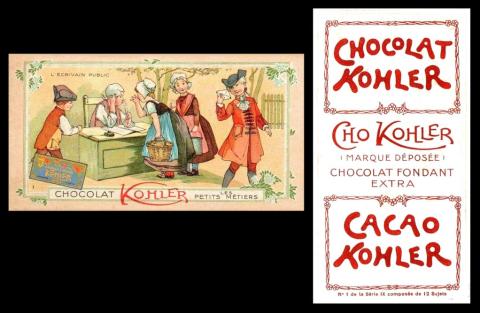
Our card shows a man at a desk outside in a courtyard, and he is called "L`Ecrivain Public" - or the public writer. At one time he was a valued member of village life, and sometimes court life too, for he wrote letters and documents for those who did not know how to write or wanted to make a good impression on to whom they were sending the letters. And he would travel around and perform this service, often free of charge. The job was not too hard, but needed tact and sympathy and also trust, that what you told him would be accurately conveyed and not used against you.
The earliest mention of public scribes comes from Ancient Egypt, but we know that most civilisations had them. In Europe and England they were often the link between the church or government and the people in the street, broadcasting religion to the masses and proclamations and new rules to those who needed to obey them. However many of these could well have had learning difficulties, we will never know.
For some reason there were more public scribes in France than anywhere else, which is why our card is especially apt, and many of them remain well known today. Several even grew wealthy, or found employment with a family rather than having to tour the streets. However the French Revolution seems to have swept many of them away, when learning was seen as a mark of the rich, for the man of the street lived by his wits alone. We can thank Napoleon for realising that his words would go further if everyone had the power to understand them.
What saw another demise was the rise of schooling in basic subjects, reading, writing and arithmetic. For whilst there were many farm labourers etc who never went to school, they likewise only mixed with their own people, few of whom could read. But in towns it was soon the case that most people could read, at least the basics, and pass things on by way of mouth. The exception to this was women, for in many cases they were not taught other than just enough skills to cope with being a servant or a wife. And indeed there are two women on this card.
The strange inclusion is the man with his letter, for he looks well dressed and old enough to have been able to read well enough to write. And one of the women is definitely making cow eyes at him, thinking he may be quite a catch. So why does he need the service of a public writer? Well maybe he is applying for a job above his station? Perhaps he wanted the sort of letter which would win a young girl`s heart? However it is the way he looks at the letter which makes it unusual, as if he does not really know what it says even as far as the address. So was he, instead, a farmer, drafted into the military for no more than brute strength and cannon fodder, but given a fine uniform and a ruffle at his neck....?
Again, we will never know. But oh the stories we could weave, on a dark and rainy night, with nothing better to do........
This is a different sort of card for Kohler than the thin paper ones they are usually associated with, and it is marked as series nine.
We know that the company was founded by Charles Amedee-Kohler and Frederic Kohler, who were general food traders, like their father, in Lausanne, Switzerland. The foray into chocolate seems to have been a bit of a whim, when they bought an old sawmill at Sauvebelin. which was powered by the waters of the Flon river, and realised that they could use the same power to make chocolate.
Their claim to fame is producing the first chocolate bar to have another flavouring or content - namely hazelnut - in 1830.
In 1865, Charles-Amedee Kohler gave the company to his sons Charles-Amedee II and Adolphe Kohler - and in turn they gave it to their sons, Amedee-Louis and Jean-Jacques Kohler. You can see from that how easy it is to get confused!
These two grandsons were good at business, and under them the company prospered, building a brand new factory in Echandens. In 1904 they agreed to go into business as a partnership with Chocolat Peter, and the company was renamed Peter, Kohler. Then in 1911 they merged with another chocolate maker, Alexandre Cailler. Now this is interesting because the new company was called Peter, Cailler, Kohler, and that suggests that perhaps Peter did buy out Kohler, because Cailler is put in front of their name, and if Peter and Kohler had been running the combined company Cailler would have gone last.
Anyway in 1929 Nestle came along and bought the company.
The cards in this set show a number of professions, but it is rather intriguimgly called "Les Petits Metiers", which means little jobs. It is not known whether that refers to the jobs being seen as less worthy, or whether they are being done by children, but some of the "children" are rather grown up - though translating the titles seems to suggest these are lower class jobs, so maybe it is the first after all. And the inclusion of the "pickpockets" seems very odd indeed.
They show :
- L`Ecrivain Public (publiuc writer)
- Le Marchand de Mort aux Rats (rat killer)
- Le Marchand d`Eau (water seller)
- Carreleur de Souliers (shoe mender)
- Marchand de Mouron (chickweed seller)
- Colleur d`Affiches (poster putter-upper)
- Le Remouleur (grinder)
- Le Vitrier (glazier)
- Les Pickpockets (pickpockets)
- Le Rebouteaux (dentist)
- Marchande de Plaisirs (seller of wafers, I think)
- Marchand de Volailles (poultry seller)