
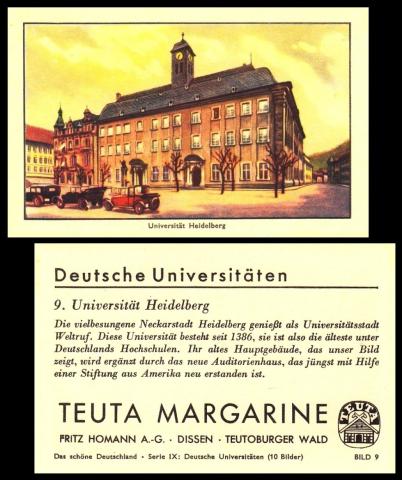
Now you may be wondering who first diagnosed "learning difficulties", and for that we must go to the place on our card, Heidelberg, in Germany to meet a physician, called Carl Phillip Adolf Konrad Kussmaul, who first coined the term "wortblindheit" or, translated to English, "word blindness".
Adolph Kussmaul was born on the 22nd of February, 1822, the son of a German Army Surgeon. He was educated at Heidelberg University, studying medicine, and was subsequently Professor of Medicine not only there but at Erlangen, Freiburg im Greisgau, and Strasbourg, where, in 1877, he made the discovery that although after strokes or other brain injuries, people could be rendered unable to understand written words or speak them, the condition also existed in people who had not had such life changing events.
He also discovered and named a curious condition called Selective Mutism, where, in a severe case of shock or trauma, the person seems to forget the power of speech, a phenomenon that sometimes returns when they are forced to revisit the incident or re-see the person who caused the trauma in the first place.
In 1843 he was given a posting with Maximilian Joseph von Chedus, at the Heidelberg eye clinic, a renowned specialist just entering his fiftieth year of age. Two years later our man received a gold medal for his dissertation, called "Die Farbenerscheinungen im Grunde des menschlichen Auges" - or the color phenomena in the fundus of the human eye. In 1850 he would make the predecessor of the modern opthalmoscope, using similar principles to Galileo`s telescope, but rather than looking outwards into space he reversed the lenses and used it for looking inwards and magnifying the further end. However he never made it work, and we now know that is because he simply had the light source in the wrong place, it needed to be in the middle of the tube, between the observer and the eye of the observed.
In 1848 he became a military surgeon and at the time of the war against Denmark was chief physician, something which enabled him to set up a private practise in the Black Forest after the war. However his fame preceded him and he was offered several jobs as MDs or Professor of Medicine, one after the other, until he retired in 1886, and was granted the title of Professor Emeritus at Strasbourg. He was also made an honorary citizen of Heidelberg, where he died, on May the 28th, 1902
As for our cards, they are often listed in dealer catalogues as "Deutsche Universitat Serie IX" but that`s not actually true, for it is not a ninth series of German Universities, if you read the whole text it says these are Serie IX of a set called "Das Schone Deutschland", which was complete in two hundred cards, or twenty sub series like ours, each of ten cards.
The ten cards in serie IX show the following universities -
- Universitat Konigsberg
- Universitat Berlin
- Universitat Leipzig
- Universitat Jena
- Universitat Marburg
- Universitat Bonn
- Universitat Frankfurt am Main
- Universitat Erlangen
- Universitat Heidelberg
- Universitat Munchen
We also know all the other sub sets, namely
| I | - Deutsche Landschaften [;andscapes] |
| II | - Deutsche Flusse [rivers] |
| III | - Deutsche Bergen [mountains] |
| IV | - Deutsche Seen [seas] |
| V | - Deutsche Inseln [islands] |
| VI | - Deutsche Hafen [harbours] |
| VII | - Deutsche Rathauser [town halls] |
| VIII | - Deutsche Burgerbauten [mines] |
| IX | - Deutsche Universitan [universities] |
| X | - Deutsche Burgen [castles in towns] |
| XI | - Deutsche Wasserburgen [castles on rivers] |
| XII | - Deutsche Schlosser [more castles] |
| XIII | - Deutsche Kirchen [churches] |
| XIV | - Deutsche Kloster [,pmonasteries] |
| XV | - Deutsche Bader [baths/spas] |
| XVI | - Deutsche Jugendherbergen [youth hostels] |
| XVII | - Deutsche Stadttore [city gates] |
| XVIII | - Deutsche Denkmaler [monuments] |
| XIX | - Deutsche Brunnen [fountains] |
| XX | - Deutsche Brucken [bridges] |
I`m not so sure about the three castles, because there are river castles in the first set, and not all the second are in the mountains, whilst the third is a complete mixture. But maybe someone can please enlighten me as to the true definitions of the words Burgen, Wasserburgen, and Schlosser....