
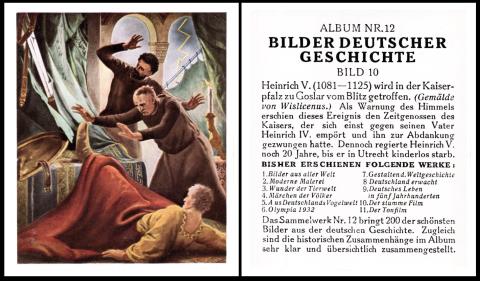
This is believed to be the only card of a person just after they have been struck by lightning - and not just a person, but a King, for this was Henry the Fifth, the King of Germany from 1099 to 1125 and the Holy Roman Emperor from 1111 to 1125.
In case you are wondering, he did survive, and remained King for another twenty years, but died childless.
Research has shown that no British King or Queen have ever been struck by lightning, though whilst another Henry, the British King Henry IV, was trying to quell a rebellion in Wales his tent was struck by lightning, whilst he was asleep in it, and destroyed, but he woke up and managed to get out. Though the Welsh rebels claimed that they had cast a spell on the tent, and forced it into flames. Other world leaders were not so lucky and the Roman Emperor Carus died when his tent was struck by lightning in 283 A.D., though there are suspicions that his enemies killed him and the lightning was a way of concealing the truth.
The event in this card took place at The Imperial Palace of Goslar, in central Germany. You can see the lightning, forking through the sky in the right hand window. But as for what actually happened, who knows, because putting this event in a range of search engines only brings up people offering to sell this image, and mostly taken from our card. The text on the back was a bit more helpful as it translates to "Henry V (1081-1125) was struck by lightning in the Kaiser`s Palace at Goslar. (painting by Wislicenus). This event appeared to the contemporaries of the emperor as a warning from heaven, as he had once rebelled against his father, Henry IV, and forced him to abdicate.Nevertheless, Henry V reigned for another 20 years until he died childless in Utrecht."
Knowing the artist was a bit more helpful, but not much, for it is indeed by Hermann Wislicenus, who was born in Eisenach on the 20th of September 1825, and who painted several murals in the Imperial Palace of Goslar, of which this must be one. In fact he won a competition in 1877 with the prize being being able to supply the art for the newly restored Palace of Goslar, after which he completed sixty eight frescoes tracing the history of the German Empire from Charlemagne to the present day. That took him and a succession of students some twenty years, and he died shortly after in 1899.
This card creates another puzzle for the unwary, for all that is on it by way of an issuer is "Cigaretten-Bilderdienst", and that means . Now if you look that up in our original World Tobacco Issues Index all you will find is "CIGARETTEN-BILDERDIENST, Dresden or Berlin - see under name of firm, or under brand name if brand only quoted". That`s no help to us, because our card has neither a name of firm nor a brand, but my first point of call was Reemstma, simply because they used the same system as on our card of a top line saying either "Album Nr." or "Sammelwerk Nr." followed, in both cases, by a number. And going down the Reemstma listing in that same book brings us to :
- ALBUM Nr. 12 or SAMMELWERK Nr. 12 : BILDER DEUTSCHER GESCHICHTE (Pictures from German History). Size 70 x 84. Nd. (200). Anonymous ... R16-18
A. "Album Nr. 12"
B. "Sammelwerk Nr. 12"
And this is identically described in our updated World Tobacco Issues Index, save a new card code, of R189-500
By the way, the words "Cigaretten-Bilderdienst" actually translate to "cigarette picture service", and Germany had a rather unique way of issuing cigarette cards, because the packets contained coupons, not cards, and you got the cards in exchange for the coupons, which were mailed up when you had the required amount, presumably given on the packets, to an address, presumably given on the packets - as neither of those facts appear on our card.