
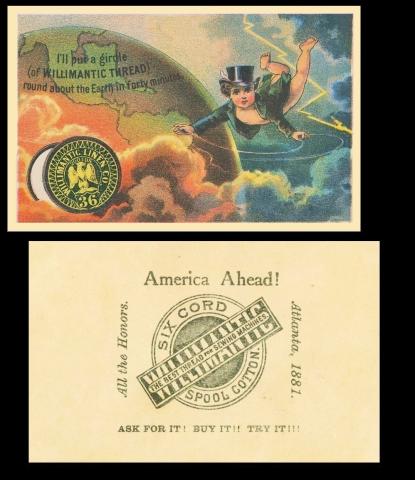
The lightning here is used to suggest speed, because the cherub, very nattily attired in his top hat and tails, is promising to "...put a girdle (of Willimantic Thread) round about the Earth in forty minutes." It seems to be referring to the fact that sewing with that particular thread was faster than the rest, which, to the consumer, would suggest that it was free of knots and seldom broke, and so it would speed up the sewing.
The first curiosity about this card is that the only clue to an issuer is "Willimantic Thread". But it turns out to be much more intriguing than that.
It all begins in 1854 when the Willimantic Linen Company was founded by Austin Dunham and Lawson Ives, to produce linen cloth. However, it soon decided to abandon that and make sewing thread instead. By the 1880s, it had built four large mills, fitted them with electric light, and had a workforce of over a thousand people, who lived in a factory town on site in which their every need was met.
Now this card mentions "Atlanta 1881" on the reverse. That refers to the International Cotton Exposition, in Atlanta, which was held from October the 4th to December the 31st, 1881.
The thread was sold on its quality, and its strength. It also proudly boasted that it was an All American company, using All American materials and labour. And by 1890, most of the cotton sewing machine thread made in America was made by Willimantic.
However, in 1899, Wilimantic Linen came under the steely gaze of what was ostensibly another American company, with the patriotic name of The American Thread Company - but in fact it had been founded by J. & P. Coats of Paisley, who had its eyes on expanding into the American market. However they were canny, and did it in such a way as to avoid the usual tariffs levied on British companies and imports, namely by buying up local American businesses. And though the Willimantic Linen Company tried their best to fight off the challenge they had no choice in the end but to submit, not to Coats but to Dewhurst, which soon turned out to be linked to Coats after all.
At first things went smoothly, and most of the staff was allowed to stay on, but by 1912 there were uprisings, and a strike over wage cuts and higher prices in the factory town stores. The workers actually won that time, and it almost certainly led to an ant-trust suit which ended up awarding the Willimantic plant to an American company from New York.