
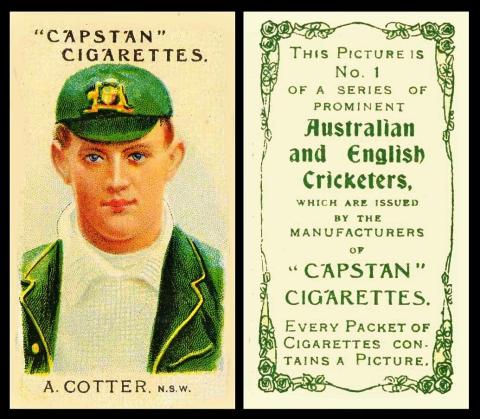
Here we have the first part of a two part set, the other will come along tomorrow, and the front will already be visible when this can be read.
But let`s start with our man, billed as "A. Cotter, N.S.W." whose story turns out to be a fascinating, and poignant, one, of a life cut short.
His name was Albert "Tibby" (or, in some references "Tibbie") Cotter, and he was born on the 3rd of December 1883. His skill at cricket was first spotted at school in Sydney, so much so that by the age of eighteen he had already been signed up to play for his county, New South Wales. Two years later, he was on the international field, bowling for Australia, a team he continued to play with for nine years and twenty-one tests. He was not always popular, and in 1905 his delivery to, of all people, Dr. W. G. Grace, is often claimed to have been the origination of the idea of aiming straight at the opponent that was later developed into the infamous practise of "Bodyline" bowling.
In April 1915 he enlisted in the Australian Imperial Forces - perhaps through seeing a particularly rousing poster and believing it was his duty, or perhaps because someone pressured him into it, as we know that once he had joined there was a lot of rousing propaganda about how a leading sportsman like him had joined up. He was sent to the 1st Australian Light Horse Regiment, and he joined them at Gallipoli, arriving near the end of the campaign and finding that much of their war was being spent as foot soldiers, dug in to trenches, though there were a few mounted charges, most notably the one from Pope`s Hill on August the 7th 1915.
Later he moved to the 12th Australian Light Horse Regiment, which also served at Gallipoli, and was at the second Battle of Gaza, on the 17th-19th April, 1917. At the end of October of that year there was another charge, at the Battle of Beersheba, on the 31st of October. Then there is confusion, as there probably was in real life, and not just to our story, because it is recorded that as the troops dismounted he was shot at close range by a Turkish soldier, whilst other reports say that he was attending the men, as a stretcher bearer, and shot mistakenly. Further research proves that he was actually supposed to be serving as a stretcher bearer, but managed to convince another man to change places, fearing that it could the last "charge" of the war. And, unfortunately for him, it was just that.
His body was brought back to Australia and buried at Waverley Cemetery in what seems to be a family plot. It is also a sad one, for the headstone, which is an extraordinarily long one, has three stone books each apparently pinned up as flat and open, and the first of these reveal that his brother, John, was also killed in action in on the 4th of October 1917, whilst serving in France, (though research proves it was actually in Belgium that he died), and two other people, an Arthur Dale, married to our man`s sister who was "killed accidentally" on the 30th of May 1921, and an L.S.O. Edwin Cotter who was also "killed accidentally" on the 14th of December 1929. I cannot find the first one of these two at all, and he has no military rank, but the second does have a military rank, which basically means he was either killed in a vehicular crash, a weapons malfunction, or another kind of equipment failure, just not killed on the battlefield, so he cannot be recorded as "killed in action" even though he was still serving his country at the time. One clue may be that rank, as it is L.S.O., or Landing Signal Operator, which today means the people who guide the aeroplanes back on to the deck of an aircraft carrier from the ground. Now though Australia’s first dedicated aircraft carrier was H.M.A.S. Albatross, not commissioned until 1929, the job was the same when aeroplanes came in to land on an airstrip on the ground, and we know that the Australian Flying Corps were in action in the Middle East from 1915 to 1918. So it is not inconceivable that he was struck by an aircraft as it failed to land.
However I have done a bit more research on that, and it seems both were actually killed in different railway incidents, Arthur Dale being run over by a train almost halfway between two stations, and being discovered "frightfully mutilated", and L.S.O. Edwin Cotter "falling from a train" en route to Sydney.
The next book records his father and mother, who seem to have had more peaceable ends, dying at the ages of 83 and 84 respectively, and the last book is for another brother, William Henry, his wife, and their daughter.
I`m glad this was a Card of the Day, it is already way too long for a diary date description, and now we have the card chat...!
This set first appears in part three of our original Wills reference booklets, as part of a cricketers group listing, described as :
- 59. CRICKETERS - Australian Issue
H. 50 Prominent AUSTRALIAN AND ENGLISH CRICKETERS. Size 67 x 35 m/m. Numbered on backs. See Fig. 41.H. Fronts lithographed in colours; backs in green, thick board.
In the original World Tobacco Issues Index the set is still listed under the large group of "Cricketer Series", but the entry is slightly different. That reads :
- CRICKETER SERIES (A). Sm. ... W62-221
4. 1907-1908 issues. Titled "Prominent Australian and English Cricketers". "Capstan" brand issues. See W/59 H and I.
(i) - Nos. 1/50. Size 66 - 67 x 35
(ii) - Nos.51/73. Size 63-64 x 36
A. Fronts with letterpress in grey. Nos. 51/73
B. Fronts with letterpress in reddish-brown. Nos. 66/73, same subjects as A, different portraits and numbers
The only difference to the above in our updated World Tobacco Issues Index is that the final word is changed to "numbering" - and, of course, there is a new card code, for the group, of W675-347