
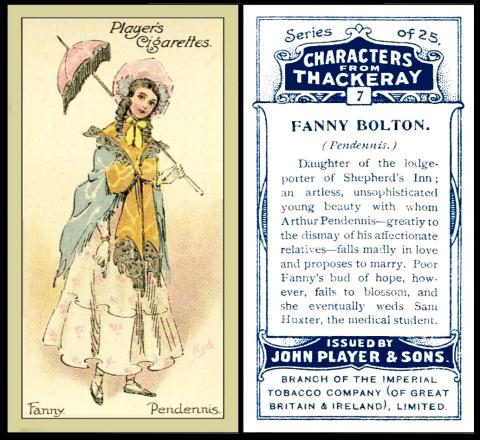
here we have gentle but naive Fanny Bolton, the daughter of the proprietor of the Shepherd's Lane Inn. She meets Arthur “Pen” Pendennis, quite by chance, and the two begin a slow dalliance, despite the fact that he is somewhat above her station. However we know that he is kind and gentle too, and the two would probably have become amazing friends, if never lovers. He has "lived a bit" though, having had a bit of a crush on an actress, done pretty awfully at University, moved to London and been seen with all the right people as a "Man About Town", had a little stab at journalism, and found himself becoming a Member of Parliament. Despite this, he seems very attracted to the idea of giving it all up and going with Miss Bolton, until one of his friends puts him off her, and maybe even dobs them in to his beloved mother. And so what could have been the perfect coupling is lost - he goes on to marry his adopted sister, which was great for her as she always fancied him a bit, whilst Fanny marries a Mr. Huxter, who calls himself a surgeon but is only a medical assistant. Later, however, there is revealed to be a bit of a twist, for the friend who spilt the beans was none other than this Mr. Huxter, whose coarse and boorish ways had long ago alienated him from his former friendship with Arthur Pendennis - and we are left to wonder if the revealing of the relationship to the mother was not a deliberate ploy to gain the hand of fair Fanny.
This set follows on from the two small sized sets of "Characters from Dickens", these being a First Series, issued in March 1912, a Second Series issued in October 1912, and ten extra large cards, which were originally issued in June 1914, and which we have yet to feature on our website. They did not just follow in in as much as being characters from literature, either, for they are also in exactly the same format of design, and all were from drawings by "Kyd" (J. Clayton Clarke).
Now “Kyd”, was but a monogram, and a pseudonymous one at that, for it hid an artist called J. Clayton Clarke. And, thrillingly, he has another cartophilic claim to fame too, for he illustrated the set of "Votaries of the Weed" for Gallaher. But you can read more about him with the Card of the Day for the First Series, of the Dickens set, so as not to slow this one down any further.
Our set is first described in our original reference book RB.17, issued in 1950, and devoted to the issues of John Player. There it is entered as :
- 49 25 CHARACTERS FROM THACKERAY. Small cards drawn by "Kyd" (J. Clayton Clarke). Fronts in colour. Backs in grey, with descriptive text. Home issue, July 1913.
That is much shortened in our original World Tobacco Issues Index, to simply
- CHARACTERS FROM THACKERAY. Sm Nd. (25) ... P72-26
And this text is carried over identically to our updated World Tobacco Issues Index, with only a new card code
- CHARACTERS FROM THACKERAY. Sm Nd. (25) ... P644-062
Strangely this set had no second series, and was never reprinted by John Player, not even when the Dickens sets (with which it is uniform) were, in 1923.
The characters and their books are as follows :
- Lady Southdown - Vanity Fair
- Lord Gules - Book of Snobs
- Harry Esmond - Esmond
- Cocksure - Book of Snobs
- Fred Bayham - The Newcomes
- Tom Tusher - Esmond
- Fanny Pendennis [reverse says "Fanny Bolton (Pendennis)"
- Lady Castlewood - Esmond
- Dr. Portman - Pendennis
- The Marquis of Steyne - Vanity Fair
- Jos Sedley - Vanity Fair
- Barnes Newcome - The Newcomes
- Becky Sharp - Vanity Fair
- Major Pendennis - Pendennis
- Dobbin - Vanity Fair
- Mr. Moss - The Newcomes
- Capt. Costigan - The Newcomes
- Ensign MacShane - Catherine
- Mr. Goldmore - Book of Snobs
- The O`Dowd - Book of Snobs
- Mr. Gandish - The Newcomes
- Rawdon Crawley - Vanity Fair
- Col. Newcome - The Newcomes
- C, J. Yellowplush - The Yellowplush Papers
- Hon. Mr. Deuceace - The Yellowplush Papers
Just like the Players sets of Dickens Characters, this seems to follow no rhyme nor reason, and simply adds characters when they think of them, rather than keeping the books from one character following on in a small group together.
As for why this set was issued, researchers seem to feel it may have been to tie in with a book, "In Thackeray`s London", by Francis Hopkinson Smith, the first edition of which was published in the same year 1913. I am not so sure, as that book was American, published by Doubleday, and it is a rather small tome, bound in grey cloth. Francis Hopkinson Smith was also American, an author and an artist, both of which are combined to good effect in the book - but he was also an engineer, and it was he who built the foundation for the Statue of Liberty.