
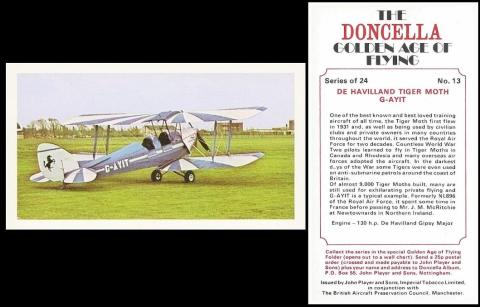
Here we have a different form of "moth", a de Havilland "Tiger Moth".
Mr. Geoffrey de Havilland named a lot of his aeroplanes after moths, and other insects, and with good reasons - firstly he was a very keen entomologist, and secondly, he knew that though the butterfly wins the beauty contests, the moth is resilient and built for strength, as long as many other qualities that are to be valued in the construction of aeroplanes.
This is not the original "Tiger Moth", that was coded DH.71. It was a single seater, and it was a test piece, built in 1927, to research the possibilities of high-speed aviation, and also as a trialling aircraft for a new engine to replace one called the "Cirrus", which was built out of surplus parts acquired through a company called the Aircraft Disposal Company,. Now the A.D.C. were a British company, set up to make money and also dispose of aeroplanes left over from the First World War, some of which were flyable, but most of which were parts, and a lot of those being parts removed from otherwise damaged aircraft.
Only two DH.71s were ever built, and both were entered for the 1927 King`s Cup race, however one had to scratch beforehand, and the other retired mid race. However the one that was withdrawn went on to set the speed record for Class three light aircraft the same year (at 186.47 m.p.h.) and it was also flown successfully to almost break the altitude record, but "only" made it to 19,191 feet. Sadly neither of these aeroplanes survive - the record breaker was exported to Australia where it crashed during practise for a race, with the loss of the pilot, and the other one was destroyed during an air raid on the deHavilland factory at Hatfield in 1940, which killed twenty-one people and injured seventy others. .
Our aeroplane was a DH.82, which were first flown in October 1931, and were one of the primary training craft for the Royal Air Force, plus air forces of other countries too, though during the Second World War it was pressed into service in many ways, even as light bombers. And it remained in the Royal Air Force until the early 1950s. Today it remains popular with the military and civilian fliers, especially with flying schools, who were the top buyer when military need ceased.
Our craft seems to have been built in 1941, and served with the Royal Air Force, and then was re-numbered and privately sold. The card identifies that buyer as John McRitchie, but he actually bought it a Derek Wilcox who was the original post Air-Force buyer, in August 1970. Mr. McRitchie bought it in the same year, though by the time of this card he had sold it on, to a Robin Alexander, who owned it from May 1974 right until 1989, when it shows up as an asset of the Ulster Tiger Group. It remained with them until 2011, and then was bought by a Ninian Stewart-Richardson. At time of typing it looks like he sold it on, and it is now in South America, but it is reportedly still flying.
This set is too late for our original World Tobacco Issues Index part one, but they do appear in part four - and I keep telling myself that maybe when I have added all of the cards in all of the newsletters to the card index and gallery my present for the effort might just be parts two, three, and four of that work, even though I have absolutely nowhere to put them.
It is described in our updated World Tobacco Issues Index, though, as :
- THE DONCELLA GOLDEN AGE OF FLYING. Nd. (24) and unnumbered Set Completion Offer card, offer expiring
(a) 31st December 1978
(b) 31st December 1979
This was not, as generally supposed, the first John Player set since 1939, for there was a raft of unissued sets, and also an actual set, of five cards, known as "The Jubilee Issue" and released in 1960.
It was not even the first `Doncella` branded set, that honour going to the 1975 set, "The Golden Age of Motoring". That was followed by "The Golden Age of Steam" in 1976, and then in 1977 came our set. And it was followed by "The Golden Age of Sail" in 1978, which makes it rather curious that the set completion offer for our set was reprinted in the same year.
Now this set was also issued, in 1979 by Sharman Newspapers, still as "Golden Age of Flying" - and they also issued the "Motoring" and the "Steam" set . They are listed in our original British Trade Index, and that also gives the cross references to the Player`s set, which is how I know the reference book code above. So that reads, for our set, as "Golden Age of Flying. 89 x 50. Nd. (24). As Player Set P72-265-3 in World Index IV ... SGS-1"