
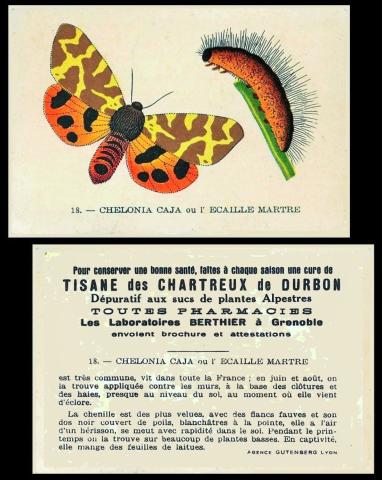
This fine creature is an actual Tiger Moth and you can see why it was so named, though that is not its latin name, which is Arctia Caja, and was granted it by Linnaeus in 1758.
Those stripes and patterns are not just for beauty though, they act as a warning, and a safeguard, because this moth`s bodily fluids are poisonous, with sometimes deadly effect on the central nervous systems and brains of any other species daring to defy the heed. Humans, especially small ones, can also be affected with rashes, contact dermatitis, stinging, or even allergic reactions. And it also has an audible warning system for bats and other night hunters.
Strangely every tiger moth has a slightly different stripe and spot design, and the colour of their hairy bodies also vary. But they do look basically the same to the untrained eye. Its caterpillars look much the same as each other, big and furry, hence their nickname of "woolly bears"
They live in America, Asia, Canada and Europe, but prefer the colder areas, so as our temperatures continue to rise, one day it may well desert our shores. Relocation is possible as it has no firm needs it can eat any plants and sup on any form of nectar, and it is also not fussy about where its eggs are laid, though there is an intriguing link with the fact that many of the plants it chooses to deposit those eggs with are poisonous, and we are not yet sure if this is simply for protection, or whether it is a means of getting the poison into their bodily fluids from the time they begin to start to eat. What we do know is that the caterpillars are already toxic to the touch pretty much from the time they emerge.
There are a lot of words on this back and it`s hard to find the maker. The top section translates to "To maintain good health do a course of treatment each season with / Durbon brand Chartreux herbal tea / a purifier made of Alpine plants / [Available at] all pharmacies / [from] the Laboratories of [Monsieur] Berthier of Grenoble."
The bottom part is all about the butterfly or moth.
This is quite an elusive set but we have a small list which we hope to expand, with your help! So far we know of
- Papilio Machaon ou Machaon ou Grande Porte-Queue
- Parnassius Apollo ou Apollon
- Le Bombyx du Pin ou Gastropacha Pini
- Papillon Blanc (Pieris brassicae brassicae)
- Le Grand Mars ou l`Iris Changeant (Apatura Iris)
- L`Oeil de Paon ou Paon du Jpour (Vanessa Io)
- Citron de Provence (Rhodocera Cleopatra)
- Le Sylvandre (Satyrus hermione)
- Sphinx du Tuthymale (Deilephila euphorbiae)
- Vanessa Cardiu ou La Belle Dame
- Sphinx Ligustri ou Sphinx du Troene
- Charaxes Jasius ou vulgairement Jasius
- Saturnia Pyri ou Grand Paon de Nuit
- Amphidasis Betularia ou appele vulgairement La Phalene du Bouleau
- Liparius Monacha, vulgairment la Nonne
- Cestodes Tenia ou Ver a Soie
- Chelonia Caja ou L`Ecaille Martre
- Limenitis Populi ou Grand Sylvain
- Aglia Tau ou la Hachette
- Abraxas Grossulariata ou Zerene du Grosseillier ou Phalene Mouchetee
- Catocala Sponsa ou la Fiancee
- Vanessa Atalante ou L`Amiral
- Vanessa Antiopa ou Morio
- Deilephila Nerii ou le Sphinx de Laurier Rose
- Papilio Podalirus ou le Flambe
- Phalera Bucephala
- Gastropacha Quercifolia ou Feuille Morte
- Argynnis Aglaia ou Le Grand Nacré