
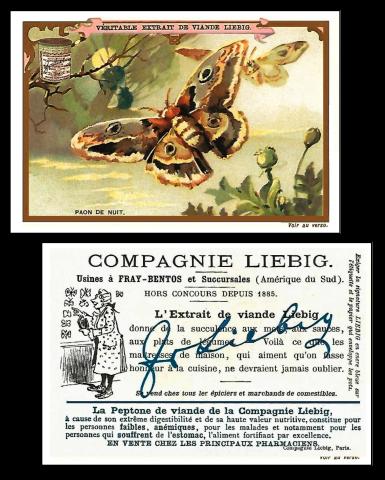
If we look at the presentation pack of the stamps, top left we have the Emperor moth, or Saturnia pavonia. They are easy to spot, and they do fly in the daytime, but only the males, for the females prefer to fly at night - though they are always available, hidden in long grass, should any males pick up their scent and fancy dropping in...
These moths prefer slightly unkempt surroundings, heaths and scrublands, where they can use their colour to blend in all the better. However their caterpillars are green, and often edging towards the lurid end of green-ness.
The reason why we have another French card is because of a curious fact, and that is that in France the Emperor moth is called la Paon du Nuit, or the Peacock of the night. This is not only because they think it resembles the Peacock butterfly of the day, but because in general moths are consided as the butterflies of the night, a much more romantic and pleasing thought, don`t you think, than our tendency to think of the beautiful butterfly and the mediocre moth.
And, as I hope to show you this week, moths can indeed be just as beautiful as butterflies.
This card comes from one of the lesser known Liebig sets. Our example is in French but you can also find it in Italian. There is a difference of opinion between the Fada and the Sanguinetti cataloguing system though, as Fada has "Butterflies of Central Europe" as F.516 and our set as F.517, whilst Sanguinetti has the "Butterflies of Central Europe" s S.518 and our set as S.519. But both agree that both sets were issued in 1897.
The cards in our set are :
- Atlas Blue
French - Polyommate - Atlante
Italian - Multicolore - Atalante
- Brimstone
French - Citron - Pieride
Italian - Citronea - Liride
- Heliconius Doris
French - Eliconia - Doris (Bresil)
Italian - Eliconia - Dorica (Brasile)
- Peacock Butterfly
French - Paon De Jour
Italian - Pavone Diurno - Papilio Hyale
- Peacock Moth
French - Paon De Nuit
Italian - Pavone Nottorno
- Red Admiral
French - Le Vulcain -
Italian - Volcano - Argo