
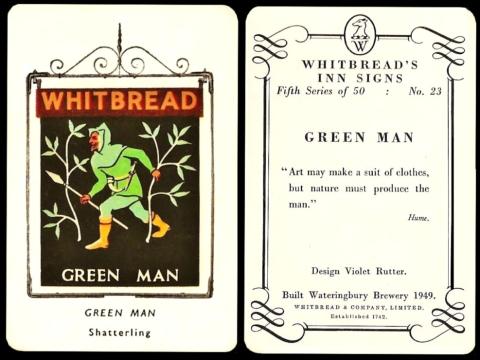
This Green Man seems to owe much to Robin Hood, but the more usual Green Man is just his head, either made from, or encapsulated in, foliage, and in that he symbolises how in springtime nature bursts forth, with unquenchable force, covering all in its path. It means that everything on this earth is not static, it has its time to be born, and its time to die. It is a very popular pagan symbol, and all round the globe, and it is almost exclusively a male, and always just a head, though women`s heads do, very rarely, appear.
There seems to be a link with King Arthur too, or at least to the Green Knight, who both tormented and advised Sir Gawain, both before Sir Gawain decapitated him, and then after he had picked up his head and ridden away, requesting they meet in a year and a day`s time.
Returning to our figure, he appears to be a different type of Green Man, and nothing to do with foliage, but in actual fact he too is usually represented in parades and pageants by a local villager dressed in a costume of leaves and moss, who most often dances at the front of these, clearing the onlookers out of the way, and sometimes demanding money, or forfeits. The latter is reminiscent of the trials that the Green Knight would set Sir Gawain; and research proves that this version of the Green Man is indeed linked to Sir Gawain, as well as to another figure called Jack in the Green, who is lauded in Derbyshire on May Day, being covered in foliage and flowers and led through the streets on a horse. Sometimes Jack in the Green also has a lady friend, who traditionally was a man in woman`s clothing. And at the end of the ceremony, the wreath about his head is removed, and pushed down on a pinnacle of the Church tower, in an act which is also said to symbolise the beheading of that Green Knight, by Sir Gawain.
As for the Green Man in Shatterling, near Ashford in Kent, it started out as a farm, in 1728, owned by Lt. Colonel Christopher Kien, who also lived at Kensington Palace in London. He then leased it to a local farmer, and in 1744, when he died, the lease was passed to his widow, and she seems to have allowed the farmer to stay on, not just that, but was gracious enough, on his death, to allow it to the widow. By that time though, one of the outbuildings was being used as an ale house, with all the correct legal papers, and had been since 1740, though there was possibly a bit of double dealing going on for the ale house was listed as being in the parish of Staple, rather than at Shatterling.
It seems to have stayed with several generations of the same farmer`s family too, even after widow Kien had prepared for her death by leasing it to a Samuel Joynes, then by leaving it to the Coussemaker family who seem no relation, but in 1788 it is recorded as being left to a George Kien Hayward Cousemaker, so there must be some link to the Kien family.
At some time after that date there was some trouble with the ale house, and it was closed. In fact it was more than closed, because a codicil was reportedly added to the deeds stating stating that it could never be an ale house again. However in 1820 this was challenged, by a Filmer Larkins, and though he was not allowed to open the former ale house in the outbuildings, he was allowed to convert the house into one. We also have rather enlightening details, suggesting that the trouble was not revellers as I was thinking, for in the license it states that the ales sold could not be adulterated, or sold from pots of illegal measure. Only then does it go on to stress that there could be no gaming, nor drunkenness, and that known thieves could not be served. The premises at that time were owned by the daughter of George Kien Hayward Cousemaker, and she supported the application for a full license in 1826, after the trial period was over. However she sold it in 1841, to a John Dadds of Wingham, and he sold it, pretty much straight away, to a George Collard, from Staple, who was a licensed victualler.
Whitbread came along in 1955, which is the year this set was issued, and the "Green Man" was amongst several public houses which they gained on taking over a company called Combined Brewery Holdings. And they kept it until 1972, when they sold it on as a Free House. In 1996 it was renamed to "The Frog and Orange". That was auctioned in 2021, and it seems likely the premises will be demolished and the land used for housing. But it seems that this was later changed to only two houses not the several which were originally imagined, and nothing yet has begun.
As for our card, it is from the fifth set in a group of cards which we discuss fully with our Card of the Day for the 1st of April, 2025 (but not for long as it is getting ready to move!).
This fifth series (and also the fourth) differs from the first few in they chooses not to display the name of the county. And there is another difference too, for the fourth and fifth were only available on card, not on aluminium. And this fifth series was the last one in this group, until the "Special Issue of Four" in 1951, which you can read about in our newsletter of the 12th of July 2025.
In our original British Trade Index part II, these six, and the one off card of "The Britannia Inn" are catalogued together. The entry for our set reads
WHITBREAD & CO. Ltd.
Brewers. Issued 1950-1958.
- INN SIGNS. Md. 76 x 51 ... WHI-1
5. Fifth Series. Nd. (50). On board
By the time of our updated British Trade Index, our set is listed as :
WHITBREAD & CO. Ltd.
Brewers. Issued 1950-1974. All 76 x 50.
- WHITBREAD`S INN SIGNS. Fifth Series. 1955. Nd. (50). ... WHI-190
As far as the inns which had their signs immortalised, they were as follows :
- ADMIRAL HARVEY Ramsgate
- ARMY & NAVY Rainham
- BAILIFF`S SERGEANT Dymchurch
- THE BELL Hythe
- BRENT`S TAVERN Faversham
- THE BRICKMAKERS Deal
- BRITANNIA Milton Regis
- THE BULL INN Sissinghurst
- BURNT OAK Gillingham
- CARDINAL`S ERROR Tonbridge
- CARPENTERS` ARMS Canterbury
- CECIL ARMS Strood
- THE CHEQUERS Biddenden
- THE CHEQUERS High Halden
- CLARENDON INN Sandgate
- CLOTHWORKERS` ARMS Sutton Valence
- DENMARK ARMS Rochester
- DUCHESS OF KENT Dover
- DUKE OF CUMBERLAND Barham
- FALSTAFF TAP Canterbury
- THE GEORGE Folkestone
- THE GRAPES Milton Regis
- GREEN MAN Shatterling
- THE HARP Tunbridge Wells
- HOP POLES Canterbury
- KING`S HEAD Hythe
- MAN OF KENT Crundale
- NAG`S HEAD St. Leonard`s-on-Sea
- NELSON`S HEAD Hythe
- NEWCASTLE INN Ewell Minnis
- OLD GOLDEN CROSS Hastings
- PIER HOTEL Herne Bay
- RAILWAY HOTEL Gillingham
- RED LION Stodmarsh
- ROYAL DRAGOON Canterbury
- ROYAL OAK Bonnington
- ROYAL OAK Iden Green
- SHIP CENTURION Whitstable
- SHIP HOTEL New Romney
- SHREW BESHREWED Hersden
- SPREAD EAGLE Chatham
- TRAFALGAR MAID Chatham
- TRUE BRITON Folkestone
- WHITE HORSE Tonbridge
- THE WINDMILL Cranbrook
- WOODLAND TAVERN Gillingham
- THE WOODMAN East Malling
- THE WOOLPACK Goudhurst
- THE YORK Chatham
- YPRES CASTLE Rye