
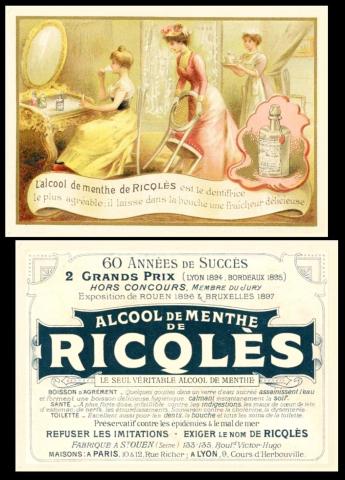
RICQLES [trade ; medicinal drink : O/S - Lyon France] "Advertising Card - The Beauty Parlour" (1897/98) Un/??
And we close our week, a little later than planned, with our cosmetic creativity, or #NationalBeauticiansDay.
There are many forms of beauty, both male and female, but often it is artificially enhanced by these clever cosmetologists, heavenly hairdressers, marvels of make up. magnificent manicurists, perfect pedicurists, and supreme stylists.
We can go it alone, and even go without, but so long as you are not trying to be someone you are not, there is nothing wrong with seeking advice as to how to show our true selves off for the better, and to protect the health of our skin, nails, and hair.
As far as the story of beauty, we have to go right back to Ancient Egypt, where the earliest cosmetics were made. Amazingly these included kohl, not just to highlight the natural beauty of the eyes, but to protect them from the glare of the sun. They were not so sensible in other ways though, and a sun tan was just as highly prized as it grew to be in the 1920s and 30s. This was swept away by the Greeks and Romans, who believed that having sun tans was a sign that you laboured all day in the fields, and tried to have the palest skin of all. This continued through the Middle Ages, and reached its peak in the Elizabethan era, where people, including Queen Elizabeth I, would paint their faces with white lead and mercury to get themselves, dare I say, beyond the pale.
Up to the twentieth century, and before women joined the work force, most people were either rich enough to have a lady`s maid to attend to their beauty needs, or they cut their own hair and didn`t bother with any other forms of beauty. But when women went to work, they learned the art of comparison, and enhancement, and the beauty salon, for all, was born. Some employers even had salons at the factories. Another change came with the beginning of motion pictures, leading to a rush of women demanding to have their hair cut like their favourite leading lady.
One man bridged the gap between the movies and the woman in the street, and that was Max Factor. He was born in Russia in 1877 and moved to America in 1914, at just the right time to become involved with the film industry. He realised that there was a call for home made glamour, and so along with developing his own products to enhance the glamour of the stars he started selling the same products to the general public. His first lines were eye shadow and eyebrow pencils, both launched in 1916. Then in 1920 he added several other products, and sold them as "make-up", a phrase he invented himself. And though he won an honorary Academy Award in 1929 h was adamant that his best work was making everyday people look more beautiful.
This card has two clues as to its date. The first is at the top of the reverse, where it reads "60 Annees de Succes" - or sixty years of success. Now we know that Heyman de Ricqles founded his company, in Lyon, in 1838, which makes sixty years after that 1898. Then the wording on the reverse goes on to speak of its successes - "2 Grands Prix (Lyon 1894, Bordeaux 1895. Hors Concours, Membre du Jury Exposition de Rouen 1896 & Bruxelles 1897". No other dates appear, but we know that the Brussels International Exposition was held from the tenth of May to the 8th of November 1897, so it seems likely that towards the end of that run these cards were issued, and perhaps even in time to give some away at the event.