
Now this week sees a subtle shift in the newsletter, but all will not be revealed yet. Suffice to say there is a very good reason for the disappearance of our banner photo headings, and you must watch this space to read why.
Well we are getting back into the swing of things now, with lots of chances to meet up, carefully of course, at our events, and the Annual Convention draws ever closer. Dont forget that members can rent a table at this to sell their surplus cards, you dont have to be a full time professional dealer. Do enquire if you are interested. And do tell us if you are stalling out, we will happily feature your stock and story on this website.
And so to events a little nearer to hand..... starting with
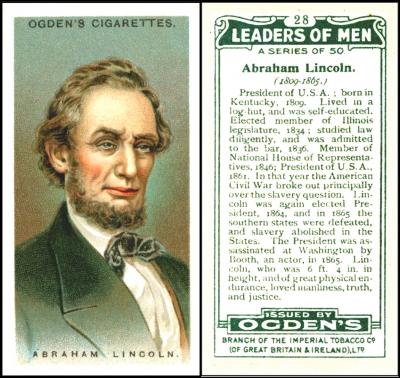
Today in 1809 Abraham Lincoln was born in the American state of Kentucky. The Trading Card Database tells us there are almost four hundred cards of him, most of these are American and the site includes some really great early cards.
We did not issue so many over here, but Carreras “Famous Men” (1927) 7/25 has a long biography, which manages to fit in pretty much all the important events of his life, his hatred of slavery, his study of the law and entry into politics, the fact that he became the sixteenth President of the United States in 1860 and his efforts to abolish slavery.
Another useful card is Ogdens “Leaders of Men” (O/108 - 1924) 28/50, which starts by telling us he “Lived in a log-hut and was self educated.” That has more details of his law studies and achievements, and traces him right up to his becoming President in 1861. This set was also issued, overseas only, in September 1925, by John Player. And you can see the log hut on Millhoff "Men of Genius" (1924) 7/50

It is strange, but true, that his fight to prevent slavery was the main cause of the American Civil War which started in the year of his election. (You may be saying OMG right now, seeing me mention this, but don’t worry I will keep telling myself to keep it really short) He was re-elected during that war, in 1864 and a year later saw the Southern States fall, signalling the start of the end of slavery. Oh that it were that easy, because enslavement is still a way of life for many worldwide.
Unfortunately, this also led directly to Lincoln’s death, on April 15th, 1865, by gunfire, in a theatre, during a play, along with the wounding of the Secretary of State, but he survived whilst Lincoln died the next morning.
The Carreras card actually says that Lincoln “met a martyr`s death at the hands of Wilkes Booth, an actor, in Washington”. Well, that is partially correct, but John Wilkes Booth was not just an actor, though he came from a long line of theatrical personalilties, he was also a big Confederate sympathizer, frequently attending rallies and standing up and heckling President Lincoln, and the recent surrender of Robert E. Lee to the Union Army was almost certainly on his mind when he packed the pistol. I have always wondered why he was not picked up sooner at Ford`s Theatre, because he was well known to be trouble, and to allow him up towards the place where the President and staff were seated like sitting ducks with no means of escape seems like someone on the Presidential staff may have been a sympathiser too.
The original plan seems to have been for a gang of about ten men to kidnap the President and murder him, then return for the Vice President, so restarting the Civil War. However this was doomed, and John Wilkes Booth died a less than heroic death, going on the run and being shot whilst hiding in a barn, his hurried hideout. He was also shot by a Union soldier, just to make it worse.
The Ogdens card is one of the few to give vital statistics, that “Lincoln, was was 6 ft 4 in in height, and of great physical endurance, loved manliness, truth, and justice.” And we will never know how those qualities could have changed America...
Today, why not spring out of bed, turn on your radio, and spin the dial to see what else is out there in order to mark the fact that its World Radio Day. You don’t have to like everything, and you don’t have to permanently stay there, but it is always fun to experiment, and the best thing about radio is that it contains the chance of new discoveries of artists, bands, and musical genres that you would probably never find if you only listen to what you like and/or already own.
It seems cool that radio also began with an experiment, which led to the discovery of the behaviour of electromagnetic waves in 1864. And it remained experimental until a German called Heinrich Rudolf Hertz definitely proved their existence almost twenty five years later.
We still speak of Hertz as a measurement, but few think of anyone but Guglielmo Marconi, who got involved with radio in 1894. He probably cemented his name to the medium because he involved the Post Office and the BBC, and also opened the first purpose-built radio production factory in 1912 in Chelmsford, from where he made the first live public broadcast in 1920. Curiously, the Post Office banned these for two years, on the grounds that they interfered with military communications. However in the end the clamour from members of the public and from prospective broadcasting licencees won out, although in the end only one licence was awarded, to the BBC.
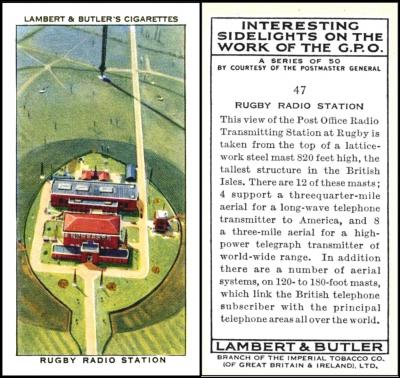
Now the two 1934 Wills sets of “Radio Celebrities” are well known, as are the many other sets featuring Radio Stars. So lets have a look at the actual mechanics instead. Our first set is Lambert & Butler “Interesting Sidelights on the Work of the G.P.O.” (1939) which features several radio related cards, but includes our curious view of Rugby Radio Station as 47/50. The picture is taken by a very brave photographer who was on top of the mast, at that time the tallest structure in the British Isles, at 820 feet high. This was one of twelve masts on site which were aerials for transmitting telephone signals to America and all over the world. The station was opened in 1926, and by the 1950s it was the largest transmitting station in the world, occupying sixteen hundred acres on and around the former RAF Lilbourne; however in the 1980s its need lessened and it was closed forever in 2007, though it is still remembered online - and it is currently being converted into homes. So let us hope this includes affordable ones, in honour of the fact that radio was available to all.
Another unusual group of sets are ones that marked the growth of home radios, but also appealed to the tinkerer in our nature and showed us how to build one ourself rather than just go to the shop and just buy one. These come in two types. The first are ones which almost covertly give advice, like Salmon and Gluckstein “Wireless Explained” (1923), S.C.W.S. “Wireless” (1924), and Wills Three Castles and Vice Regal branded Australian issue “Practical Wireless”(W/292 – a curious set which is usually dated as 1923 but seems to have been issued between 1922 and 1930. However the need for a radio was uppermost in such rural areas). The other sort of sets are more openly D.I.Y. Radiocraft, like the trio by Godfrey Phillips` “How to Make Your Own Wireless Set” (1923), “How to Make a Valve Amplifier for the B.D.V. Crystal Set” (1924), and “How to Build a Two-Valve Set” (1929); Morris`”Wireless Series” (1923), whose twenty five cards were “compiled from information supplied by the Wireless Press Ltd.”; and Wills Household Hints” (1936) which contained cards showing how to make a wireless aerial (49/50) and an earth (50/50).
Several sets on Boy Scouts also feature the badge for “Wireless Man” the criteria for passing which was to know how to build, maintain, and repair aerials and wireless sets, as well as knowing the functions of the different parts; and it is almost certain that a lot of their knowledge was gleaned from cigarette cards.
Today is the start of National Nest Box week, and today is also traditionally when birds choose their mate. This event runs until the 21st of February and the idea behind it is to provide our garden visitors with a place to call home.
Now there is a nestbox website, run by the British Trust for Ornithology which will give you lots of hints and tips for siting the boxes. But our advice is to spend some time looking out of your window first and see what birds visit you most, then look them up online and see where they like to live, rather than making a box to suit a bird that never comes.
They may not nest this year, but they may come and check it out, and that is also fun to watch.
And if you have a dog, you can also put their fur clippings out in a container and wait for the birds to come and steal it to line their nests.
But if you get eggs, don’t disturb or steal them, just make a note to buy a camera for next year, and fit it after all the birds and fledglings have moved on.
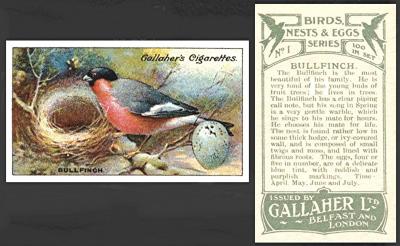
What you are looking for as cartophilic inspiration are sets like Gallaher “Birds, Nests and Eggs” (1919), for instance it tells us our Bullfinch, 1/100, likes a nest “…found rather low in some thick hedge, or ivy covered wall, and is composed of small twigs and moss, and lined with fibrous roots.” – and this is pretty easy to replicate. Another useful set is John Player “Birds and Their Young” . A good set, like these, will also tell you when eggs are likely to appear, so you can keep away and leave them to hatch. However Wills “Life in the Treetops” (1925) mostly features birds that very rarely frequent most of our gardens, like woodpeckers, owls and herons.
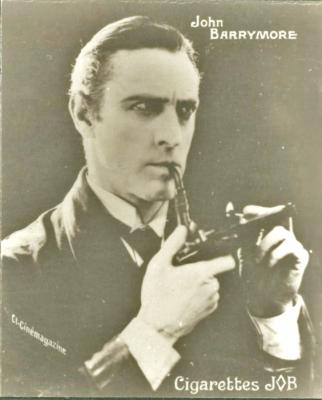
Today, or maybe yesterday, John Barrymore was born; the earlier date comes from his birth certificate but family histories say the day after.
I have to say I do like John Barrymore, who was from one of the famous acting dynasties which survive to this day, though their family name was not Barrymore at all, it was Blyth, and he was born John Sidney Blyth. He was amazingly handsome, and funny, and his life is full of romantic interludes and exciting adventures; he was married four times, and was also the first proper lover of Evelyn Nesbit, the American beauty and cause of the Thaw-White murder in New York five years later in 1906, though she had other lovers before, starting in her early teens, he was the first she loved for himself, not for how useful they might prove to her. And he fathered one of the children she was glad to get rid of before they ever got to see the light of day.
A star of stage and screen, starting out in plays with his father Maurice, (or Herbert Blyth) he appeared on many cards, and his trading card database gives a total of 39 of them. These cards all call him John, but he preferred to be called the more racy “Jack”. The first of those listed is from the 1917-1921 American series of Kromo Gravure “Leading Moving Picture Stars”; this set is very hard to find, but I have tracked down a photo of his card in the collection of the Metropolitan Museum of Art. There are other cards not featured there, including Societe Job “Cinema Stars” (1926), taken from images that had been supplied by the French “Cinemagazine, who also issued picture postcards. And Nicolas Sarony`s “Cinema Stars” (1933) 26/50 which tells us he started not as an actor but as a journalist, making his stage debut in “Magda” at the Cleveland Theatre in Chicago in 1903. The Godfrey Phillips “Characters Come To Life” (1938) is also not listed, and that shows him as Shakespeare`s Mercutio, “half rogue, half dreamer”. And that says it all, really…
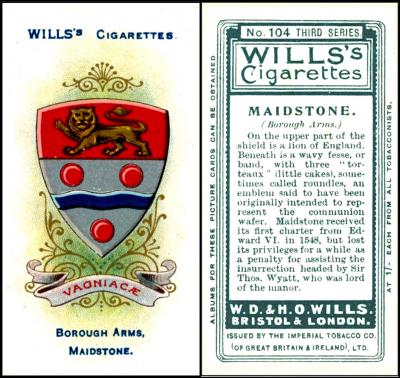
Thanks to everyone who got in touch with additions, we know a bit more about the Kent Branch of the Cartophilic Society. The first mention of it is in Cartophilic Notes and News Vol.11 No.116, page 3246, magazine dated February 1983. This is under “Branch Notes” where it tells of a pair of proposed Branches, starting with the Cotswolds (inaugural meeting 17 March 1983) and moving on to Kent, where it says that “Mr Jack Curtis ... fixed an inaugural meeting for a proposed Kent Branch for Wednesday 16 February 1983 at 7.30 p.m. at The Bull, Gabriel’s Hill, Maidstone. If this magazine reaches you to late to attend do get in touch with Mr. Kent (sic?) for further details”.
Nothing appeared in the Branch Dates section of that magazine though.
Sadly the Bull is no longer in existence. The cows are sad too. But you can read about it at the 2014 project website.
A bit more information about the Branch appears in the next edition (Cartophilic Notes and News Vol.11 No.117, page 3263, magazine dated March 1983), where it says that three Branches had been launched, or were about to be, Winchester and Solent, Kent, and Cotswolds. Grants had been given to each Branch to help them on their way. The Council said that “The day when the whole of the country is covered by branches and clubs may not be that far away”.
Later in the same edition, in “Branch Notes” we have a report, written by J Curtis. “We held the first meeting of the Kent Branch, at The Bull, Gabriel’s Hill, Maidstone, on Wednesday the 16th of February 1983. For a first occasion the meeting was quite a success with thirteen members attending. Our next event will be on Wednesday 2nd March, then the second Wednesday of every month from April.”
This issue also has them in the Branch Meeting Dates and Venues section at the back, saying that meetings would take place on the second Wednesday of every month and that they would commence at 7.30 p.m.
From November/December 1983 no meeting dates are given for this branch, it just says “Contact Secretary for details”. A big problem was that in January 1984 it was decided not to print the Branch dates in every issue, so that makes my tale harder to tell. And the next time it does appear (March/April 1984) there is no Kent Branch, though it is recorded that they did present a report at the 1984 Annual General Meeting on 14 April 1984.
Now J. Curtis was “Jack” Curtis, and he also ran “Grand Cigarette Card Fairs”, described as “The only regular Cigarette Card Fair in London”, at Caxton Hall. These were advertised in the Cartophilic Notes and News, and the 1983 dates were Jan 8, Apr 2, July 9, Aug 6, Sept 24, and Nov 19. It had twelve regular dealers, including Murray Cards and admission was 25p; but this event seems to disappear at the same time as the Kent Branch.
I am not sure if this is connected with the fact that in the March/April 1984 edition of Cartophilic Notes and News we suddenly have a North Kent Cigarette Card Club, non-affiliated, who met at Chelsfield Village Hall, near Orpington and an East Kent Branch who met at “Lions Den”, 11 Cleary House 1 Maison Diew Road, Dover starting at 6.30 p.m.
Did they replace Kent? Do let us know if you can add anything to the above because we will be starting to work on the Branch Archives very soon. Scans of ephemera and souvenirs relating to any Branch or Club are also very welcome and will be added
Why not spend this Thursday doing what are called “random acts of kindness”, strange words concealing the thought of really good things, like holding the door for someone less mobile, or letting someone with one item go in front of you in a shopping queue, the idea, of course, being that they will be inspired to help someone else later that same day. It’s a bit like letting a truck out of a side turning, who then lets someone else out at the very next turning.
You may be thinking this is all just my idea of a perfect world, and its only in my head, but, no, it is, wonderfully an actual day, started by the Random Acts of Kindness Foundation, who were founded in 1995.
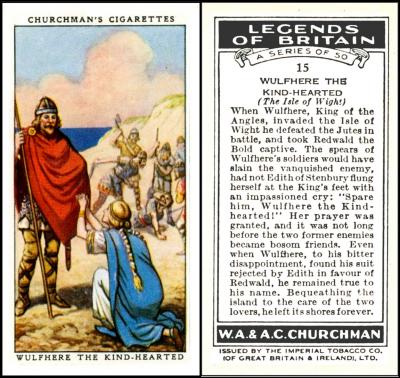
Kindness on cards is quite hard to find, but it is there. W.A. and A.C. Churchman shows us "Wulfhere the Kind Hearted" as 15/50 of their "Legends of Britain", he spared a rival fighter during his invasion of the Isle of Wight because of a maiden`s prayer, and even when she spurned Wulfhere for his rival he gave them the Isle of Wight and never went back.
I doubt that Boy Scouts were always kind, but if they followed the manual, many of the things they were supposed to do were for the benefit of others. Their rules include being loyal, helping others, being courteous, and being a friend to all, including animals.
If we think about it, a large clue to how we ought to behave forms the greatest proportion of the name "man-kind". Also the German for child is "kinder", hence kindergarten for nursery.
So today, why not try to bring a little kindness to others into your, and their life.... And if you like it, do it again tomorrow.
Today is a double date for Tudor Royalty, for in 1503 Henry Tudor was created Prince of Wales, and in 1516, early in the morning, his daughter, Mary, was born at Greenwich Palace to his first wife Catherine of Aragon, becoming the only one of her children to survive to adulthood.
Henry and Mary would eventually rule England, separately; he was Henry VIII, chiefly known for his giant girth and six wives, and she was Mary 1, or Mary Tudor, who seems to only be remembered for trying to rewrite his reformation of the Church, and her cruelty to those who disagreed with her. She only reigned over England and Ireland for five years, from 1553 until 1558, and some may say this was too long, and she was also Queen Consort of Spain, due to her marriage to Philip of Spain.
And if you are wondering how she married a Spanish King, well Catherine of Aragon was Spanish.
She should not be confused with another Mary, Queen of Scots, who took the Scottish throne in 1542. She was the daughter of James V of Scotland, and became queen aged just six days old.
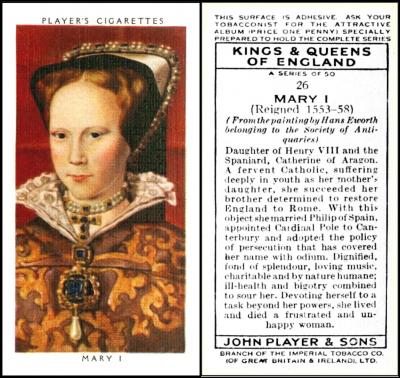
The portrait of Mary Tudor that you will most readily find is on John Player "Kings and Queens" (1935) 26/50, this comes from an original work after Hans Eworth, which means someone else`s copy or tribute to a work he did. At that time the original belonged to the Society of Antiquaries. This set was also issued by Allen`s Confectionery 22/49. The same portrait was also used for Carreras "Kings and Queens" (1935) 31/50
Another example which is easy-ish to find is the Carreras modern-ish Black Cat branded "Kings & Queens of England" (1977) 30/50 issued to commemorate the Queen`s Silver Jubilee.
A more unusual card of her can be found in Godfrey Phillips "Characters Come to Life" 9/36 where she is shown portrayed by Gwen Ffrancon Davies in the film "Tudor Rose"
This week's Cards of the Day...
We hope that you have enjoyed our brief sip of Scotch Whisky to celebrate “International Scotch Day”. If you came to the bar a bit late, do make a note in your diary for next year, as it is always the same day, February the 8th, and though there are other whisky related celebrations and days, this one is the only one devoted to the promotion of the true “Scotch”.
So here are a few “grains” for you to swallow…
- Whisky is actually made from grain, mashed into a pulp and fermented.
- Nobody knows when Whisky was actually first produced in Scotland, as records only date from the fifteenth century, however it was almost certainly before that by some while.
- The word whisky comes from the Classical Gaelic “uisce” which actually means water, but it is only part of a phrase that fully means the water of life; and a similar word is also found in German and Eastern European tongues.
- Scotland is either the largest producer, or the second largest, depending on who you are talking to - the largest producer is Ireland, but they call their drink Whiskey with an E, whereas Scotland, who is the second largest producer, calls theirs Whisky without the E. So it all hinges on the technicality of spelling, which is impossible to detect in speech.
You can read a bit more about whisky at the anyday guide - but in the meantime lets pour ourselves another wee dram, sit back, and further examine our Cards of the Day for this week.
Saturday, 5th February 2022
![THO-235 [trade : UK] D.C. Thomson "Famous Teams in Football History" second series [New Hotspur] (1962) Un/16](/sites/default/files/styles/content_aligned/public/2022-02/5%20hibernian.jpg?itok=VMe3pDPy)
This Saturday card was chosen for the team name, because in 2020 a limited edition single malt whisky was named after Hibernian F.C., the team which was shown on the card, and it was blended and bottled within easy walking distance of their Stadium. There were only five hundred bottles ever produced. Where they are now, who knows, but I bet few have been opened, for such is the way of drink related collectables.
You may be wondering what happened to series one, and if so, well it was a set of twelve cards, but it was issued anonymously and it was recorded as ZB9-19 in our original British Trade Index of 1969. However in our more recent British Trade Index it appears directly before the second series as THO-230
Hibernian Football Club were founded in August 1875, and you can read all about them at their website and I am excited to hear they are one of the top three “greenest” football clubs in the U.K., and the “greenest” in Scotland with Vegan food and many initiatives to reduce waste and consumption.
The team appears on many cards, one of the earliest being our old friend Gallaher “Association Football Club Colours” the reverse of which tells us that they “Became members of the Scottish League in 1895 and won the championship for the first and only time in 1902-3. They won the Scottish Cup so long ago as 1887, and again in 1902, whilst they failed in the final of 1896.”
For more recent cards, do have a look in the online shop run by ItaliaFrance, which has a goodly selection at the moment, including some seldom seen European items - though the Bells card has sold.
Sunday, 6th February 2022
![G075-145 [tobacco : UK] Gallaher Ltd “English and Scotch Views” (1910) 65/100](/sites/default/files/styles/content_aligned/public/2022-02/06%20drummond.jpg?itok=d33VizCZ)
This showed Drummond Castle in Crieff, Perthshire, and this is here because it was the castle owner, John Drummond, who made the first legal Scotch Whisky in 1818; some forty years after an illegal still had first operated on the site.
Our original Gallaher reference booklet (RB.4) tells us that these cards are real photographs, and that the fronts are toned black and white and then glazed. They followed on from Gallaher`s “Irish Views”, or sometimes “Irish View Scenery”, issued from 1908 to 1910 and are very similar in appearance to those, as well as suffering from the same problem of differing tones, which was caused by the production methods of the cards. In fact if you look closely at the cards you will be able to see that during the run of the “Irish Views” series several variations of glazing were experimented with, but none entirely solved the problem.
In the British Cigarette Card Issues catalogue of 1950, issued by the London Cigarette Card Company, “English and Scotch Views” is listed for sale as odd cards only, they cost from 5/- to 15/- a card.
The “Irish View Scenery” was listed there as odds only for the most part, but you could have bought a set of the 1-600 “glossy” cards for £85 or a set of the 1-400 “glossy” black photo cards for £60 a set. These two were also the cheapest versions for odds, therefore they must have been the most readily available. The most expensive version was set 201-400 B, unnumbered cards with plain backs, for these were listed at between 7/6d and 20/- each, for just the odds.
Monday, 7th February 2022
![B046-200 [tobacco : UK] A. Baker & Co. London "Beauties of all Nations" (1898) Un/25](/sites/default/files/styles/content_aligned/public/2022-02/07%20baker.jpg?itok=ROJGrhD4)
This was selected because the beauty was named as “Scotch”.
Now this set has two variants, this version, the earliest, being issued by A. Baker and Co of 65 Holloway Road, London. They were fairly short lived, because a new company was registered on 5 March, 1898, with the sole aim of taking over the retail and manufacturing businesses of the tobacconist A. Baker and Co. Now curiously this new company was called “Albert Baker and Co” and they stayed at the same location of 65 Holloway Road, but they did change the name on all their products, and that included their cigarette cards, so there is a set of these cards which say “A” Baker, and a set which says “Albert” Baker. If you have a set, be brave and have a look to see whether you have a marriage, in other words some cards of each printing. I am not sure you will be able to make these into two complete sets, as the cards are quite scarce, but it costs nothing to add them to your wants list.
Our “Directory of British Card Issuers” (RB.7) tells us that by 1946, when the booklet was issued, A. Baker & Co were only retail shops, which were owned by Imperial Tobacco Co. Ltd. They were still based on the Holloway Road though, and to be honest their business was always mainly retail, not manufacturing. They did issue several sets of cards, though their main claim to fame is that they are the “B” in “Actresses BLARM” issued in 1900; the others being Lambert & butler, Anonymous, Redford, and Murray. Their other sets were a mixture of ones also issued by other people [“Star Girls” (1898) - “Actresses HAGG” (1900), which I always thought an odd word to use in conjunction with beauty – “British Royal Family” (1902) – and - “Cricketers Series” (1902)] and ones that only they issued [“Actresses Baker`s 3 sizes” (1901) the three being standard, medium and extra large/postcard size – “Beauties of All Nations” (1898 and 1899) – and a very interesting set showing their shops, issued in 1901 and presumably used for advertising purposes, but, alas, if we use the list of shops off the back of the extra large card of their “Actresses – Baker`s 3 Sizes”, it appears that we are only just over half way complete with this, as we have found just 23 of 41 cards. If anyone out there has any of these black and white cards, do let us know, for we might be able to cross a few more off the research list.
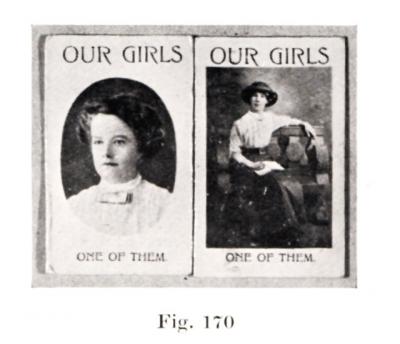
Their issuing of cards stopped in 1903, and the factory reportedly closed in 1921. They also owned W.B. Newman & Co. who seemingly did not issue cigarette cards, and Finlay & Co. Ltd. of Newcastle-on-Tyne, which were primarily retail shops, but issued two sets, “Worlds Aircraft” (1912) a set of thirty cards, and “Our Girls”, which some believe were issued in 1910, and others insist are First World War Women War Workers so cannot have been issued before 1914. The first two of those cards to be recorded are shown here, courtesy of the London Cigarette Card Company Handbook of 1950. It is believed that there are twenty-seven cards in total, but this seems an odd number, so do let us know what you have out there and we will see if we can compile a list. Scans would be very useful as well.
Tuesday, 8th February 2022
![TEA-030.1 : TAR-1 [trade : UK] Teachers Highland Cream [whisky] "Scottish Clans and Castles" (1955) Un/24](/sites/default/files/styles/content_aligned/public/2022-02/08%20teachers.jpg?itok=kNwZJMmH)
These circular cards measure about 80 m/m diameter, and were intended to be used as a beer-style mat beneath your whisky.
This set is recorded in our original British Trade Index part two, as a set of twelve, issued in 1969. There are two varieties, TAR-1.A which are named for "Teachers Highland Cream", which you can see in our newsletter of the 1st of June, 2024 as the diary date for Saturday June the 1st - and TAR-1.B which we show here today, and which are named for "Teachers Highland Cream Scotch Whisky".
The cards in both versions are the same apart from three which have differences in the wording:
-
Clan Macdonell of Inveraray Castle from 1.A is altered to Macdonnell in 1.B
-
Clan Macdougall of Dunolly Castle is renamed as above to Dunollie
-
Clan Macneil of Mismull Castle is renamed as above to Mismul.
Our British Trade Index part three of 1986 corrects the above in several ways, most importantly that the full name of the issuer Wm. Teacher & Sons Ltd, Glasgow does not actually appear on the first two groups. In addition Mismull Castle should read Kismull Castle and be altered to Kismul in TAR-1.B - and that the pictures in set TAR-1.B had been redrawn.
Another addition in the British Trade Index part three records that more cards had been issued in 1970, after the publication of our British Trade Index part two. These twelve cards were numbered 13 to 24, and their backs were different, they had a rectangular text giving the firm's full name. These have the reference code of TEA-030.2 : TAR-1.2
Wednesday, 9th February 2022
![GPQC-1 [trade : UK] Grant Whisky “Clan Tartans” (1991) 1/25](/sites/default/files/styles/content_aligned/public/2022-02/09%20macrae.jpg?itok=M58pqXmD)
These are almost identical to M122-28 Mitchell`s “Clan Tartans” apart from the facts that
-
there are 25 cards in this set but 50 in the Mitchell
-
that the Mitchell set has its name in the front top panel whereas the Grant is just a thin panel infilled in grey
-
that the bottom of the reverse says “COMMISSIONED BY / WILLIAM GRANT & SONS LTD / PRINTED IN THE U.K. BY IMPERIAL PUBLISHING LTD / © 1991. FIRST ISSUED IN 1927”. (The 1927, of course, being the date of the Mitchell set.)
Now this set was not issued one card at a time with a bottle of whisky, as you might imagine, it is said to have come as a complete set in a box. However the “box” can be seen at the Scotiana website and I would probably call it more of a “wallet” than a box, especially as the thickness of just twenty five cards is not great.

However it does provide us with a great piece of information as the box or wallet advertises the Glenfiddich brand, and they actually had a range of bottles featuring clans, though they were issued earlier than this. They also sold their expensive drinks in tins, so it is possible that these cards were either included in special tins, or you had to send tokens or seals to get a complete set.
If there is anyone out there who remembers acquiring these cards, at the time of issue, and can add any more info, please do get in touch.
Thursday, 10th February 2022
![[tobacco : UK] R. & J. Hill Ltd “National Types”, or “National Flags” (1914) Un/20](/sites/default/files/styles/content_aligned/public/2022-02/10%20hill.jpg?itok=kmyOipb-)
This is a curious set indeed, it is untitled and anonymous as regards a cigarette company, only an advertisement, for Black and White Whisky; and I cannot yet supply you with a reference code, because I can`t track it down in the World Tobacco Issues Index. However you can read a bit more at the American website Pre-War Cards, who call it Flags, Arms, and Types of All Nations, and also credit R. & J. Hill as a co-issuer.
The set shows people in National Costume holding a flag, hence it was recorded by different collectors as both “National Types”, and “National Flags”. You can also find it with just a plain back, and that is believed to have been issued by Henry Archer & Co., a tobacco company which was founded in 1850 and actually merged with Hill in 1905, during which Mr. H.C. Archer became managing director of Hill’s.
How we got to Hill as the issuer was that these fronts were also issued by Hill as a titled set, “Hill’s National Flag Series” in 1914; also that the exact same square “Black and White Whisky” advertisement appears on two other sets which were issued by Hill, their “Continental Actresses”, and on one of their versions of “Statuary”. But why Hill would issue a set which has no reference to them, and advertises someone else’s product is curious indeed.
There are several errors in the set, starting with Great Britain, who was first printed with the wrong flag; the original was a kind of red solid, recorded as a “Red Ensign with the white missing”. This was later replaced by the Union Jack. As the cards were printed in Germany, in 1914, there might well be a deeper reason for this. Another error is “Birma”, using an “I” not a “U”. And Italy has a very curious initial letter.
Friday, 11th February 2022
![BEL-020 [trade : UK] Arthur Bell & Sons, “Famous Bells”](/sites/default/files/styles/content_aligned/public/2022-02/brells.jpg?itok=BA39crKs)
Arthur Bell & Sons was founded in 1825 in a tiny shop in Kirkgate, Perth
They started issuing these tags in 1969, they came swinging around the neck of a bottle of Bells Whisky, hence the fact that they ought to have string through the hole at the top. However some collectors remove this because it is not only harder to store, for if it crosses the tag it can dent it, but also because if you catch the string it can break the top circle. Most of the bells are black wording on a gold backround, and all are more or less shaped like a bell.
Forty-two make the complete first "standard" set, and actually the title recorded is wrong, it should be “Other Famous Bells”, referring to the thought that Bells Whisky was the most famous bell and these were other ones. These tags fitted into a blue corner slot album which, when fully completed with every bell in place, was to be returned to Bells. It would be checked to ensure that you had one of each not a 42 in place of a missing 3, and you would be sent a little parcel containing a book, "Pride of Perth" about the maker, a key chain shaped like a bell, and also your completed book would be returned. Also available was a "Bell`s Collectors Certificate" to prove that you had collected the complete set.
Several special tags were issued, including a silver one in 1977 for the Silver Jubilee of Queen Elizabeth II. And you could get beermats showing the bells, though slightly boringly these were square.
One odd fact was that in official company documentation these were called "swing tickets" not tags.
well time has beaten me once more, but dont forget these newsletters stay in the archive just waiting to be added to by you. So if we mention anything you wish to comment on, or any subjects that you collect and would like to add cards to, please just get in touch. The merit of the internet is that nothing is ever fixed nor unchangeable.
See you all next week !