
Saturday, all over again, and, despite many other claims to my time, we have a new newsletter, though two of the cards will need to be added to over the weekend. I will tell you as to the whys with each card, it would slow down this preamble too much to do it now.
I am delighted to say that there are many Christmas trees popping up in windows; I see them on my travels, and especially enjoy them on our evening walks, when their illuminations shine out brightly. It cannot help but raise the spirits.
According to Silentnight, the bed people, when I publish this newsletter there will be just thirty-three sleeps until it is Christmas. So if you have any interesting Christmas cards, of the Cartophilic kind, please do send us a scan of the front and back (or all sides if they are folders) so that we may feature them over the festive season. And New Year cards, of the Cartophilic kind, too, along with calendars. We do not mind their age, from the earlies to the moderns, all are welcome here.
I have waffled too long, so on with the newsletter, and let us begin with....
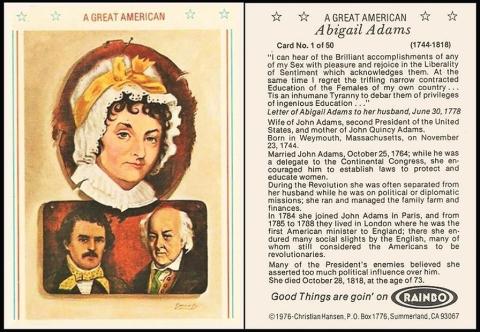
RAINBO [trade : bread : O/S - USA] "Great Americans" (1976) 1/50
We start our week with Abigail Smith, who was born today in 1744, in Weymouth, but not the English seaside town, its namesake in Massachusetts, America. Her father was a minister, but her mother had a very long and exciting pedigree, that made our lady cousin to John Hancock`s wife.
John Adams first met Abigail Smith when she was 15 years old, in 1759. because his friend was engaged to her older sister. The family did not approve of John Adams, who was but a lawyer, and from a farming community too. However, eventually they gave in; though this may have been due to Abigail becoming pregnant. This child was born nine months after the wedding, and was followed by five more, one of whom was John Quincy Adams, the sixth President of the United States of America.
In 1768 the family moved to Boston, where they rented a house that was known locally as The White House. In 1771, after several relocations, they returned to the farm. Then they came back to Boston, but there was political unrest, so they returned to the farm again. Then Mr. Adams was sent to Paris, as a diplomat. After a short while, his wife and older daughter joined him there, and this seems to have been when she first started to develop an interest in politics. They were sent to London after that, which she did not enjoy so much. They came back to America in 1788.
Then, in 1797, John Adams was elected President of the United States of America. He was sixty-one years old, and she became his advisor on many things. She also frequently wrote to the papers, sometimes under aliases, to inform the general public of things that would make them regard him more favourably. And in 1800, the couple became the first President and First Lady to live at another White House, the one in Washington.
In 1800, the Presidency over, they returned home. Her oldest daughter died in 1813, and it affected her deeply, some say it even hastened her own death, which ostensibly came through typhoid, in 1818, at the age of seventy three. Therefore she never got to see her son become President, for that happened in 1825. Her husband did, just, as he dies in 1826, at the age of ninety.
Strangely there is only one card of her listed in the Trading Card Database which was issued before the 1980s, and that is the 1889 series branded for "Consols" entitled "Portraits of Ladies of the White House". Our set is also pre-1980, but it is not listed there, which is why I chose it. But it is very scarce, so one of these days I may start a list of who is included. Not now though!
It turns out that "Rainbo" only began in 1958, before that it was "Colonial" bread, and we featured a set issued by them in our newsletter for the 29th of March 2025, as the diary date for Wednesday the 2nd of April. And it seems that just like that set, these cards were inserted in the wrapper with loaves of bread
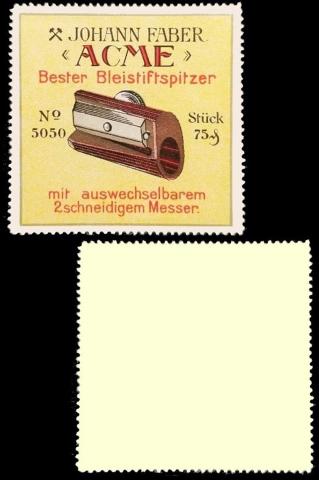
Johann FABER [trade : pencils and stationery ; O/S - Germany] "Poster Stamp" (19??) 1/?
So I started today`s diary date with the belief that on this day in 1897 the pencil sharpener was invented. That did not turn out to be the truth, and not just because almost as soon as the pencil was invented (in Italy, in about 1560) the user would have got so far in their writing and the "lead" would have broken, rendering the pencil useless. However, someone realised that if they cut the wooden surround away from the "lead", with a knife, the lead was revealed again and they could carry on. And I say "lead" because there is no actual lead in a pencil, it is graphite.
Reputedly, the first alternative to a knife was invented in Paris, in the 1820s, by a Mr. Boucher, who was a draughtsman and found that he needed his pencils to remain consistently sharp and pointed. However he never patented it. The first person to patent a pencil sharpener was also French, a man called Bernard Lassimone, not too long after, in 1828, and we know that he not only had them produced, but they were sold commercially as well. In fact there were lots of updates and tweaks to pencil sharpeners, throughout the nineteenth century.
However, what makes our date important is that the pencil sharpener patented on this day was described, for the first time, as "portable". The inventor was interesting too, though, or maybe because, almost nothing is known about him.
He was called John Lee Love, and he was reputedly born on September the twenty-sixth, 1889, in Fall River, Massachusetts, though there is no proof of this. He was an African-American, and he worked as a carpenter, which we know was in Fall River, so it is possible that the workplace and the birthplace got interconnected when they were not.
It is said that he was always trying to make better ways to do things, and that was how he came to patent his first invention, an improvement to a plastering tool, on July the ninth, 1895, using aluminium parts instead of wood, making it lighter to work with, and easier to clean - which does sound like he may have been a plasterer and a carpenter.
His second invention was the pencil sharpener, and again it seems likely that this came from his work, for carpenters use pencils, albeit thicker ones, which are easier to grip, and less likely to roll away - and because of this they had to be sharpened with knives. The thickness of a carpenter`s pencil is actually for a reason, as it measures a quarter of an inch on the flat side and half an inch on the other. It is possible that his original intention was to find a better way of sharpening these pencils, because they would not fit in to any commercial sharpeners on the market. And it may also be why his sharpener saw the pencil sliding into a cone, and being cranked by hand in a circle, in effect turning the blade against the pencil - whereas today the system is the other way around. Best of all, it had a place to collect the shavings so they could be disposed of more easily, and that was almost certainly a first.
After these two inventions in quick succession, you would imagine that he would have gone on to make other things, but apparently he did not.
The next we hear of him, or so we think, is in 1931, when he was one of ten passengers who died in a car versus train accident in North Carolina, on December the twenty-sixth, 1931. However the description of his body does not match him in any way, and there is speculation that it was another man of the same name who perished. As to what happened to our man, if this were not him, nobody seems to know....
This stamp celebrates another shadowy character, Johann Faber. He was one of three brothers who worked for the family business, A.W. Faber, but left, in 1879, to start his own pencil business in Nuremberg. His brother, Eberhard, had already left, in 1848, and settled in New York, where he ran a stationery store in Manhattan.
However it is the only item I found that actually shows a pencil sharpener... unless you know any others?
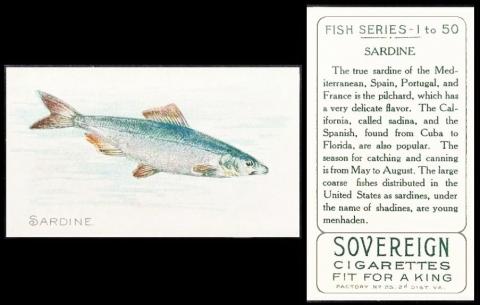
AMERICAN Tobacco Company Group Issues [tobacco : O/S - USA] "Fish Series", numbered 1 to 50 (1910) Un/50 - A565-088.b : A54-42.b.1 : ABC/T.58 : USA/T.58
Today, I hope you will join me in peeling back a lid on a tin and celebrating #NationalSardineDay.
Let us start with an odd fact, for the word "sardine" comes from Ancient Greek, and is thought to refer to its origins in the seas about Sardinia. Modern Scholars have cast doubt on this, because Sardinia is a long way from Greece - but research has proved that the Myceneans, who were the first true Greek civilisation, did indeed trade with Cyprus and Sardinia.
As far as what a sardine is, well that is also debated.
In the United Kingdom, a sardine is considered to be a young fish that will eventually grow into a pilchard - though another school of thought discounts this and just bases it on size, anything under six inches being a sardine and anything over that size being a pilchard.
Strangely, its "proper name" is Sardina Pilchardus. So I guess it is up to the consumer what they want to call it.
Speaking of strange, the sardine was first featured on a card in 1889, and that was Allen & Ginter`s "Fish From American Waters", which is available in standard size, or as a larger card with the addition of a decorative, art drawn surround, in this case a lighthouse and a buoy. I like the way that above the checklist on the reverse it says "You will catch one in a box of twenty Richmond Straight Cut No.1 Cigarettes" (the standard sized card says "one in a box of ten" by the way. The strange part is that the artwork of the sardine really did the rounds, as it was used for a veritable shoal of series - the 1900 re-issue of "Fish From American Waters" by the American Tobacco Company, the 1907 Philadelphia Caramels` "Zoo Cards", the 1910 American Tobacco "Fish Series" (which was multi-backed for several brands, namely "Piedmont Cigarettes", "Sovereign Cigarette Factory", "Sweet Caporal Cigarette Factory" and "Sweet Caporal Tobacco Wrappers Factory") - and also the 1912 Imperial Tobacco Co. of Canada`s "Fish Series". However it is not until our 1910 "Fish Series" version that any text appears.
As to the reference to "menhaden", your guess is as good as mine what that is!
After this, the word "sardine" seems to fall from favour, and it is as a pilchard that it appears in John Player`s "Sea Fishes" (1935), Carreras "Turf"`s "British Fish" (1954), and The White Fish Authority`s "The Fish We Eat" (1955). It only returns to being a sardine again in 1974, with Topps "Wacky Packages" series eleven - a card whch also appears in the 1980 version, as part of Series 4.
Now this is one of the cards that I will have to describe over the weekend, as it arrived rather late, my fault, I was trying to work with a very light card for way too long, and failing, but at last I asked around to see if anyone had a darker sardine and ended up with this. But it only came Friday night, whilst I had deserted my post to see the Christmas lights get switched on in a local shopping centre, two buses away, hence the lack of time to write the description on that night.
Anyway, now it is Saturday, I will tell you that the set is first recorded by Jefferson Burdick as :
- T.58 - Fish Series. (100). Sw.Cap, Soverign [sic], Piedmont, etc. First 50 as Set No.8. Two types of Pompano.
He values them at just five cents a card, which is odd, as he values the Allen & Ginter version, which is that "Set No.8", at fifteen cents a card, three times as highly - and yet the pictures are the same. More than that, though, our cards have descriptive text, which you would imagine would make them more interesting, not less. As far as the "Two types of Pompano", that refers to the fact that the Pompano fish can be found with its mouth open, or closed.
in our original World Tobacco Issues Index as :
- FISH SERIES. Sm. 63 x 38. Unnd. (100). Brand issues, inscribed (a) "Piedmont" (b) "Sovereign" (c) "Sweet Caporal Cigarettes". See ABC/T.58. Ref USA/T.58 ... A54-42
1. Inscribed "1 to 50"
2. Inscribed "51 to 100"
This is rather odd, because in my hunt for the Pompano, I discovered no cards that were Inscribed "51 to 100", only ones with "1-50" and ones with "1-100". Furthermore, though the entry was changed quite considerably in our updated volume of our World Tobacco Issues Index, it does not mention this fact and still reads :
- FISH SERIES. Sm. 63 x 38. Unnd. (100). ... A565-088
Brand issues, inscribed
(a) "Piedmont"
(b) "Sovereign"
(c) "Sweet Caporal Cigarettes". F.25 and 30
(d) "Sweet Caporal Tobacco Wrappers". (inscribed "Fish Series 1-50" but 77 seen)
1. Inscribed "1 to 50"
2. Inscribed "51 to 100
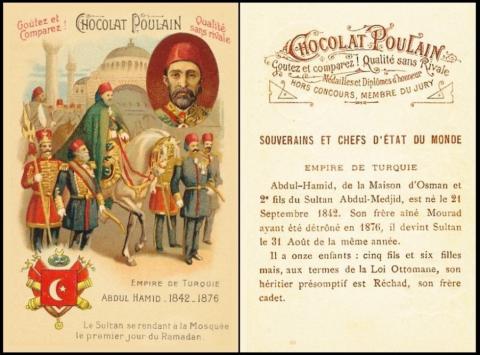
Chocolat POULAIN [trade : chocolate : O/S - France] "Souverains et Chefs d`etat du Monde" / sovereigns and chiefs of World States (1876) Un/??
After quite a gap in such things, we have a centenary - of the Hat Law in Turkey, enacted today in 1925.
It all started simply, when the police and military were issued new caps and other headwear, whereas, traditionally, these had always worn the fez. There were grumbles, especially from older Turks, but the younger ones just accepted it. Maybe because of that, "Law No. 671" was enacted. and that meant not only were the members of parliament forced to wear European hats, but the Turkish people were banned from wearing their beloved fez. And, in addition, there was a clause in the law that prevented it being challenged, or altered.
This all seems to have arisen from a simple decision, by Mustafa Kemal Ataturk, who travelled to Northern Turkey in August 1925, and chose to wear a white hat with a white brim, instead of a fez, and gave a speech calling for freedom to wear any form of hat. When he came back to Ankara, the following month, people were noticeably seen to be wearing various hats, not just the fez. The next month, parliament began to discuss moving away from the fez and turban, and into more western style headwear, and it passed into law in November.
Immediately there were protests, and acts of rebellion, and arrests, which often resulted in executions and killings. And the strangest thing of all is that the law was never repealed - even when the constitution was redrafted in the 1980s - so to this day "not wearing a proper hat" could land you in jail for up to two months.
There are plenty of Fez-es here, on a card which shows Abdul Hamid. He turns out to be Abdul Hamid II, and he ruled from 1842, as it says on this card, but long after 1876, which it also says on this card - in fact he ruled right until 1909. But some cards have later dates, the King of Italy actually including the fact that the image is his arrival in Paris in 1903 - so why the reign of Abdul Hamid II was truncated, I have no idea, unless the first batch of cards were issued, and then new ones added later
Only time for a very brief list, but will add to it later - however the cards known so far are :
- America - Republique des Etats-Unis d`Amerique - Roosevelt, President depuis 1901
- Austro-Hungary - Empire d`Autriche Hongrie - Francois-Joseph I - 1830-1846
- Bulgaria - Principaute de Bulgarie - Ferdinand I - 1861-1887
- Denmark - Royaume de Danemark - Christian IX - 1818-1863
- Holland - Royaume de Hollande - Wilhemine - 1880-1890
- Italy - Royaume d`Italie - Victor Emmanuel III - 1869-1900
- Portugal - Royaume de Portugal - Charles I - 1863-1889
- Russia - Empire de Russie - Nicolas II - 1868-1894
- Serbia - Royaume de Serbie - Pierre I - 1845-1903
- Siam - Royaume de Siam - Chulalong-Korn - 1853-1858
- Spain - Royaume d`Espagne - Alphonse XIII - 1886-1902
- Sweden and Norway - Royaume de Suede et Norwege - Oscar II - 1829-1872
- Turkey - Empire de Turquie - Abdul Hamid - 1842-1876

Editorial BRUGUERA [trade : magazines and comics : O/S - Barcelona, Spain] "Cromos Cinefotos" (1940s) G-2, No.4
Today in 1909 saw the birth of Frances Marion Dee, in Los Angeles, California. In fact John Sinclair`s "Film Stars" (no.41) says that she "was born in the shadow of the studios". However, when she was seven, her family moved to Chicago, because her father was in the army and was relocated there.
She graduated from college in 1929, and returned to California, where she found work as a movie extra in a film called "Words and Music" - she was one of the girls at the college. All her early work was in the background, and her name never appeared on the posters.
That all changed in 1930, with her seventh film, called "Playboy of Paris", starring Maurice Chevalier. Now according to Godfrey Phillips` "Film Stars", she owed that part "... to Ernest Lubitsch, the director who was attracted by her work in a minor role in "Monte Carlo". She was placed under contract and given the leading feminine part with Maurice Chevalier in "Playboy of Paris".
After that she became very popular, and made sixteen films over the next three years. However her next film was "The Silver Cord", which starred an actor called Joel McCrea. The two became friends almost immediately, and were married in October of the same year. They remained married until they were parted by his death in 1990; though they did separate in the mid 1930s and got back together, and in the 1960s he filed for divorce; however, the couple stayed married until his death.
She continued to make lots of films, another sixteen before the outbreak of the Second World War, and eight after, before moving into television, though she continued to make films for the big screen too. These later films included "I Walked with a Zombie", released in 1943 directed by Val Lewton, part of which, believe it or not, was inspired by Charlotte Bronte`s book "Jane Eyre".
She died on March the sixth, 2004, aged 94.
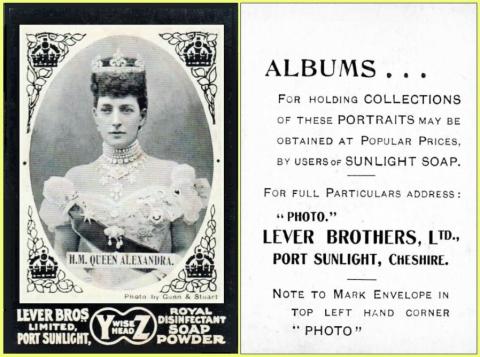
LEVER Brothers [trade : soap : UK - Port Sunlight, Cheshire] "Personalities" - YZ brand (1901) Un/
In our second centenary of the week, today in 1925 saw the State Funeral of Queen Alexandra.
She had died on the 20th of November, 1925, after a seizure the day before at Sandringham House in Norfolk at the age of eighty. She lay in the small chapel there until being brought to St. James Palace in London, by Royal Train.
On the morning of the State Funeral, she was escorted, with her coffin on a gun carriage from St. James` Palace to Westminster, between throngs of the general public and ranks of military personnel. And her funeral was held at Westminster Abbey at 11:30 a.m., where a service was conducted by the Archbishop of Canterbury.
However the coffin was not interred, it continued to lie in state, the whole day, so that the general public could pay their last respects, and the next morning it was removed, to Windsor, where her husband`s coffin was waiting.
Curiously, he had actually died in May 1910, but his coffin had not been buried either, it had gone in a memorial chapel. And the two coffins were still not buried until the twenty-second of April, 1927, beneath a monument in the South Aisle
I had not come across YZ as a brand before, so I did a little digging. It was actually advertised as "a soluble soap powder with which a powerful disinfectant and deodoriser has been incorporated. YZ may be used in powder or solution. Sprinkle it about where a suspicious smell is detected, in lavatories, sickrooms, cesspools, sewers, etc".
This is the second version of the set, it was previously issued with a slightly different inscription in the bottom border, "Soap Makers to Queen Victoria" in the centre, and with "Royal Dry Soap" on the right hand side. You will soon be able to see that in our newsletter of 27th of August 2022, as the diary card for Friday, the 2nd of September 2022, I`m working on that now.
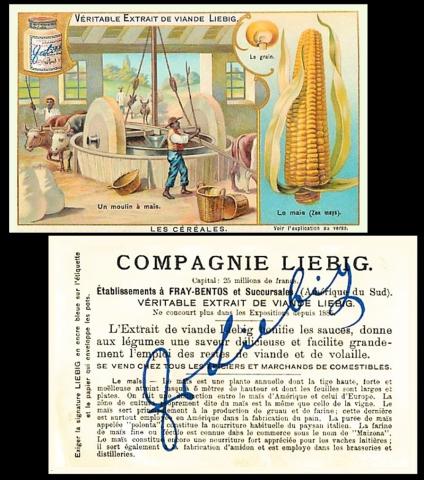
Liebig [trade : meat extract ; O/S - South America] "Les Cereales" (1904) Un/6 - F.782 : S.781
Today is #NationalMaizeDay and time to celebrate this very useful crop.
Maize, or corn, is a tall, annual grass, which is self- pollinating and has male and female flowers on the same plant, the males being higher up so that their pollen falls on to the females and does its duty. It is only the females which make the corn cobs, the males are just tassels, and remain so.
It comes in many varieties, maize, and field corn, primarily being given to animals, and sweet corn being eaten by humans.
The first domestication of maize happened in Mexico, by Native Americans, who realised that it grew best in combination with squashes and beans, and sometimes sunflowers, so that they supported and nourished each other. This idea fell out of favour, but is now coming back in style once more, and is seen as the way forward.
This set shows cereals, and the other cards are ;
- La Froment (Triticum vulgare)
- Le Mais (Zea mays)
- Le Ris (Oryza sativa)
- Le Seigle (Secale cereale)
- Le Sorgho (Sorghum vulgare)
- L`Orge (Hordeum distichum)
This week's Cards of the Day...
This week we will be celebrating #NationalCampDay which is every November the nineteenth.
I know we have several readers, and me, who are very fond of spending the night under canvas looking out at the stars, so this gives us all a chance to remember the trips we have made this year, or plan ones for next year. Some of us even get the tent out and put it up either in the garden (which may be a bit cold at this time of year) or indoors, which I often do myself, though my tent is very small and cosy, it would not really work if you had a tent that was more of a marquee
By the way, if you have never tried camping, why not give it a go? It is not all roughing under the stars, the word to search for online is #glamping - and prepare to be surprised...
So lets have a look at our clue cards this week, three of which were supplied by readers, for which many thanks. I have few really early cards, unusually sized or shaped ones, and European ones, so it is always a pleasure to be allowed to feature one of yours.. And, if you look at this week`s trio, none of them reveal their owner`s name, yet they, and us, still have equal pleasure in seeing them online, and perhaps even learning a little more of their back story...
Saturday, 15th November 2025
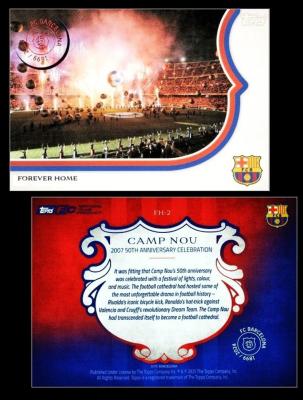
This started off our week with the "camp" idea, for the definition of a camp is an area of ground on which temporary accommodation has been erected.
I can find no occasion on which a football stadium was pressed into service, and though many accounts speak of the 1924 Scout Jamboree at Wembley being on the field, it was not, it was housed nearby on land known as The Paddocks, about seven minutes walk away.
The first time that Camp Nou, showing here, appeared on a card was in 1982, sticker thirteen of Panini`s "World Cup Stickers". However you would be excused for missing it, as it is actually called "Barcelona - Estadio Nou Camp". These three words are all correct, though, as in Catalan "Estadio" means stadium, "Nou" is new, and "Camp" means field, or ground.
However, by the time this card appeared, it was over twenty years old, for it was opened on the twenty-fourth of September 1957. It replaced the former home of Barcelona F.C., the Camp de Les Corts, which had opened on the twentieth of May, 1922. That too replaced a prior stadium, , which had opened on the fourteenth of March, 1909. Each time these stadiums had expanded until there was no more room for them to grow - the Camp de la Industria being built for fifteen hundred spectators and growing to six thousand, the Camp de Les Corts starting with a capacity for twenty-thousand but reaching sixty thousand, and Estadio Nou coping with a hundred and twenty thousand during the 1986 European Cup Quarter Finals, when Barcelona met Juventus.
Strangely, the Camp de la Industria came along ten years after a Swiss man, Hans Gamper, placed an advertisement in a bi-weekly sports magazine asking whether any one would be interested in starting a football team. That occurred on the twenty-second of October, 1899, and lots of people must have agreed as he had a meeting almost a month later in order to set out the constitution of the new club.
After the 2022 season, work on renovating, updating, and enlarging began. This is still ongoing, and Barcelona is playing their home games at the Olympic Stadium, which was built in 1927 for the 1929 Exposicion Internationale Barcelona, with an eye on using it for the 1936 Olympics. However they lost their bid to host the Olympics, over the growing unrest which would later be known as the Spanish Civil War - which makes it rather odd that the 1936 Olympics were awarded, instead, to Berlin.
The text on our card is both light and small, but it reads : "Camp Nou / 28th May 2023 / Barca marked their final game at Camp Nou ahead of redevelopment with a 3-0 victory over Mallorca. After the game, the stadium`s greatest moments played out on the big screen while fireworks exploded overhead, reminding the fans that Camp Nou`s exciting future is inseparable from its proud past. "
This set, of just three cards, is known as "Forever Home" - and it is one of many items that are allied to the base set of fifty cards called "Topps FC Barcelona 125th Anniversary" - including autographs, patches, relics, etc. You can read all about them at The Trading card Database/FCB.
Sunday, 16th November 2025
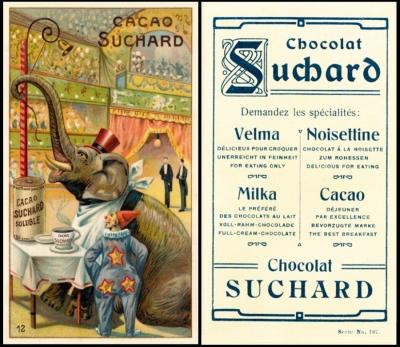
This card celebrates the circus tent, though this circus seems to be on a much grander scale, for there are seats up high, and an orchestra above the flap that lets the acts come in to the sawdust ring. That suggests it is more of an indoor circus, in a theatre, or even purpose built arena, and, therefore, a much larger, more profitable circus than most.
This set appears to hark back to a time when the use of performing animals made up the bulk of the acts, but actually it is only dealing with elephants. And for a set given away with chocolate, presumably for children, some of the cards are rather gruesome.
The cards are :
- Two adult elephants and two babies.
- Elephant hunting in Africa.
- Tiger hunting in India.
- Two robed elephants pulling an elaborate carriage on wheels.
- Elephant carrying timber in its trunk.
- Elephant used for ploughing a field.
- Elephant with howdah on top, lots of people standing round.
- Elephant on ball, with spectacles and cocoa tin, two clowns and a ringmaster pig at base of card.
- Two elephants crossing an Indian river, with two men on top of each.
- Elephant with howdah on top,, accompanied by an Arab on a horse and a Chinese man on foot.
- Elephant pulling a gun carriage, with four men.
- Circus elephant with red hat sitting at tea table, clown in blue starred costume beside him.
Monday, 17th November 2025
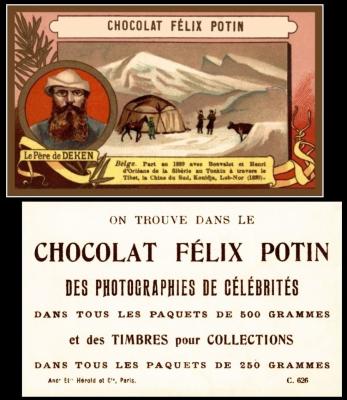
This tent is an adaptation of a military tent, pressed into service for exploring, something which makes a lot of sense given that a lot of early explorers had been military men. However as soon as early civilisations gained the knowledge that a shelter would keep them dry and warm, they were making them, out of branches and animal hides, and, more importantly, realising that they could de-construct them and take therm to new sites. The indigenous peoples of pretty much all the countries in the world would have done this, refining the structures depending on local needs and weather conditions.
This is our first reader`s card of the week, and I am grateful that they also supplied the list. Some cards have already been added since it arrived here, but three remain. If anyone can locate the missing explorers, please tell us.
Our man today is billed as "Le Pere de Deken", but his real name was Constant Pierre-Joseph de Deken , and he was born in Wilrijk, in Belgium, on the seventh of March, 1852.
He was the son of an innkeeper, and from an early age he felt the calling to religion, going on to study it at seminary. They first sowed the seeds of missionary work, which led him to join a local religious order, who ordained him as a priest in 1879 and sent him to China in 1881. This is why he is called "Pere" on the card, for it means "Father" both in a natural and a religious sense. In fact he went to what is now part of Turkestan, and he stayed there for ten years, during which time he learned to speak Chinese.
In 1889, this ability led him to a man called Gabriel Bonvalot, who was running a scientific expedition and wanted someone who could act as an interpreter. Another man on the expedition was Henri d`Orleans (who I think is one of the missing cards in this set). Their goal was to traverse Central Asia, ending up in Shanghai, and they did accomplish their goal, after which the explorers left and returned to France. It seems that they asked our man to go with them, but he refused. However in 1890 he did leave, for Brussels, where he published a book about his travels.
Then, in 1892, he was sent to the Belgian Congo, to preach the gospels to the population in the area of Boma, and out into the surrounding areas. For some reason the climate did not suit him, and he was frequently unwell, so much so that he returned to Brussels in late 1894 and stayed there for a whole year, for most of which he was hospitalised. He had only just left his bed when he was again asked to return to the Congo, and he obeyed. But shortly after his arrival, in November 1895, he again felt unwell, and he died, of fever, on the third of March, 1896, just a few days before his forty-fourth birthday.
This set was also issued by others, at least by :
- Chicoree Casiez = (CC)
- Felix Potin = (FP)
- Guerin Boutron = (GB)
This was accomplished by changing the name in the long cartouche at the top, and then reprinting the backs. And we know that sometimes cards turn up that were not printed to either the front cartouche nor the back, so the printer must have done a long run then overprinted in these places when a new order came in.
Do note that the set title, of "Explorateurs" only appears on the Guerin-Boutron version. It is also their cards which supply the set length, of eighty-four cards - so we presume the other issuers versions are of that same length as well ? However, the cards of those other issuers are much harder to come by. Anyway, the subjects we know of so far are :
- Adjutant Prat - Explorateur Francais = (GB)
- Albert Nebout - Francais = (FP)(GB)
- Alfred Marche - Francais = (GB)
- Aime Olivier - Francais = (CC)
- Andree - Explorateur Suedois = (GB)
- Armand Reclus - Francais = (GB)
- Ballot - Francais = (GB)
- Baron Dhanis - Belge = (GB)
- Bonnel de Mezieres- Francais = (GB)
- Bonvalot - Francais = ((FP)GB)
- Bretonnet- Francais = (GB)
- Briquez - Francais = (GB)
- Brunache - Francais = (GB)
- Camille Douls - Francais = (FP)(GB)
- Capitaine Baratier - Explorateur Francais = (FP)(GB)
- Cap. H. Brosselard - Francais = (FP)(GB)
- Capitaine Menard - Explorateur Francais = (CC)(FP)(GB)
- Capitaine Trivier - Francais = (GB)
- Capit. Braulot - Francais = (GB)
- Capit. Braun - Francais = (GB)
- Capit. Vermeersch - Francais = (FP)(GB)
- Capt. Casemajou - Francais = (CC)(FP)(GB)
- Capt. Germain - Explorateur Francais = (GB)
- Cap. Toutee - Francais = (GB)
- Clozel - Francais = (GB)
- Comte Leontieff - no country = (FP)(GB)
- Cupet - Francais = (GB)
- Dallmann - Allemand = (GB)
- De Gerlache - Belge = (FP)(GB)
- De Goetzen - Allemand = (FP)(GB)
- De Long - Americain = (GB)
- Dr. Bayol - Francais = (FP)(GB)
- Dr. Catat - Francais = (GB)
- Dr. Crevaux - Francais = (GB)
- Dr. De Behagle - Francais = (CC)
- Dr. G. Nachtigal - Anglais = (GB)
- Dutreuil de Rhims - Francais = (GB)
- Emin Pacha - Anglais = (GB)
- Fondere - Francais = (FP)(GB)
- Gal. Dodds - Francais = (FP)
- Gal. Duchesne - Francais = (GB)
- Galieni - Francais = (GB)
- General de Torcy - Francais = (FP)(GB)
- Gentil - Francais = (GB)
- Georges Melville - Americain = (GB)
- Georges Revoil - Francais = (CC)((FP)GB)
- J. Boissiere - Francais = (GB)
- Jean Chaffanjon - Francais = (GB)
- Jean Dybowski- Francais = (GB)
- Lauziere - Francais = (GB)
- Le Pere de Deken - Belge = (FP)(GB)
- Lieut. Bunas - Francais = (FP)(GB)
- Lieut. Dejoux - Francais = (FP)(GB)
- Lieut. Loury - Francais = (FP)(GB)
- Livingstone - Anglais = (CC)
- Louis Noros - Americain = (GB)
- Maistre - Francais = (FP)(GB)
- Mal des Logis Martin - Francais = (FP)(GB)
- Marquis de Compiegne - Francais = (FP)(GB)
- Marquis de Mores - Francais = (FP)(GB)
- Mercuri - Francais = (GB)
- M.F. Grenard - Francais = (FP)(GB)
- Mizon - Francais = (GB)
- Mme. Dieulafoy - Francais [see below] = ((FP)GB)
- Mr. Boffard-Coquat - Francais = (FP)(GB)
- Mr. Chesse - Francais = (FP)(GB)
- Mr. de Bonchamps - Francais = (FP)(GB)
- Mr. Dieulafoy - Francais [see below] = (GB)
- Mr. Roux - Francais = (GB)
- M. Vanderheym - Francais = (GB)
- Nansen - Explorateur Suedois = (FP)(GB)
- Nindemann - Americain - = (GB)
- Nordenskiold - Suedois = (FP)(GB)
- Paul Crampell - Francais = (GB)
- Savorgnan de Brazza - Francais = (GB)
- Stanley - Anglais = (GB)
- Sven Hedin - Suedois = (FP)(GB)
- Theodore Lacour - Francais = (GB)
- Treich Laplene - Francais = (FP)(GB)
- Victor Giraud - Francais = (GB)
- Victor Largeau - Francais = (GB)
Two of these cards are very similar at a quick glance, both being entitled "Dieulafoy ", however the pronoun differs, for one is a lady, "Mme. Dieulafoy - Francais - Mission Archaeologique en Susiane (Perse)" and she has a group of building, no visible desert - whilst the other is "Mr. Dieulafoy - Francais - Mission Archaeologique en Susiane" and he has the upper parts of a building partially emerging from a lot of desert. Further research discovers that they were husband and wife, Jane and Marcel-Auguste Dieulafoy, and they both worked on the ancient Persian city of Susa.
That only leaves three cards to find - so please do have a look and see whether you can fill them in...
Tuesday, 18th November 2025
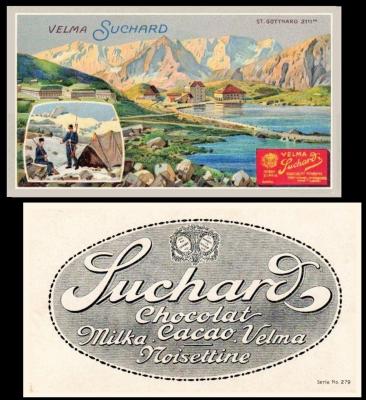
Here we have the St. Gotthard Pass, which seems to have shrunk since the card was issued, as its given height now is only 2,106 metres. It is a route which connects Northern and Southern Switzerland, through the Alps, and it has been known for many centuries. However it was only usable all year round after 1220, when a bridge was built across the Reuss river, before that the river was too treacherous to cross for a great many months of the year.
The "St. Gotthard" connection only came along about the year 1236, after a small chapel dedicated to St. Gotthard of Hildesheim, the patron saint of traveling merchants, had been built on the southern side of the pass.
The men on our card may look like explorers, but look closely and they are armed with rifles. That could be a reference to the Battle of the St. Gotthard Pass, during which the Imperial Russian Army, in league with Austria, attacked French forces. They captured the St, Gotthard Pass on the first day of the conflict, the twenty-fourth of September, 1799, then continued in a northerly direction along the river, reaching Lake Lucerne on the twenty-sixth of September 1799.
This would also explain the other anomaly, that being that the card shows a more military tent.
Now I have to say that these cards are quite scarce, and my trawl of the internet has only unearthed two more, so if anyone can add any please do :
- Furka 2431 m.
- St. Gotthard 2111 m.
- Gemmi 2329 m.
Wednesday, 19th November 2025
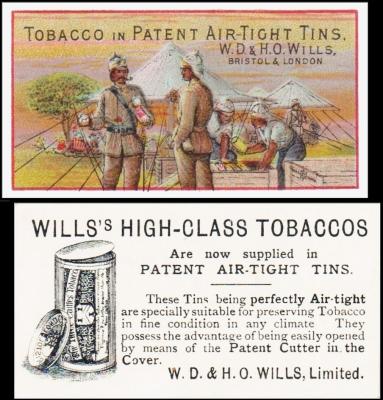
Here we have a military tent, which, you may be surprised to learn, was first used by the Romans. These were made of cow hides, pulled taut over poles - and this is where we get the word "tent", from "tendere", in Latin, which means "to stretch".
Their general soldiers` tents were almost seven feet square and approximately six feet high, and accommodated eight men, whilst the centurions, or officers, had a tent all to themselves, which was taller, not only so it was easily spotted amongst the others, but also because they would meet with other leaders, speak to their men, or interview prisoners inside the tent, so it needed to be imposing. Like the tents of today, all of these stayed up whilst they were in one place, then they were packed away before the group moved on, and loaded on to a mule.
This is not the first ever Wills advertisement card, but it appears to be the first we have used, so it assumes the mantle of being the home page, for now, until we use the earliest of all. Also, as we use them, we will move the relevant information on that section of the listing over to the card it refers to, and just add a link to here.
Our original reference book RB.3, to the Cigarette Card Issues of W.D. & H.O. Wills, published in 1942, lists these cards first, with the following preamble :
- Advertisement Cards.
One year before "Woodbines" and "Cinderella" cigarettes were introduced - 1888 - Wills started to use printed cigarette cards. The printers, Messrs. Mardon, Son & Hall, state they producd a type-set card printed in two colours, but unfortunately specimens have not yet come to light. Also it is stated a card showing a representation of a "Gold Flake" packet was put into circulation in 1888 : no-one, however, seems to have preserved a copy.
Wills started to make cigarettes by hand in 1874. "Gold Flake" was introduced in 1883, and until 1897 any stiffeners were quite plain.
During 1889 the forerunner of all Wills`s coloured Advertisement cards made its appearance. This was on very thin, almost paper-like material, and slightly larger than the size we call standard today. This card advertises "Three Castles" cigarettes on the front, and shows a picture of a serving maid knocking on an ornate door, carrying a tray of cigarette packets. The back advertises 14 cigarette brands, packed "in paper packages".
It is thought a group of cards was issued in 1890, but this has not been definitely proved and further mention will be made of the matter later.
In 1893, a group of four cards made their appearance ; two reproduced patent air tight tins of tobacco - opened ; " Gold Flake Honey Dew" and "The Three Castles Tobacco". The third showed a packet of "Superfine Shagg Tobacco" (note the old spelling) and the fourth a flat packing of "Gold Flake, a mild coarse cut pipe tobacco". All four are printed on the backs in black and red.
Another group followed, believed to be four -
A. Girl with a large tobacco leaf inscribed "Wills` Gold Flake". Back advertises "Gold Flake Tobacco"
B. Sailors on deck, inscribed "Capstan Navy Cut"
C. Similar to "B" but back "Navy Cut `Capstan` cigarettes in cartons of 10, etc"
D. Birds Smoking Party - birds seated round a table, inscribed "Wills`s Best Bird`s Eye." Back "The Original Bristol Bird`s Eye, etc."
The main emission of 1894 consisted of reproductions of three famous Show Cards :-
1. A maiden, seated, with a basket of packets
2. A boy and girl, with a dog, outside an old fashioned tobacconists, with caption at the bottom "Father says - "Must be Wills."
3. Interior scene. Husband and wife seated near the fire. Child and dog just returned, inscribed "It`s all right, Father, `tis Wills."
There are seven different types of backs for each of these -
A. "Autumn Gold" Cigarettes
B. "Best Bird`s Eye" Cigarettes
C. "Eothen" Cigarettes
D. "Passing Cloud" Cigarettes
E. "Pole Star" Cigarettes
F. "Sahara" Cigarettes
G. "The Three Castles" Cigarettes
In 1 the variety appears both on the front and back, but in 2 and 3 the variety is only on the backs.
There is one other group to be recorded, believed to be three, but these may have been issued separately -
1. Ship`s deck scene, with a cask of tobacco and sailors , advertising "Three Castles". Backs, "The Three Castles Tobacco" etc.
2. Soldiers and Tents - military scene, inscribed "Tobacco in Patent Air-Tight Tins. W.D. & H.O. Wills." Backs , "Wills` High Class Tobacco... W.D. & H.O. Wills Limited. "
3. "Westward Ho!" packet design. Back "Westward Ho!" Smoking Mixture
It is thought this group may have been issued in 1890 without "Limited" in the title, and re-issued 1893/4 with this word added. It will be noted no.2 above does not include this word on the front, although it is included on the back.
Our second Wills reference book, RB.11, "The Cigarette Card Issues of W.D. & H.O. Wills Part I (revised) and Part II" was published in 1948 and it saw a major change, as it numbered all the sets, giving us the first ever Wills` card codes - and our set was given the code of W/1. There had also been discoveries in the interim period, of more cards, and so the text reads :
- 1. ADVERTISEMENT CARDS - see pages 3-5
Five further cards have come to light - additions to the group referred to in the third paragraph on page 4. Nine titles of this 1893 group are thus known, all depicting packings of tobacco, with black and red printings on backs.
1. The "Four Seasons" Tobacco
2. "Gold Flake"
3. "Gold Flake" Honey Dew
4. "Leathery Fox" Tobacco
5. "Superfine Shagg" Tobacco
6. The "Three Castles" Tobacco (green, black and gold tin)
7. The "Three Castles" Tobacco (yellow, red and gold tin)
8. "Traveller" Brand Golden Flaked Cavendish
9. "Westward Ho!" Smoking Mixture
An illustrated recapitulation of all known early Advertisement Cards is planned to appear in the next Wills section
That third volume of the Wills listings, RB.14, "The Cigarette Card Issues of W.D. & H.O. Wills Parts I and II (revised) and Part III", was published in 1949. It did indeed list all the cards, but it also included a picture (which is proving impossible to scan, mainly because it seems to be taken off another image, presumably from a magazine, so I will try to find that as it will almost certainly be of better quality. The listing reads :
- 1. ADVERTISEMENT CARDS - see pages 3-5 and 45.
Two further cards have been seen since the publication of Part II and it appears likely that other cards were issued. An illustration of cards known appears at Fig,28, with references linked to the following recapitulations.
A. 1888 issues. Messrs Mardon, Son & Hall state that the firm produced a type set card printed in two colours, and a card showing a reproduction of a "Gold Flake" tens packet No specimens of these cards have been seen.
B. 1889-90 issue. Serving maiden knocking at door. This is the earliest coloured card issued by Wills. Back headed "W.D, & H,O, Wills, Tobacco, snuff, cigar and cigarette Manufacturers...." with a list of fifteen brands. Printed on thin almost paper-like material, No limited liability indication appears on this card..
C. 1890-93 issues. Reproductions of Wills` Tobacco Packings. Backs printed in black and red, with advertisements for seven brands of tobacco. All cards seem bear "Limited" after Wills` name, indicating issue in 1893 or later. Some cards bear indications that the full stop after Wills` name has been altered to a comma, with the word "Limited" added; this gives weight to the theory that these and/or similar cards may have been issued in 1890-92 without the limited liability indication. Subjects known :
1. Best Bird`s Eye Tobacco
2. The "Four Seasons" Tobacco
3.. "Gold Flake"
4.. "Gold Flake" Honey Dew
5. "Leathery Fox" Tobacco
6. "Old Dominion" Tobacco
7. "Superfine Shagg" Tobacco
8. The "Three Castles" Tobacco (green, black and gold tin)
9. The "Three Castles" Tobacco (yellow, red and gold tin)
10.. "Traveller" Brand Golden Flaked Cavendish
11. "Westward Ho!" Smoking Mixture
D. 1893 issue. Reproductions of Wills` Showcards. It is believed that all three cards were issued with each of seven different back advertisements -
Fronts :
1. "Father says - "Must be Wills."
2. "It`s all right, Father, `tis Wills."
3. Maiden with basket of flowers
Backs :
A. "Autumn Gold"
B. "Best Bird`s Eye"
C. "Eothen"
D. "Passing Cloud"
E. "Pole Star"
F. "Sahara"
G. "The Three Castles"
In the case of card No.3, the different brands (A to G above) also appear on the front of the card.
E. 1893-4 issue. Reproductions of Wills` Posters. One card (No.3 below) is known with each of two different brand advertisements, and other varieties may come to light -
Fronts : Backs :
1. "Westward Ho!" design (a) "Westward Ho!"
2. Soldiers and tents (a) "Wills`s High Class Tobaccos"
3. Sailors on deck (a) "Navy Cut Cigarettes"
(b) "Wills`s Navy Cut"
4. Girl with tobacco leaf (a) "Gold Flake" Tobacco
5. Deck scene with casks (a) "The Three Castles" Tobacco
6. Birds` smoking party (a) Best "Bird`s Eye Tobacco
These cards did not appear in the fourth Wills booklet, RB.16, "The Cigarette Card Issues of W.D. & H.O. Wills Parts I, II, and III (revised) and Part IV", published in 1950. However, the fifth booklet started off with an even bigger discovery, that being :
- 1. ADVERTISEMENT CARDS - see pages 3-5, 45, and 81-2.
Four cards believed to be from the 1888 issue referred to on page 82, have been found, and are illustrated at Fig. 28-A.
Paragraphs A and B on page 82 can thus be revised as follows -
A. 1888 issues. Reproductions of Wills Cigarette Packings (Fig.28-A)
Subjects knows (all tens cigarette packets) -
1. "Gold Flake" - green background, border in gold
2. "Best Bird`s Eye" - brown background, border in black
3. "Dubec" - green background, border in gold
4. "The Three Castles"" - green background, border in gold
Printed on thin almost paper -like material. No limited liability indication appears on the cards. Back in black, with frameline, as follows -
"W.D. & H.O. WILLS, Tobacco, Snuff, Cigar and Cigarette Manufacturers
CIGARETTES in Paper Packets
"LOUISVILLE" .................. mild
"HEARTSEASE" ................. medium
"EVENING STAR"................ full flav.
"PASHA"............................. Turkish
BEST BIRD`S EYE
"GOLD FLAKE"
HONEY DEW
"HAWTHORN"................... .medium
RUSSIAN........................... mild
"OLD VIRGINIAN"............... strong
"PASSING CLOUDS".......... mild
"THREE CASTLES"............. very mild
"GARFIELD"........................ pressed, amber tips
"DUBEC" ............................ fine aroma
As cards illustrating four of the brands quoted above have now been found, it may well be that the others were also issued
B. 1889-90 issue. Serving maid knocking at door (Fig.28 - item B). Printed on thin paper-like material as in A., without limited liability indication; identical back wording as in A., but without frameline.
The design of this card is the same as that on a U.S.A. card issued by D. E. Rose, New York (see Burdick No.446), in the series "Imperial Cards". The caption on the D. E. Rose card reads : "Sallie Wilson in "Morning Dew", and the lady is carrying a posy and a letter in place of the cigarette packages shown on the Wills card, otherwise the two designs were obviously prepared from the same original.
In our original World Tobacco Issues Index this has been cleaned up quite a lot, and all the amendments added in, not just together, but in the right place. Therefore that entry reads :
- 1. EARLY ISSUES WITHOUT I.T.C. CLAUSE. Series prepared up to 1902 for home and/or export brands
1A. THE EARLY ADVERTISEMENT CARDS. Issued 1888-95, mostly in U.K. Listed in probable order of issue - See C.W. pages 1226-9, and W/1. Small size, 65-67 x 35-36 m/m. Unnumbered.
* THE SERVING MAID (A), Dark brown border. Single card issue. See W/1.B ... W62-1
* CIGARETTE PACKINGS (A). Dark brown or gold borders, dark backgrounds. 4 known. See W/1.A ... W62-2
* TOBACCO PACKINGS (A). White backgrounds, no borders. 11 known. See W/1.C. W62-3
* CIGARETTE ADVERTISEMENT CARDS (A). Red framelines, white border. Series of 3, See W/1.D, each with seven back advertisements ... W62-4
A. "Autumn Gold" Cigarettes
B. "Best Bird`s Eye" Cigarettes
C. "Eothen" Cigarettes
D. "Passing Cloud" Cigarettes
E. "Pole Star" Cigarettes
F. "Sahara" Cigarettes
G. "The Three Castles" Cigarettes
* TOBACCO ADVERTISEMENT CARDS (A). Red framelines, white border. Series of 6, See W/1.E. Five vari-backed, one seen with two backs. W62-5
This is very slightly altered in our updated version of this work, to read :
- 1. EARLY ISSUES WITHOUT I.T.C. CLAUSE. Series prepared up to 1902 for home and/or export brands
1A. THE EARLY ADVERTISEMENT CARDS. Issued 1888-95, mostly in U.K. Listed in probable order of issue - See C.W. pages 1226-9, and W/1. Small size, 65-67 x 35-36 m/m. Unnumbered.
* THE SERVING MAID (A), Dark brown border. Single card issue. See W/1.B ... W675-001
A. Size 65 x 36. "Three Castles Cigarettes" 30 mm long
B. Size 67 x 38. "Three Castles Cigarettes" 28 mm long, picture redrawn
* CIGARETTE PACKINGS (A). Dark brown or gold borders, dark backgrounds. 4 known. See W/1.A ... W675-002
* TOBACCO PACKINGS (A). White backgrounds, no borders. 11 known. See W/1.C. W675-005
* CIGARETTE ADVERTISEMENT CARDS (A). Red framelines, white border. Series of 3, See W/1.D, each with seven back advertisements ... W675-007
A. "Autumn Gold" Cigarettes
B. "Best Bird`s Eye" Cigarettes
C. "Eothen" Cigarettes
D. "Passing Cloud" Cigarettes
E. "Pole Star" Cigarettes
F. "Sahara" Cigarettes
G. "The Three Castles" Cigarettes
* TOBACCO ADVERTISEMENT CARDS (A). Red framelines, white border. Series of 6, See W/1.E. Five vari-backed, one seen with two backs. W675-009
Thursday, 20th November 2025
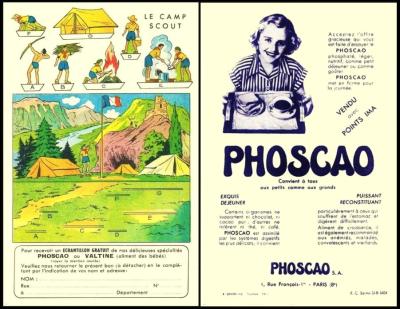
Here we have the birth of the delight of camping for many boys and girls, and it also sorts out those who will never want to do it again, those who will always flock together with other campers for the fun and revelry, and those who are happy to sleep all alone in a muddy field with no companions and probably no "amenities" either....and it is from this last group that most explorers come.
The idea of this set is that the scene has vertical lines across it in certain places. These lines are numbered, and if you look at the little figures too you will see they also have numbers. Then it gets to the difficult bit, for you have to incise the lines (without incising anything else) and cut neatly round the little figures, and slot the numbered base into the numbered line. You will also see a dotted line part way down the picture, and that is a fold line, which enables the printed scene, here of the tents, to act as a backdrop for the cut out figures.
I have to say that most of these cards were probably ruined during the effort at making them work, and just discarded. I seriously doubt anyone attempted to make "Le Train du Far West", which not only involves cutting out a train and several carriages as one shape, but then bending this curvaceously round to make an arc. And this is backed up by the fact that the train is the card you are way more likely to find. But saying this, we must give thanks to the children who knew, instantly, that doing any of this was not for them, and left their cards untouched for us to enjoy today.
At first I thought this was one card in a set devoted to camping, but it turns out that it is all kinds of scenes, so I have changed the title. I do not know the actual title, yet, but what I have will suffice for now. Finding this out also led to another discovery, that the set was issued several times, as you can find cards with several pictorial backs, and also non-pictorial, text only, ones.
There are also other types, much more brightly coloured; most of these just cut out to make a model, but I have seen one of these which is a hybrid; half of the card shows a cowboy and a very Bonzo like dog at a picnic, and the other is to be removed and cut out, that has a lion, a cactus, and a palm tree, which fit in slots on the top picture.
However for now I will only deal with the cards in our style, of which the ones I know so far are :
- "Haute Couture" - six cut outs, two models, a designer, a fitter with a dress, seated women, and the runway
- "Le Camp Scout" - seven cut outs, a tent, five tabs of uniformed boy scouts, and an almost unclothed boy with a bow
- "Le Coin des Poupees" - eight cut outs, a child and doll, a ball, a teddy, a doll on its back, a baby, a pram, a wardrobe, and a playpen.
- "Le Train du Far West" - six cut outs, a long train, a tree, a cactus, two Native Americans, and a tepee.
- "Savoie" - two cut outs, a pair of skiers and one who has fallen [Savoie is a region in the French Alps, famed for skiing]
- "Sur L`Aerodrome" - five cut outs, an aeroplane, a luggage trolley, a car, passengers, and a set of runway stairs.
- "Tout le Monde au Travail" - six cut outs showing people at work
If anyone can add to this, please do. I did think it closed at six, but then I saw the final one online, albeit rather too small to make out what the figures were doing.
Friday, 21st November 2025
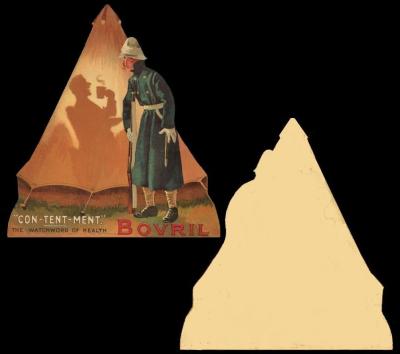
This is another reader`s card, and they know nothing about it.
And I have to say I have not been any more successful.
It is a very striking card though, and very skilfully done, for it has the aura of being a "hold to light" card without actually being one.
The uniform, of the long blue outer-coat, ought to be easy to trace, but it is not. And the white pith helmet was routinely issued to any military personnel sent to hot countries from the 1850s until the 1950s. It did change its shape though, and it also changed its colour, after the Anglo Zulu war of 1879, when it was discovered that the whiteness of the standard issue pith helmets made the men good targets, for which the solution, in a typically British way, was for the soldiers to stain their helmet with tea. After that became common knowledge, the manufacturers started making pith helmets in a colour called "khaki", which is Indian for dust.
We also know that Bovril was invented in the 1870s, by a Scottish butcher, called John Lawson Johnston, but at that time it was sold as "Johnston`s Fluid Beef". However, it only became "Bovril" in the 1880s, a name that Mr. Lawson-Johnson conjured up from a combination of the beginning of the Latin for ox-like, which was "Bovinus" (which is where we get "bovine" from, referring to cows and the like) - and a recently popular novel written by Edward Bulwer-Lytton, called "The Coming Race", which involves a race of people who lived far below the Earth, and who were far superior to humanity, because of a strange electro-magnetic substance called "Vril".
What Edward Bulwer-Lytton thought of this is not recorded.
And there we must close, so I can get my hot chocolate and thence to bed. But tomorrow I will fill the gaps, as soon as I can.
Thanks for tuning in, and I will see you all again next week....