
It has been quite a task to get this newsletter done this week, and it not entirely finished yet, but time has beaten me. However considering how much of it I have finished I ought to be very delighted. And I will add all the things I wanted to in time.

Donruss [trade/commercial : cards : O/S - USA] "Twister" - promo card (1996) 1/1
Today ought to be Skywarn Recognition Day, as it has been on the first Saturday in December since 1999 - but this year it has been cancelled, due to a lack of time and resources. The committee that operate this annual event hope that next year, which they are already planning, will be the best ever.
You may be wondering why we are celebrating something that is not on - to which we say is that not the best time, to keep the dream alive.
The day was started by the National Weather Service (founded on February the 9th, 1870) and the American Radio Relay League (founded on April the 6th, 1914). Given those dates, we are not sure why they picked this day for the celebrations - but we will try to find out.
The idea behind it was to celebrate all the assistance given by the second to the first as far as reporting localised weather incidents, which may otherwise go unnoticed, and therefore be able to track this weather right the way across America, issuing warnings along the trajectory if a pattern can be worked out in time. Most of their reports are on heavy rain, snow, and gales, but they also monitor tornadoes, which are much more lethal, not necessarily because they are fast (anywhere from 100 to 300 m.p.h), but because they can be two miles across at ground level. Worst of all, despite the popular image of them, which is also on our card, not all are this visible.
These radio operators often sit at home and just watch the skies in their spare time. And some of them rely on a smaller network of people in their locality who report straight to them. They hardly ever go out and "chase" tornadoes.
With that in mind, perhaps our card is rather a tangent, for it promotes a film, released in May 1996, about storm chasers. And they are primarily out there to sell their footage to television and news papers, rather than to participate in scientific analysis, or to pass the information on so that people may be saved - though in these modern times, when their footage goes online, especially on social media, it can actually do a pretty good job of informing lots of people at the same time.
Returning to our card, this was a promotional item, issued to advertise the set in advance of its release. It was unnumbered, and it only mentions "your local card store" though we know that some cards were distributed with card and collecting magazines, including "Non-Sport Update".
The set that it advertised is quoted as comprising a base set of 90 cards, two checklists, and nine foil parallels. However there were no cards numbered 89 and 90, the final card was number 88, and the checklists were numbered 91 and 92.
Some collectors also actually consider it as a base set of seventy-two cards, which are the film scene cards - they count the nine "Emergency Personnel" cards and the seven "Behind the Scenes" cards as sub-sets, even though they follow on in the numbering. The film cards are certainly much easier to acquire, and there is a belief that these other cards were produced in lower quantities in order to keep making the collector buy ever more packets.
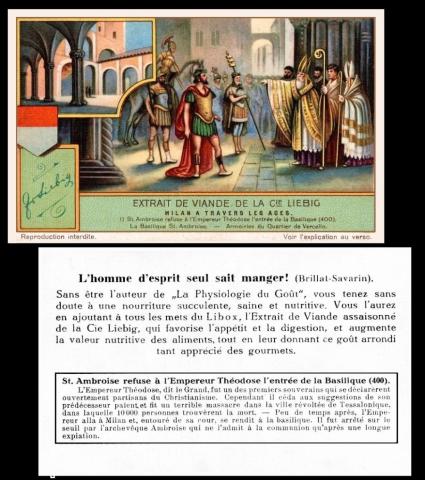
Liebig [trade ; meat extract : O/S - South America] "Milan Travers les Ages" / Milan through time (1930) Un/6 - F.1241 : S.1242
Do we have any readers in Milan? Well, if we do, then you will already know that today is the feast of the patron saint, St. Ambrose, and he is celebrated every year on this day.
For everyone else, Ambrose of Milan was born in wht was then France and is now Germany, about 339 A.D., as a Roman-Christian, and was actually of Greek descent. His birth date is arrived at from a letter which he wrote saying he was fifty-three years old, and that has been dated for the year 392, however the actual piece was not dated, it just mentions events which allowed historians to presume it
When he was very young his father died. We are not really sure who he was either. His mother moved to Rome with her three children, all of which became Saints as well (his brother as St. Satyrus and his sister as St. Marcellina). The family seem to have still maintained themselves to a reasonable standard, and Ambrose went to school, where he studied literature, law, and rhetoric, which is an interesting little subject, often studied in conjunction with the law, as it is the skill of persuasion. And he quickly found employment with the government, becoming a judicial councillor first, and then the governor of Liguria and Emilia, which was based in Milan.
Whilst he was there, in 374, the incumbent Bishop of Milan died. In his official capacity our man went to supervise the election of the new Bishop, only to become elected - despite the fact that he was a Nicene Christian and the former Bishop and many of the congregation were rivals to that faith, being Arians. Possibly with this in mind, he refused - though he was also neither baptized nor a student of religion. The Arians would not back down though and our man became the Bishop within a week.
He seems to have been a good Bishop, he gave his land to the community, and his money to the poor (save a stipend for one his sister).
Our card shows an event that happened in 380, and it concerned a man called Theodosius. He believed that Nicene Christianity was the true faith, and spoke out against the Arians and others. The boiling point was we know as the Massacre of Thessalonica, in 390, which happened whilst Ambrose was out of the area, and when our man found out, he contacted Theodosius, in an attempt to bring peace and cool things down. What he said was that he would not give communion to Theodosius unless he said that he was sorry for what he had said and done. And Theodosius chose to comply. However it was in a far less grand manner than this card shows - there was no so called "Encounter at the Door" where our man barred Theodosius from entering.
Ambrose died on the fourth of April 397, aged approximately fifty-seven - just two years after Theodosius.
The only thing I am still struggling with is his canonization, there seems no record of when it was done, and curiously he always seems to have been regarded as a saint, even in his lifetime.
Our set was issued in France (as "Milan a Travers les Ages" - or Milan through the Ages") - and Germany (as "Mailands alten Tages" - or Milan in olden times)
The subjects are :
- St. Ambrose refusing Emperor Theodus entry to the basilica (400 AD)
- Departure of the Death Legion to fight against Barbarosso (1150)
- Barnabo Viscosti checks his hunting dogs (1350)
- Bonaparte's entry into Milan (1796)
- Withdrawal of the Austrians after their occupation (March 1848)
- Liberation Day (June 8, 1859)
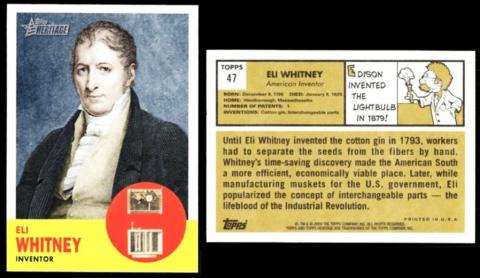
Topps [trade/commercial : cards : O/S - USA] "American Heritage" (2009) 47/150
Our third date celebrates the birth of Eli Whitney, today in 1765, to a farming family in Westborough, Massachusetts, USA.
His mother died when he was just eleven and his father remarried a short time after, to someone who openly opposed his desire to go to college. This seems to have caused a bit of trouble, and it is recorded that he started working as a school teacher, plus,intriguingly, a labourer on a farm, the "a" of which seems not to suggest he was doing that on the one owned by his family.
He entered Yale in 1789, and graduated in 1792, ostensibly to study law, but he found that too expensive, and took up a chance offer to teach privately in South Carolina. On the journey there, though, fate stepped in, and on the boat he struck up a friendship with the widow of a Revolutionary War hero. She seems to have taken a shine to our man and introduced him to her husband to be, another Yale alumni, and the two men decided to set up business together.
I am not sure what that business was, yet, but it may well have been cotton farming, because, in 1793, our man invented a mechanical device for separating the wanted "cotton" from the unwanted "seeds". This was a wooden drum, fitted with hooks that caught on the cotton fibers as it revolved and pulled them through a close mesh which the seeds were too big to fit through.
He called this a "cotton engine", but that proved to be a bit of a mouthful, and it was universally shortened to "cotton gin". And though it is seen as so important today, in its time it was not a great success. Even getting the patent granted took almost six months. Oddly, the two men never intended to sell the devices, they were intent on hiring them to the farmers on temporary loan. At first this was popular, but the men struggled to make enough devices to satisfy demand, and also most farmers had handymen who could spend a season with a borrowed device, learn how it worked, and make their own, albeit rudimentary, copy. Another problem is that cotton needs to grow before it can be harvested, so the hire fees were not an all year. And so, inevitably, the company went out of business in 1797.
As for his other claim to fame, the idea of making musket parts which could be manufactured anywhere and fitted, on site, to replace broken ones, that is rather sketchy. He definitely did not invent the idea, for it was used to good effect during the Punic Wars of 264 to 146 B.C. And his involvement in a scheme to make musket parts at all only came from the failure of his "cotton gin" business, which left him pretty near bankrupt, during which time he discovered that the War Department were issuing contracts for the supply and manufacture of muskets, ten thousand at a time, and he had applied for one, which he was given. But he only stumbled on the idea of making interchangeable parts later, most likely in a book, and we are not certain that he ever made them. It also seems likely that he was hoping to use the money not to pay his debts but to get his invention up and running again.
However there was a problem, as he factored in additional costs for his muskets, the tooling, the adaptation of old machinery, and even the purchases of new, that the production required, and even insurance, which it seems the other suppliers did not. That meant that he delivered less actual muskets for his purse than others. But he did, with this, change accounting, and we still use his system today when determining the price of goods.
Sadly during the end of his life he became unwell, with what we today call prostate cancer, and he died in 1825, shortly after his fifty-ninth birthday. His son was also an inventor, but much later, as he was only five when his father died - and it is he who provides the name for one of Yale University`s admissions programmes, not his more famous father. .
The earliest card to show our man was issued in 1887 by the Lone Jack Cigarette Company, part of a set called "Inventors and Inventions". It shows his portrait, above a very modern looking "Cotton Gin", even enamelled in red. The wording below that reads : "Eli Whitney Born 1765 - United States - Died 1825. Lone Jack Cigrette Co. Lynchburg, VA". The reverse is descriptive, but only of the set, not the man, for it reads "One each of this Valuable and Interesting collection of the greatest Inventors and Inventions of the present and past age packed in each box of Lone Jack Straight Cut, Lone Jack, and Special Cigarettes. This edition has been secured at heavy cost, and it should be sought after by every smoker."
His next appearance comes in the American Tobacco Company`s 1911 set of a hundred cards known by cartophilists as T.68, which was variously titled as "Heroes of History" when branded for `Miner`s Extra`, `Natural Leaf Scrap`, or `Royal Bengals - or "Men of History" when branded for `Pan Handle Scrap`.
By the way, forty-eight cards from this set, including the one of our man, seem to have been issued in 1927, with different backs, and as a trade set, by Gridley Butter, who also called it "Heroes of History".
And those were the only pre 1930s issues.
Our card was issued a lot later, and you can find it in three formats, ours, which is the base set - "chrome" which is slightly scarcer - and "chrome refractor", which changes colour as you tilt the card. and is much scarcer, your chance of getting one of those in a standard pack from the shops being only one in a hundred packs.
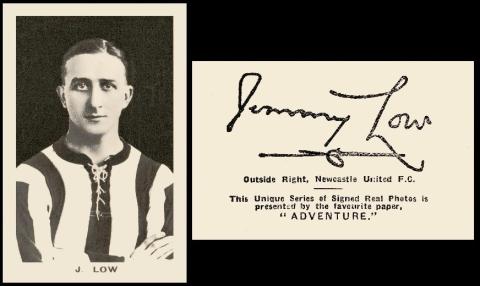
D.C. THOMSON - "Adventure" [trade : periodicals : UK] "Footballers - Signed Real Photos" (21 January to 17 June 1922) Un/22 - THO-355 : THO-17
Today in 1892, the two football clubs called Newcastle East End and Newcastle West End merged, to form Newcastle United.
Before that, we know that the first mention of football being played in the area dates from the third of March, 1877, however it was not an actual named club, for it was only later on in that year that "Tyne Association Football Club" is recorded as having been founded. We are not sure what happened to them.
In 1881 the Stanley Cricket Club started a football team and they won their first match in the November of that year. Then, approximately a year later, they announced that they were changing their name, to Newcastle East End Football Club, because there had been some confusion with a club in another Stanley, over in County Durham.
As for Newcastle West End Football Club they were yet again an offshoot of a cricket team, and were founded in August 1882.
Newcastle East End turned professional in 1889, and became a Limited Company in 1890. As for East End, they were struggling. In fact, in 1892, they approached the East End team and asked if they would like to take their team over. They never seem to have replied to this, though they were gracious enough to take on some of its players and staff when West End, inevitably, failed completely. And they also took over the lease of their stadium. However they still played as Newcastle East End - until today, the ninth of December, 1892, when they decided to become Newcastle United. The change was recorded as satisfactory by the Football Association on the twenty-second of December, 1892, but, curiously, the club was not legally constituted as Newcastle United Football Club Co. Ltd. until the sixth of September 1895.
I do not know why I picked this card, except, hopefully, I have never used this set before. It shows James Low, who was born on the ninth of March, 1894, right in the cusp between the change of name to Newcastle United being recorded and of it being granted. However our man would have probably never imagined this would affect him, as he was born in Kilbirnie, part of Ayrshire, Scotland.
He seems to have started out at Elgin City even before he went to Edinburgh University to study agriculture. This probably developed his skills, which were spotted by a Heart of Midlothian scout whilst playing for the University, and signed up in 1912.
He stayed with Hearts until 1919, though most of the team had volunteered to fight in the First World War. As he had been to University, he was snapped up by the Seaforth Highlanders, until, in 1917, he was wounded in action, in the head.
In 1920 he turns up playing for Elgin City again, then moved to Rangers, where he stayed until 1921, at which point he was signed by Newcastle United. He retired in 1930, and joined his family business, a manufacturer of fishing nets.
Our set has a Scottish version, and indeed the last eight cards from our English version were also issued in Scotland. Thrillingly, that includes the card of our man, which was issued on the 6th of May, 1922.
It is catalogued in our original British Trade Index as follows :
- FOOTBALLERS - SIGNED REAL PHOTOS (A). Sm. 69 x 44. Black glossy photos. Unnd. (35). As issued, there were 22 in the English issue (Nos. 3. 4, 6/11, 14, 15,17, 18, 20, 21, 23, 25, 26, 29, 30, 32/35) and 22 in the Scottish issue (Nos. 1, 2, 4, 5, 12/16, 18/20, 22/23, 31, 32, 34). 8 subjects (Nos. 4, 14, 15, 18, 20, 23, 25, 26, 34) were identical in both issues except for team change of No.25 (A). ... THO-17
- R. Archibald
- F. Barson
- J. Bateman
- W. Birrell
- J. Cassidy
- T. Curry
- Len Davies
- Stan. Davies
- W. G. Donkin
- J. Doran
- A. R. Dorrell
- J. Dunn
- R. Ferrier
- Alec Graham
- T. Hamilton
- R. Kelly
- W. Kirton
- J. Low
- N. McBain
- J. McDonald
- J. McKay
- D. Meiklejohn
- David Mercer
- V.E. Milne
- S. Puddefoot *
- P. Quinn
- A. Rawlings
- W. Salisbury
- E. Scott
- E. Simms
- J. R. Smith
- F. Walker
- W. Walker
- C. Wilson
- R. T. Woodhouse
* team on back "West Ham" in English, "Falkirk" in Scottish issue
In our updated British Trade Index it is slightly differently described, and the list has been removed to the handbook. The entry reads :
- FOOTBALLERS - SIGNED REAL PHOTOS (AD). 1922. 69 x 44. Black glossy photos, signed on back. 22 issued in England 22 in Scotland. Unnd. (35), as 9 photos were issued in both England and Scotland. See HT-43 ... THO-355
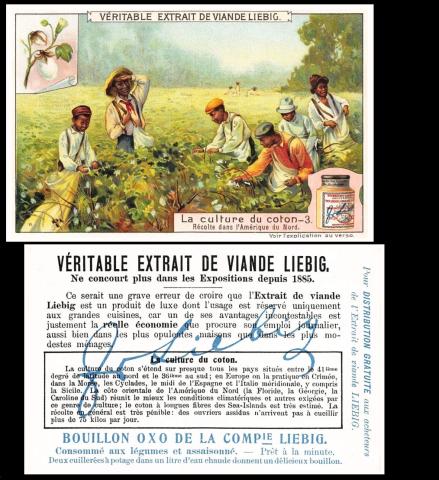
Liebig [trade : meat extract : O/S - South America] "La Culture du Coton" / the production of cotton (1909) 3/6 - F.0951 : S.952
I have no idea why, but I started by writing down "Battle of Dungeness". This was a Naval battle, and I failed to find any cards.
Then I found out it is Human Rights Day, and realised. almost immediately, that I had discarded lots of cards which were suggested to me for Eli Whitney because they featured slaves. This one was slightly less disturbing than some of the others, so it is here.
As for Human Rights Day, that is observed every tenth of September, the same day that the Universal Declaration of Human Rights was read out at the United Nations General Assembly in Paris, in 1948. That document is a blueprint for humanity, and a stand against inhumanity, stating that everyone is entitled to the same basic rights, regardless of race, colour, religion, sex, language, politics, origins, property, birth, or status. And it makes for powerful reading, especially if some of those things are lacking in your own current situation.
The most exciting thing about it is that it has been translated into five hundred and seventy-seven languages - making it the most translated, as well as the most accessible document in the world.
The cards in this set are as follows :
- Ameublissement du soi en Afrique
- Labour et semailles dans L`Inde
- Recoite dans l`Amerique du Nord
- Premier epluchage des fibres
- Mise en ballots et pesage
- Transport de coton sur le Mississippi
This set shows the process and all the people who are involved in it, many if not most of whom are not doing it for love. It starts with a card of ten children, raising wooden beaters high above their heads and starting the process of making the hard soil into something which may, possibly, become loose enough for cotton to be planted and grow into a crop. The children range in size and many of them are too small to be doing such work - and three of them are girls. There are three other figures on the card, attempting to pull an unwanted tree from the patch of soil, two of those are older, but only slightly.
And the saddest thing of all is that when this card was issued, in 1909, nobody would probably have looked it like me and wondered why these children were doing such hard labour, out there in the heat of Africa, and what kind of lives they would have had. Yet most of these would have worked until they died, and sometimes they would have died as they worked. Life was cheap, and tough. And sometimes, still to this day, it remains the same...

TOPPS [trade : cards : O/S - USA] "Comic Book Foldees" (1966) 36/44 - R708-12
Today is #NationalStretchingDay, but it comes with a couple of warnings....
Firstly, the day is actually designed to encourage the general public to find a qualified person who can massage and stretch their bodies - not just to do it alone, for when we do that we often do it wrong, causing more damage. We also stretch but a couple of times and then think that is it, with neither the important warm up or cool down being incorporated. This is especially important if we do not move that much in our daily lives, or if we have had injuries in the past.
Secondly, even the word "stretch" is a misnomer, you cannot actually stretch a muscle like a piece of elastic, nor watch it snap back into shape. What you can do is exercise a muscle to make it more flexible, and less prone to pain when it is suddenly called on to work after much inactivity. And it is this fear of pain which starts to restrict our motion, as we age.
This is a fun card, but it reinforces the wrong idea of making our muscles, and our bodies, longer.
As far as who the character is, I have no idea. The first comic book stretching figure was "The Thin Man", who first appeared in "Mystic Comics" in June 1940, he was an explorer who found a tribe which could make themselves super thin at will. But his costume was blue and red, not just red, and he wore underpants outside his tights and below his belt. He was revived in the 1970s, and given a makeover, changing his suit to to green and yellow, however he still kept his underpants on the outside of those tights too.
In 1941 another stretchy guy came along, called "Plastic Man", and he did wear red, but he always had lacing through his open topped costume. And he was not known so much for stretching as for changing shape.
So if anyone can identify this character on the card, please do.
This set was issued by Topps in America, by O-Pee-Chee in Canada, and then, under license, in England, by A. & B.C. Gum. Check the copyright on your cards for which version you have.
We know that in America and in Canada you got one foldee card, and bubble gum - so they are true trade cards - and that those packs cost five cents each.
A. & B.C. Gum`s packets also contained one foldee and bubble gum, but retailed for three pence each. However I have been told that card 44 was missing from the British versions - a card which shows "Superman holding deadly kryptonite / Baseball Hero auto-graphing ball / boy eating ice cream cone"
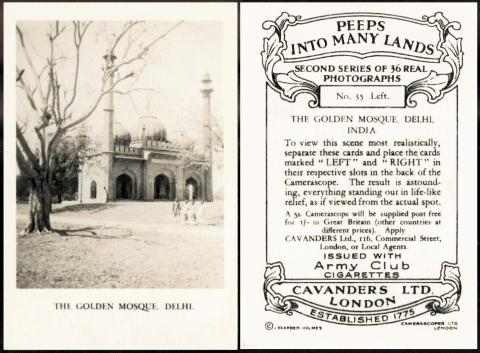
CAVANDERS LTD [tobacco : UK - London] "Peeps into Many Lands" - Second Series of 36 Real Photographs - medium size (1928) 35/48 - C230-150.2.B : C48-3.2.B
Here we have a very poignant card, for it shows a grand monument and ordinary people. However the card is rather misleading, as the building is the Golden Mosque, or Sunehri Masjid, in Old Delhi, and it is not white, as it looks here, it is brown. It was built between 1747 and 1751, and it was repaired in 1852.
This picture makes it appear like nothing has ever changed, but today, in 1911, at the Durbar in Delhi, King George V announced that the capital of India would no longer be Calcutta, it would be moving to Delhi, and that a new city, New Delhi, would be the seat of power. Indeed the foundation stone of New Delhi was laid just three days after, though it took much longer to build the city around it, for that was only inaugurated in 1931.
Today, Calcutta is called Kolkata, and is the largest city of West Bengal. It is right on the bank of the Hooghly River, which is how it came to be so important as an early trading post. Before that, it was three smaller villages under the control of the Nawab of Bengal. In 1690, he gave the East India Company license to trade from there, and they developed the area to suit their purposes, also renaming it Fort William after King William III, which was a good title, as it was nothing more than a fortified and armed headquarters, with garrisons for many men. In fact today it is the HQ of the Eastern Command of the Indian Army.
Delhi is supposedly the fortified area mentioned in the Mahabharata, though no trace of any buildings dating from that time have yet been discovered. There is another story that King Dhillu built the first city in 60 B.C. However, the first tangible reference to it comes in 1214, when it was the capital of the Delhi Sultanate, and then it became the capital, off and on, of the Mughal Empire (for they sometimes used Agra).Then, in 1857, after the Indian Rebellion, it came under the control of the East India Company, and they ceded it to the British Government the following year.
This set has several variations, which are ably described in our original World Tobacco Issues Index as :
- PEEPS INTO MANY LANDS. Black and white photos. Nd. ... C48-3
1. "A Series of..." (36). Size (A) small (B) medium (C) extra-large, 113 x 68
2. "Second Series" (36). Size (A) small (B) medium
3. "Third Series " (24). Size (A) small (B) medium. (B) is found (a) without (b) with "Reprinted by Special Request" on back
In our updated version of this volume, the text above is repeated, but there is a new card code, of C230-150
This week's Cards of the Day...
segued, with the beginning of this month, from Movember to Decembeard.
And I hope that everyone who took part, or supported their friends, in their attempts at growing a monster moustache enjoyed last month....?
Saturday, 29th November 2025
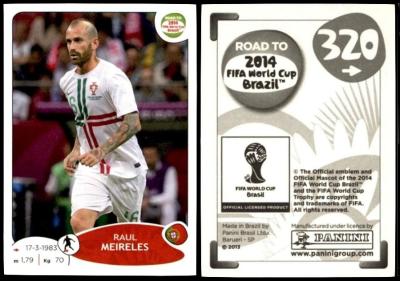
Here we have Raul Jose Trindade Meireles, who was born on the 17th of March, 1983, in Porte, Portugal.
Our man is well known for his beard, and also for his hair, which has varied through the cards from a full head of growth, a Mohican, and baldness. His beard also varies, starting out as stubble, disappearing, and then regrowing again, reaching its peak in 2014 with the Panini set of "Adrenalyn XL FIFA World Cup" and the Topps sets of "Match Attax - England World Cup", and "Match Attax - World Stars" (actually the same picture is used for both the Topps cards, but only the former shows him with a number 16 on his shirt)
His first team was Boavista, his local team, with whom he began in 2001, though for most of that time he was loaned out to Clube Desportivo das Aves.
He signed with Porto in 2004, which is the team he is shown with on his "Rookie" card, no.287 of another Panini set, called "Champions of Europe 1955-2005"
He then moved to England in 2010 after being signed by Liverpool in that year. They traded him to Chelsea in 2011, during which time he was on the team that won the 2012 Champions League trophy. Then he moved to Turkey, to play for Fenerbahce.
As far as his international duties, he played for Portugal in the World Cups of 2010 and 2014.
Our card comes from the second of those tournaments, which took place in Brazil from the 12th of June to the 13th of July 2014, and was the second time the country had hosted - the first was in 1950. The final of our tournament, held at the Maracana Stadium in Rio de Janeiro, saw Germany beat Argentina by one goal to nil.
Sunday, 30th November 2025
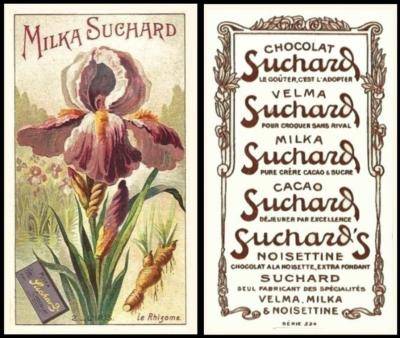
This card, or so I hope, shows the Bearded Iris, or Iris Germanica, a hybrid which can grow up to forty-seven inches tall.
The "Germanica" part comes from Carl Linnaeus, who described it as so in his "Species Plantarum", way back in 1753. As for the "Bearded", that refers to the hairs which grow on the downwards curving lower petals of the flowers, and which you can see quite well on our card.
As this card shows, it grows by means of a rhizome, or tuber, and it flowers from mid to late Spring. Some of the varieties flower again in the autumn, if weather and soil conditions are perfect. It can be grown from seed, but takes longer, the best way is to divide the rhizome into sections and cultivate that .
That is rather a good time to mention that though these cards were given away with chocolate, ostensibly to children, they are quite botanically learned, as they show the preferred method of growing the plant - whether from seed (la graine), pod (la gousse), bulb (l`oignon) or cutting (la bouture) and grafting (la greffe).The most interesting term used is "la marcotte", which means air layering, removing a section of bark right around the branch, covering it with moss, and plastic, and allowing it to root into the moss.
- La Graine - 1. La Capucine [nasturtium]
- L`Iris - Le Rhizome [iris]
- La Giroflee - La Gousse [wallflower]
- La Graine - 4. La Rose Tremiere [hollyhock]
- La Graine - 5. Le Lilas [lilac]
- Le Chrysantheme - La Bouture [chrysanthemum]
- La Violette - La Graine [violet]
- La Tulipe - L`Oignon [tulip]
- La Rose - La Greffe [rose]
- L`Oillet - La Marcotte [carnation]
- La Graine - 11. Le Geranium [geranium]
- La Fuschia - La Graine [fuschia]
I do not know why some of the cards are numbered first and others in the middle, I just copied it as they were. If anyone has a theory do let us know.
Monday, 1st December 2025
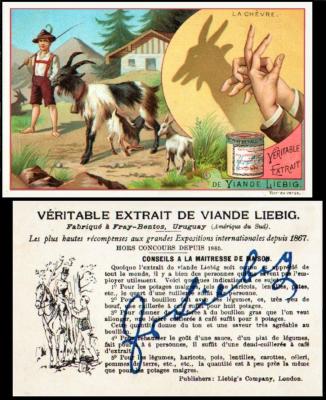
This card might have led you to a "goatee" beard, but we were again going along the horticultural route, and looking for goat`s beard, or Arunculus dioicus - a tall flowering plant with feathery flowers in the summer, leading to one of its other names, "bride`s feathers".
Strangely it is related to the rose.
These are often classed as silhouettes, but they are technically hand shadows (which is the translation of the German version "Handschatten" - a set we featured as our Card of the Day for the 23rd of December 2025).
For some reason our set translates to Chinese Shadows.
The other cards, and equally attractive they are, though I am not so keen on the hare one, are as follows :
- La Chèvre - the goat
- Le Chameau - the camel
- Le lièvre - the hare
- Le Paysan - literally the peasant, but used here for a farmer
- L'Indien - the Native Amerian
- L`oie - the goose
These are available in French (as "Ombres Chinois I), German (as Handschatten I), and Italian (as "Ombretto I" or "Ombre con le mani I")
And there is indeed a second set, "Ombres Chinois II", issued in 1893. which are catalogued as F.0388 and S.0387. The cards there are :
- Le Boeuf - the ox
- Le Canard - the duck
- Le Chauffeur - the coach driver
- Le Chien - the dog
- L`Elephant - the elephant
- L`Escargot- the snail
This is also available in the same three languages, French, German, and Italian
Tuesday, 2nd December 2025
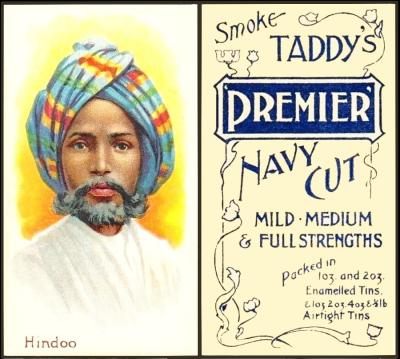
Here we have a "Hindoo", with a beard. The Hindu grow their beards for many reasons, most of which have great significance and is often linked to their spirituality. The length of the beard is also important, for a long beard shows that they are not bothered by the concerns of the material world, or, alternatively, that their god made them in this pattern and it is not for a mere man to alter that design.
In times of rebellion, beards were even more important , for it marked them as being different from the clean shaven government officials who had been, quite unwontedly, "put in charge". It seems that it is only in this context that there is any notion of it being more masculine to grow a beard.
We also know that some Hindu gods were shown with beards. Brahma, the creator, has a long white beard to show his great age and also his wisdom. But it seems that this was added later, as the earliest statues show him clean shaven. The truth is that many things were altered over time, to add features that the current generation, or imposed rulers, preferred - and also, sadly, things were removed which did not fit so well with modern ethics and ideals.
The set is recorded in our original reference book to Taddy issues, RB.12, issued in 1948. The entry reads as follows, though do note that it does number the cards, though they are not numbered in actuality :
- 22. 25. NATIVES OF THE WORLD. (untitled). Size 2 3/5" x 1 1/2" or 67 x 35 m/m. Unnumbered. Fronts : per Fig,15, lithographed in colour. Backs ; per Fig,16 in blue
- Abyssinian
- Afghan
- Arab Lady
- Australian (Aboriginal)
- Bedouin
- Burmese Girl
- Chinaman
- Congo Warrior
- Daughter of Japan
- Hairy Ainu
- Hindoo
- Java Woman
- Kaffir Warrior
- Laplander
- Maori
- Norwegian Bride
- Pygmy, Central Africa
- Red Indian
- Samoan
- Solomon Islander
- Somali
- Tibetan
- Turkish Lady
- Uled Nail Woman
- Zulu Woman
Similar series issued by Sniders and Abrahams with "Standard Cigarettes" in Australia
We featured that Australian version as our Card of the Day for the 16th of February, 2025. It is curious that the pictures are identical, especially as they did not appear for five years, at least, after our set. And James Taddy was still very much in existence.
By the time of our original World Tobacco Issues Index, the Taddy version was recorded as :
- NATIVES OF THE WORLD. (A). Sm. Unnd. (25). See RB.12/22 and H.419 ... T6-19
This text is more or less the same in our updated World Tobacco Issues Index, except that the reference to the Taddy booklet, RB.12, has been excised, and he set has been given a new card code of T045-300
Wednesday, 3rd December 2025
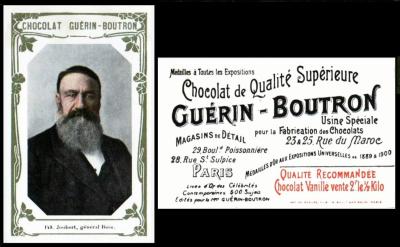
Here we have a very spectacular beard indeed, belonging to Petrus Jacobus "Piet" Joubert, born on the 20th of January 1831. His name sounds very Dutch, but his parents were French. They died whilst he was quite young, after which he relocated to the Transvaal, and became a farmer. He also developed quite an interest in the law, and in his early thirties he was elected to Parliament. He also served as Attorney-General, Chairman, and, even, briefly, Acting-President. He was Vice President, twice. And he did try, four times, to become President, but each time was beaten by Paul Kruger.
Today, historians believe that some of these election results may have not been completely honest. However it must be said that Joubert could have been a difficult President; he was very forthright, and never afraid to stand up for what he believed in, something which could well have led to him being denied his victory, if indeed he was. Reading reports of both men it definitely seems that Mr. Kruger was more of a peacemaker, and Mr. Joubert a fighter.These opinions led directly to his taking a stance against the British , who were trying to gain control of South Africa; and to what became known as the Boer War.
He was not only a military leader, he actually went out and took part in the fighting - though he was also involved with making peace at the end, which resulted in the end of the First Boer War. Sadly this turned out not to be an everlasting peace, and there was a Second Boer War, and not long after.
His death, aged sixty-eight, came on the 28th of March, 1900, from peritonitis. The cause of this is not known; some newspaper reports of the time say he had been suffering from a stomach complaint, whilst others blame it on the fact that three months earlier, in November 1899, he had been thrown from his horse, whilst on a raid against opposing forces.
As for our set, it featured images of five hundred prominent people. This is a Card of the Day, so we may be able to list them, as well as the second series. So let us start with ...
| 1. Thiers, President | 251. General Dubail |
| 2. Mac-Mahon, President | 252. General Doods |
| 3. Jules Grevy, President | 253. General Langlois, senateur |
| 4. Sadi-Carnot, President | 254. General Garneir des Garets |
| 5. Casimir Perier | 255. Lopez Dominguez, Pres Ministes (Espagne) |
| 6. Felix Faure, President | 256. Baron Gera, Ministre hongrois |
| 7. Emile Loubet, President | 257. Francois Coppee, de l`Acadie Francse |
| 8. Guillaume Premier, Roi de Prusse | 258. Ambroise Thomas, compositr de musique |
| 9. Frederic III, Empereur d'Allemagne | 259. Mme Rose Caron, dans Lohengrin |
| 10. Guillaume II, Empereur d'Allemagne | 260. Jane Hading, dans l`Aventuriere |
| 11. Imperatrice d'Allemagne | 261. Jeanne Granier, dans Mme le Diable |
| 12. Prince Henri de Prusse | 262. Mme Nuovina, dans Carmen |
| 13. Le Kronprinz d'Allemagne | 263. Mme Breval, dans le Huguenots |
| 14. Victoria. Reine d'Angleterre | 264. Mme Krauss, dans Sapho |
| 15. Edouard VII, Roi d'Angleterre | 265. Sybil Sanderson, dans Esclarmonde |
| 16. Alexandra, Reine d'Angleterre | 266. Judoe, dans Mme Nitouche |
| 17. Prince de Galles | 267. Mme Richard, dans l`Africaine |
| 18. Empereur d`Autriche | 268. Rosita Mauri, ballet de Sylvia |
| 19. Archiduc heretier d`Autriche | 269. Alvarez, dans Romeo et Juliette |
| 20. Leopold II, Roi des Belges | 270. Jean de Keske, dans le Cid |
| 21. Le Regent de Baviere | 271. Lasalle, dans Henri VIII |
| 22. Ferdinand 1er, Roi des Belges | 272. Muratore, dans Patrie |
| 23. Christian IX, Roi de Danemarck | 273. Van Dyck, dans Lohengrin |
| 24. Prince heretier de Danemark | 274. Renaud, dans Tannhauser |
| 25. Marie-Christine, Reine d`Espagne | 275. Sellier, dans les Huguenots |
| 26. Alphonse XIII, Roi d`Espagne | 276. Gounod, compositeur de musique |
| 27. Georges 1er, Roi de Grece | 277. Massenet, compositeur de musique |
| 28. Olga, Reine de Grece | 278. Coquelin aine, artiste dramatique |
| 29. Victor Emmanuel II, Roi d`Italie | 279. Coquelin cadet, Comedie-Francaise |
| 30. Humbert 1er, Roi d`Italie | 280.. Ballot-Beaupre, 1er Presidt Cour de Cassation |
| 31. Victor Emmanuel III, Roi d`Italie | 281. Rodin, sculpteur |
| 32. Helene, Reine d`Italie | 282. Emile Faguet, Academie-Francaise |
| 33. Nicolas I, Roi d`Italie | 283. Ernest Lavisse, Academie Francaise |
| 34. Leon XIII, Pape | 284. Le comte d`Haussonville, Academie-Francse |
| 35. Pie X, Pape | 285. Jules Claretie, Academie-Francaise |
| 36. Wilhelmine, Reine de Hollande | 286. Paul Bourget, Academie-Francaise |
| 37. Prince Henri de Hollande | 287. Henri Lavedan, Academie-Francaise |
| 38. Charles 1er, Roi de Portugal | 288. Maurice Barres, Academie-Francaise |
| 39. Amelie, Reine de Portugal | 289. Ribot, Academie-Francaise |
| 40. Alexandre II, Empereur de Russie | 290. Maurice Donnay, litterateur |
| 41. Alexandre III, Empereur de Russie | 291. Alphonse Daudet, litterateur |
| 42. Imperatrice douairiere de Russie | 292. Alexandre Dumas fils, litterateur |
| 43. Nicholas II, Empereur de Russie | 293. Delmas, dans Romeo-et-Juliette |
| 44. Alexandra, Imperatrice de Russie | 294. Talazac, dans Manon |
| 45. Charles I, Roi de Roumanie | 295. Tittoni, Presidt des Ministres (Italie) |
| 46. Albert, roi de Saxe | 296. Stolypine, 1er Ministre (Russie) |
| 47. Alexandre, Roi de Serbie | 297. Lepine, Prefet de Police |
| 48. Draga, Reine de Serbie | 298. Georges Berry, depute de Paris |
| 49. Peter Ier, Roi de Serbie | 299. Revoil, Ambassadeur |
| 50. Oscar II, Roi de Suede | 300. Sisowath, roi du Cambodge |
| 51. Deucher, President en Suisse | 301. General Zede |
| 52. Le Roi de Wurtemberg | 302. General de Luxer |
| 53. Le Sultan Empereur de Turquie | 303. General Picquart, ministre |
| 54. Cleveland, President des Etats-Unis | 304. General Michel |
| 55. Mac-Kinley, President des Etats-Unis | 305. General Kessler |
| 56. Roosewelt, President des Etats-Unis | 306. General Lebon |
| 57. Le Shah de Perse | 307. General de Torcy |
| 58. Le Bey de Tunis | 308. Amiral Gervais |
| 59. Dom Pedro, Empereur du Bresil | 309. Amiral Germinet |
| 60. L`Empereur du Japon | 310. Amiral Touchard |
| 61. Alexeieff, Amiral Russe | 311. Amiralissime Anglais Wilson |
| 62. Makaroff, Amiral Russe tue | 312. Sir W. Vaughan - Lord Maire |
| 63. Skrydioff, Amiral Russe | 313. Le Roi de Saxe |
| 64. Kouropatkine, General en Chef Russe | 314. le Roi de Siam |
| 65. Togo, Amiral Japonais | 315. Mohamed-en-Naser, bey de Tunis |
| 66. Kuroki, General Japonais | 316. Don Carlos de Bourbon d`Espagne |
| 67. Stoessel, General commandt a Port-Arthur | 317. Prince Louis de Battenberg |
| 68. Gregorevitch, Commandr du Cesarevitch | 318. Prince Adalbert de Prusse |
| 69. Mourawieff, homme d`Etat, Russe | 319. Baron de Mohrenheim, ambassadeur |
| 70. Liniévitch, General Russe | 320. Combarieu, ambassadeur |
| 71. Grand Duc Wladimir de Russie | 321. Imperatrice du Japon |
| 72. Grand Duc Paul de Russie | 322. Reine Douiairiere de Portugal |
| 73. Nodzu, General Japonais | 323. Reine Douiairiere d`Italie |
| 74. Roudnieff, Captaine du Varyag | 324. Princesse Henri de Prusse |
| 75. Flug, General d`Etat-Major Russe | 325. Princesse Eitel d`Allemagne |
| 76. Marechal Oyama, Japonais | 326. Princesse Albert de Belgique |
| 77. Don Jaime de Bourbon d`Espagne | 327. Princesse Pauline de Wurtemberg |
| 78. Grand Duc Nicolas Nicolaievitch | 328. Princsse Clementine de Saxe Coburg |
| 79. Eitel Frederic, cadet de Guillaume II | 329. Princesse de Montenegro |
| 80. De Bulow, grand chancelier Allemand | 330. Psse Gve Adolphe de Suede |
| 81. Mgr Favier, eveque de Pekin | 331. Princesse Royale de Grece |
| 82. Tolstoi, ecrivain Russe | 332. Princesse Andree de Grece |
| 83. Guyot de villeneuve, depute | 333. Leon y Castillo, amb. d`Espagne |
| 84. De Witte, ministre d Finances, Russie | 334. Lady Curzon Vice Reine des Indes |
| 85. Jules Verne, ecrivain | 335. Ex-Princesse Louise de Saxe |
| 86. Rennenkampff, general Russe | 336. Reine de Wurtemberg |
| 87. Grand duc Alexis de Russe | 337. Grande Duchesse de Luxembourg |
| 88. Grippemberg, general Russe | 338. Princesse Christian de Danemark |
| 89. Princesse Clementine de Belgique | 339. Duc de Anhalt |
| 90. Princesse royale de Suede | 340. Cardinal Richard, archeveque de Paris |
| 91. Princesse Helene d`Orleans | 341. Mgr. Lecot, Archeveque de Bordeaux |
| 92. Gde dsse Elisabeth, Vve du grand duc Serge | 342. Cardinal Merry del Val |
| 93. Bon Hayashi, ambr japonais a Londres | 343. Mgr Amette Coadjuteur, Archeveque de Paris |
| 94. Nogi, general japonais | 344. Mgr Montagnini |
| 95. La Duse, tragedienne italienne | 345. Mgr Lanusse |
| 96. Mme Rejane, actrice | 346. Mgr Dandole |
| 97. Mlle Cesbron, de l`Opera | 347. Mgr Pechenard |
| 98. Sarah Bernhardt, tragedienne | 348. Edmond Rostand, de l`Academie Francaise |
| 99.Grand duc Serge | 349. Etienne Lamy, Acadie Francaise |
| 100. La Kronprincesse d`Allemagne | 350. Comte de Beauregard, Acadie Francse |
| 101. General Davoust | 351. Victorien Sardou, Acadie Francse |
| 102. Prince royal de Suede | 352. Henry Houssaye, Acadie Francse |
| (Monseigr Darboy is actually card 402) | 353. Berthelot, Acadie Francaise |
| 103. General Veyron | 354. Paul Hervieu, Acadie Francaise |
| 104. Kitchener, general Anglais | 355. Anatole France, Academie Francaise |
| 105. General Billot | 356. Emile Olivier, Acadie Francaise |
| 106. General Brugere | 357. Thureau-Dangin, Acadie Francaise |
| 107. General Metzinger | 358. Brunetiere, Acadie Francaise |
| 108. Amiral Fournier | 359. Ludovic Halevy, Acadie Francse |
| 109. Shibayama, amiral Japonais | 360. Rene Bazin, Acadie Francse |
| 110. De Spaun, amiral Autrichien | 361. Campbell Bannermann, ministre Anglais |
| 111. Clado, capitaine Russe | 362. Antoine, Directeur de l`Odeon |
| 112. Kaulbars,general Russe | 363. Bouguereau, Peintre |
| 113. Kasuakof, amiral Russe | 364. Curie, Savant |
| 114. General Zurlinden | 365. Piou, Depute |
| 115. General Jacquey, depute | 366. General d`Armagnac |
| 116. Amiral Bienaimé, depute | 367. Lavalliere, dans Miquette et sa mere |
| 117. President Kruger | 368. Mme Bartet, Comedie Francaise |
| 118. Duc d`Anmaie | 369. Marthe Regnier |
| 119. General Jeannerod | 370. Arlette Dorgere, Varietes |
| 120. Amiral Puech | 371. Germaine Gallois, Revue des Varietes |
| 121. General de Boisdeffre | 372. Suzanne Yris, dans Mlle Josette ma femme |
| 122. General Bonnal | 373. Renee Despres, dans le bon Juge |
| 123. General Rau | 374. Sorel, Comedie Francaise |
| 124. General Duchesne | 375. Robine, Comedie Francaise |
| 125. General Florentin |
| 126. Lansdowne ministre Anglais | 376. Presidt. Forrer, Confederation Suisse |
| 127. Etienne, ministre de l`Interieur | 377. Messager, Compositr, Directr, Opera |
| 128. Le Prevost de Launay | 378. Frederic Masson, Academie Francse |
| 129. Prince Radolin, ambassadr Allemand a Paris | 379. Carducci, Poete Italien |
| 130. Gladstone, Homme d`Etat Anglais | 380. Kurino Ambassadr Japonais a Paris |
| 131. Pasteur | 381. Marquis de Vogue, Academie Francse |
| 132. Bienveau-Martin, ministre d. Cultes | 382. Marquis de Segue, Academie Francse |
| 133. Rouvier, ministre des Affaires Etrangeres | 383. Paul Deschanel, Academie Francse |
| 134. Gauthier, ministre d. Travaux Publics | 384. Boissier, Academie Francaise |
| 135. Dujardin-Beaumetz, ministre d. Beaux-Arts | 385. Tornielli, Ambassadr d`Italie a Paris |
| 136. Clementel, ministre des Colonies | 386. Docteur Roux, Institut Pasteur |
| 137. Thomson, ministre de la Marine | 387. Baron de Courcel, Ambr, St Petersbourg |
| 138. Guillaume, sculpteur | 388. Jules Simon, Academie Francaise |
| 139. Botha, general Boer | 389. Edouard Drumont, ecrivain |
| 140. Carolus Duran, peintre | 390. Franco Dictateur du Portugal |
| 141. Dewet, general Boer | 391. Bryan, Democrate Americain |
| 142. Marechal Canrobert | 392. Sir Bertie, Ambr d`Angleterre, Paris |
| 143. Gaston Paris, academician | 393. Jules Meline, Senatr ancien Ministre |
| 144. Sir Ed. Monson, ambassadr Anglais | 394. Cruppi, Ministre du Commerce |
| 145. Doumer, president de la Chambre d. Deputies | 395. Pichon, Ministre des affaires etrangres |
| 146. Dausset, depute de Paris | 396. Jules Ferry, homme d`Etat |
| 147. Ruau, ministre de l`Agriculture | 397. A. Balfour, Ministre Anglais |
| 148. Chamberlain, ministre Anglais | 398. Jose de Heredia, Academie Francse |
| 149. Joubert, general Boer | 399. Puvis de Chavannes, Artiste peintre |
| 150. Jules Lemaitre, ecrivain | 400. Taft, President des Etats-Unis d`Amerique |
| 151. Princess de Galles | 401. Richard Wagner, Compositr de Musique |
| 152. Miss Alice Roosevelt | 402. Monseigr Darboy, Archev. de Paris (looks like 102!) |
| 153. Duchesse de Cumberland | 403. Stanley, explorateur Anglais |
| 154. La Reine de Suede | 404. De Nelidoff, ministre Russe |
| 155. Princesse Charles de Suede | 405. Mgr Bourne, Arch de Westminster |
| 156. Duchesse d`Aoste | 406. Cardinal Vanutelli |
| 157. Infante Marie Therese | 407. Menelick II, Roi d`Abyssinie |
| 158. Haakon VII, roi de Norvege | 408. Mohammed-Ali, Schah de Perse |
| 159. Reine de Norvege | 409. Manuel II, Roi de Portugal |
| 160. Le Comte de Turin | 410. Sully-Prud`homme Academie Francs |
| 161. Princesse Olga de Cumberland | 411. Archidue Charles-Louis d`Autriche (found looking right and left) |
| 162. Princess Henri de Battenberg | 412. Abd-el-Aziz, sultan du Maroc |
| 163. Lord Minto, vice-roi des Indes | 413. General d`Amade |
| 164. Prince Georges de Grece | 414. Duc d`Oporto |
| 165. General Brun, chef d`etat major general | 415. General Mercier, ancien Ministre |
| 166. Marquis Ito, Japonais | 416. General Dubois, Gouvernr de Paris |
| 167. Prince Albert de Belgique | 417. Pce Frederic II, Grand Duc de Bade |
| 168. Duc d`Aoste | 418. General de Lacroix, Generalissime |
| 169. Duc d`Abruzzes | 419. General Tremeau |
| 170. Baron Komura, Japonais | 420. General Bailloud, Commandt le 19e corps |
| 171. Prince Albert de Prusse | 421. Prince Andre de Grece |
| 172. Prince Ferdinand de Baviere | 422. Comte de Flandre |
| 173. Prince Henri de Battenberg | 423. Prince Constantin, Royal de Grece |
| 174. Duc de Connaught | 424. Feu Archdue Rodolphe d`Autriche |
| 175. Le Reverend Pere Didou | 425. Souza, 1er Ministre de Portugal |
| 176. Sir A. Douglas, amiral anglais | 426. Mme Segond-Weber, comedie Francse |
| 177. Gilgenhiemb, gener, com` a Strasbourg | 427. Mme Deschamps-Jehin, de l`Opera |
| 178. Stoetzerm genal commt a Metz | 428. Augusta Holmes, Compositeur de musique |
| 179. Von Einem, min de la guerre, Prusse | 429. Reine douairiere de Hollande |
| 180. May, amiral anglais | 430. Ex-Imperatrice Eugenie |
| 181. Bridgeman, amiral anglais | 431. Princesse Beatrice de Saxe-Cobourg |
| 182. Barry, amiral anglais | 432. Gde Duchesse de Mecklembourg-Schwerin |
| 183. Amiral Caillard | 433. Mlle Cleo de Merode, de l`Opera |
| 184. Gen. Dessirier, gouvr de Paris | 434. Mme Eames, de l`Opera |
| 185. Barrere, ambassadeur a Rome | 435. Mme Delna, de l`Opera |
| 186. Gen, Dalstein, comt le 6 corps | 436. Mme Litvinne de l`Opera |
| 187. General Hagron | 437. Gilda Darthy, role de Mme de Montespan |
| 188. General Pendezec | 438. Marthe Brandes, Comedie Francaise |
| 189. Prince de Monaco | 439. Tse-hi, Imperatrice de Chine |
| 190. Prince Georges de Cumberland | 440. Mme Curie, savant |
| 191. Fischer, amiral anglais | 441. Mme la Comtesse de Flandre |
| 192. Grand Duc de Hesse, Allemagne | 442. Comtsse Longay, Ex-Archucsse Stephanie |
| 193. Duc de Cambridge | 443. Mme Calve, de l`Opera |
| 194. Prince Charles de Suede | 444. Psse Louise de France, Carlos de Bourbon |
| 195. Le Khedive d`Egypte | 445. Feue Imperator Elisabeth d`Autriche |
| 196. General Gallieni | 446. Princes Marie Bonaparte Georges de Grece |
| 197. Gen. Michal, comt le 20e corps | 447. Duchesse de Guise |
| 198. General Voyron | 448.Psse Gractz, ex-archiduc Valerie d`Autriche |
| 199. Amiral Menard | 449. Mme Marguerite Carre, de l`Opera-Comique |
| 200. de Brazza, explorateur | 450. Princse de Reuss, Tzarine de Bulgarie |
| 201. Paul Cambon, ambassr a Londres | 451. Tchoun, Regent de la Chine (V) |
| 202. Henner, artiste peintre | 452. Archiduc Leopold, Ferd d`Autriche (V) |
| 203. Bihourd, ambasr a Berlin | 453. Mohamet V. Emp de Turquie (V) |
| 204. Bompard, ambasr a St. Petersbourg | 454. Prince Joachim d`Allemagne (V) |
| 205. Edison | 455. Prince Oscar de Suede (V) |
| 206. Prince Henri d`Orleans | 456. Prince Eugene de Suede (V) |
| 207. Fremiet, Sculpteur | 457. Prince de Mecklemburg (V) |
| 208. Bartholdi, Sculpteur | 458. Prince Christian de Danemarck (V) |
| 209. Colonne, directeur des concerts | 459. Prince Georges de Serbie (V) |
| 210. Jules Cambon, ambasr a Madrid | 460. Prince Francois de Bourbon (V) |
| 211. Benjamin Constant, arte peintre | 461. Ernest Reyer. Musicien (V) |
| 212. Gerome, artiste peintre | 462. Becquerel, Savant-Chimiste (V) |
| 213. Fallieres, President | 463. Gen. Fevrier, Ancien Gd-Chancelier (V) |
| 214. Detaille, artiste peintre | 464. General Altmayer (V) |
| 215. De Neuville, artiste peintre | 465. Jean Charcot, Explorateur (V) |
| 216. J.-P. Laurens, artiste peintre | 466. Rene Doumie, Academie Franse (V) |
| 217. Bonnat, artiste peintre | 467. Jean Richepin, Academie Franse (V) |
| 218. Berlioz, compositeur | 468. Andre Theuriet, Academie Franse (V) |
| 219. Saint-Saens, compositeur | 469. Henri Poincare, Academie Franse (V) |
| 220. Nadaud, poete chansonnier | 470. Maitre Barboux, Academie Franse (V) |
| 221. Victor Hugo | 471. Melchior de Vogue, Acadie Franse (V) |
| 222. P. Leroy-Beaulieu, economiste | 472. Raymond Poincare, Acadie Franse (V) |
| 223. Mounet-Sully, tragedien | 473. Marcel Prevost Academie Franse (V) |
| 224. Constans, ambasr a Constantinople | 474. Cte Albert de Mun, Acadie Franse (V) |
| 225. Princesse Ena de Battenberg | 475. Cherbuliez, Academie Francaise (V) |
| 226. Princesse heretiere de Roumanie | 476. Ed. Pailleron, Acadie Francaise (V) |
| 227. Prince heretier de Roumanie | 477. Legouve, Academie Francaise (V) |
| 228. Carmen Sylva ecrivain, reine de Roumanie | 478. Camille Doucet, Academie Franse (V) |
| 229. Princesse de Roumanie | 479. Gabriel Hanotaux, Acadie Franse (V) |
| 230. Princesse Louise de Danemark | 480. Jean Aicard, Academie Francaise (V) |
| 231. Princse Nicolas de Grece (Helene de Russie) | 481. Verdi, compositeur Italien (V) |
| 232. Prince Nicolas de Grece | 482. Ed. Branly, Savant (V) |
| 233. Prince Max de Bade | 483. Marconi, Savant (V) |
| 234. Psse de Bade Marie-Louise de Cumberland | 484. Monseigneur Couille (V) |
| 235. Grand Duc de Bade | .485. Monseigneur Dechelette (V) |
| 236. Princesse de Wurtemberg | 486. Cardinal Langenieux (V) |
| 237. Grand Duc de Luxembourg | 487. Monseigneur Guillibert (V) |
| 238. Prince Ferdinand de Baviere | 488. Amiral Courbet (V) |
| 239. Prince heritier de Portugal | 489. Amiral Boue de Lapeyrere (V) |
| 240. Prince heritier de Montenegro | 490. General Serviere (V) |
| 241. Duc de Scanie, Prince de Suede | 491. General Pau (V) |
| 242. Amiral Rieunier | 492. General Leberram (V) |
| 243. Gen. de Moltke, chef d`etat-major allemande | 493. General Rouvray (V) |
| 244. Monseignr Turinaz, eveque de Nancy | 494. General Lefort (V) |
| 245. Cardinal Perraud, de l`Academie-Francaise | 495. General Warnet (V) |
| 246. Pierre Loti, de l`Academie-Francaise | 496. General Robert (V) |
| 247. Madame Heilbronn, dans Manon | 497. Jules Breton, Artiste-Peintre (V) |
| 248. Marie Laurent dans Michel Strogoff | 498. Joseph Bail, Arrtiste-Peintre (V) |
| 249. Auguez, de l`Opera, dans les Hugenots | 499. Paul Baudry, Artiste-Peintre (V) |
| 250. Taskin, de l`Opera-Com., dans la Basoche | 500. Harpignies, Artiste-Peintre (V) |
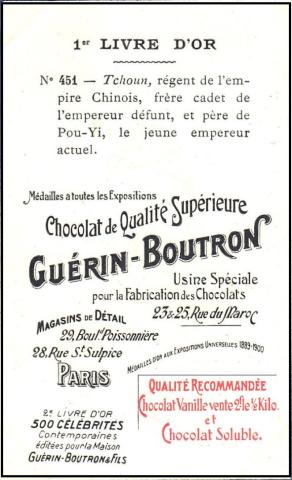
Now something has come to light whilst doing this list and that is that some of these cards are found with a different, vertical back, shown here. The earliest one found so far is on card 451, of Tchoun, Regent de la Chine. This back is not only of a vertical presentation though, the wording is different too - up the top it now says "I er LIVRE D`OR" (or First Gold Book) and down at the bottom the advertisement in red cites "QUALITE RECOMMANDE Chocolat Vanille vente 2f le 1/2 kilo et Chocolat Soluble", the "Chocolat Soluble" being an addition not on the original horizontal card. In addition to the left of that section is slightly different wording to ours; ours saying "LIVRE d`Or des Celebrites Contemporaines 500 sujets Edites pour le Mr. GUERIN-BOUTRON" and the vertical card saying "2e LIVRE D`OR 500 CELEBRITES Contemporaines editees pour la Maison GUERIN-BOUTRON & FILS". What that means is that what was just a set, became the first set, and his sons have now added in to the company. So it looks likely that at this time there was, or there shortly would be, another, second, series of cards. Now the next bit is harder, the proof, and we get this be finding out if anyone has a card numbered between 451 and 500 with a horizontal back. If so then the cards were reprinted with the vertical back some time later, when the second set came along. Alternatively, if the cards numbered between 451 and 500 only have a horizontal back the second set started to be issued before the first had even finished, and they chose to advertise them as a coming attraction by using a different back for the last fifty cards of the first series to drum up the interest.
Thursday, 4th December 2025
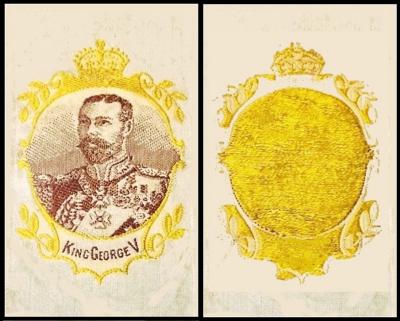
This card is rather a curiosity, as it was scanned for me and supplied as having been issued by Anstie - yet the only "King George V" in our original reference book to that company is recorded as follows :
- 1915. 1. KING GEORGE V. (untitled). Woven on ribbon. Size 2 5/8" x 3 3/4" (approx). Portrait in black, framed in red and surmounted by crossed Union Jacks and oak leaves. Produced by J.J. Cash, Ltd. Coventry.
The mystery is partially cleared up with the arrival of our original World Tobacco Issues Index, which tells us in the heading under Anstie`s name that "For Anonymous woven silks issued by the firm see Sets ZS.1".
That is in the accompanying handbook under "Anonymous Issues (4) - Silks", and the subsection "2. Unbacked silks" (to differentiate from those which were issued with paper on the back, from which the silk was peeled, and on which were often directions for use and, sometimes, even, a list of the other subjects in the set. This sub-section starts with the following :
2.A. BRITISH EMPIRE AND AMERICAN SILKS.
(a) ANSTIE WOVEN SILKS. Issued 1914-1916 in U.K., by Anstie. Width sizes only are quoted; the silks were prepared in ribbons and cut into non-uniform lengths.
- ROYAL STANDARDS AND PORTRAITS. (A). Single silks. See Ha.495.2. .. ZS1-3
1. Royal Standard. Large, width 61 m/m
2. King George V. (a) Large, width 71 m/m. Black frame
(b) Large, width 71 m/m. Gold frame
(c) Small, width 35 m/m
3. Queen Mary. (a) Large, width 71 m/m. Gold frame
(b) Small, width 35 m/m
4. Lord French. Large, width 71 m/m. Black frame
5. Lord Kitchener. Large, width 71 m/m. Black frame
These still remain in the anonymous section of the updated version of this book, and the text has not changed. However there is a new card code of ZS01-700.
Friday, 5th December 2025

ZZ Top`s first cartophilic appearance came in 1979, ten years after they were formed, with an unusual set issued by Warner Bros Records which they promoted as being "...the next big thing in music collectables". This never actually happened but the eighty odd cards do feature some great images, and the information on the back is very good, listing some of their hits, their birthdays, astrological signs, hometowns, and a short biography. It turns out that Billy is a Sagittarius, born on December 16th, and that Frank`s surname is actually Beard, though he does not sport one.
They were first featured on a Panini sticker in 1985, card 101 of the "Smash Hits Collection", which was available with an English language (that has a biography on the back) and a German one (which does not). The biography reads "ZZ Top formed in 1970 by Texans Billy Gibbons (guitar), Dusty Hill (bass) and Frank Beard (drums). Describing themselves as "a little ol boogie band from Texas" - toured constantly - sometimes sharing stage with live rattlesnakes and buffalo". They were also in the 1986 set (card 26) and the 1987 set but that varies as far as the numbering between the British set (No.180) and the Italian one (No.146), though the picture, as always, remains the same in all the printings.
This set is of twenty cards but each is available with two titles as an "a" and a "b". I am having trouble finding this set, but I know that this pair is
19.a - Bearded Billy
19.b. Frank Beardless
Dusty Hill died in 2021.
So we did okay, eventually. The details of the sets from the reference books will be added tomorrow morning if all goes well, and a bit of general tinkering, but I am happy with what I have laid out. And so I am turning in to sleep.....