
Welcome to a fairly Christmassy newsletter to take you through the festive season ! For the next time a newsletter goes live Christmas will be but a memory; it will be the 27th of December. And the one after that will be in 2026.
Who knows what 2026 will bring? Well we can tell you that our Annual Convention will be held in East Anglia, and that we are working behind the scenes to make it the best ever. So do make every effort to come along....
But without further ado, let us return to the present, and entertain you with our latest cast of characters.....
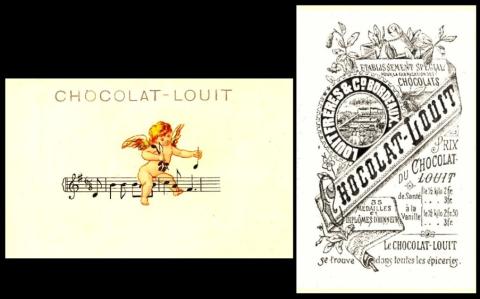
LOUIT-Freres [trade : chocolate : O/S - France] "Cherubins musicaux" / musical cherubs (1900) Un/??
Our first diary date celebrates Christmas in song, and raises up our voices together for a spot of carolling. For today is actually #GoCarollingDay.
Now a carol does not have to be old, or even religious, or even connected with Christmas - for the root of the word means simply "to sing with joy. What we have to be joyful about is not even laid down in any rule-book. And in actual fact it also covers dancing, not just singing.
We have no proof but we think the tradition of short poems and rhymes started with the pagans, as a way to celebrate the Winter Solstice. This idea was then taken over, and made more religious, by the early Christians, some say in the hope that the pagans would join them and become part of their faith, though as the Christian songs were sung in Latin and seldom joyful it is very doubtful many pagans came aboard.
The return to a freer, more joyful song was down to St. Francis of Assisi, who converted the religious songs into more modern, and local, language and used them in nativity plays. These spread from Italy right across Europe, and eventually to Britain, where a booklet, written by John Awdlay, in 1426, lists twenty-five "caroles of Christemas.
The heyday of the carol was the nineteenth and twentieth centuries, when many of our favourites were born. As the years went by the carols changed, becoming more diverse, and also covering more modern subjects. At the same time they seem to have returned to the original form, of songs for joy, making them ever more accessible to the people of today - and also helping them to continue to grow, not just be seen as something out of date and boring.
This card is definitely not boring, there is that cute little cherubim, climbing over a line of musical notes. I wonder if there are other cards in the series, and what form they take? Does the music alter, or are more or different cherubs added? Most of all I wonder whether that music is playable, or if it is a well known tune? If you know this, do please tell. The email, as always, is webmaster@card-world.co.uk

W. & F. FAULKNER [tobacco : UK - London] "Our Colonial Troops" (1900) 52/90 - F150-250.B : F14-11.B
Today in 1883 saw the founding of the Cavalry School Corps, in Quebec City, Canada. This was the first full time, professional, and trained cavalry unit in the whole of Canada.
We know that its first commander was Captain J. F. Turnbull of the Queen`s Own Canadian Hussars, and that he recruited British officers to assist him, including George Baxter, who was the Regimental Sergeant Major, and came to Canada from Aldershot.
The unit saw service first in 1885, against Native Americans, during what has become known as the North West Rebellion. The newly renamed Canadian Dragoons were then sent to South Africa, for the Second Boer War, during which they were given a new name, of the Royal Canadian Dragoons. This is when they started appearing on cards, because all the cards I know of have that "Royal" in their regimental title. These are :
- * Charlesworth & Austin "Colonial Troops" (1900)
- Goodbody "Types of Soldiers" unnumbered
- * Harvey & Davy "British Colonial Troops" (1900) card 24
- Murray "War Series K" unnumbered
- Godfrey Phillips "Types of British Soldiers" card 673
- * Roberts "Colonial Troops"
- * Jas. Bigg "Colonial Troops" (1901)
- * Brankston "Colonial Troops" (1901)
Under that name, they fought in both World Wars; in fact, they still took their horses into battle right until 1940, when they converted to using armoured cars.
And today, now part of N.A.T.O., they are in Ukraine.
This set, and its sibling, for there are two versions, is first described in our original, and first ever Cartophilic reference book RB.1, published in 1942, as :
- 1900. 90. OUR COLONIAL TROOPS (titled series). Size 2 3/8" x 1 1/2". Numbered 1 - 90 on fronts. Fronts, lithographed in full colours; no margins. "Our Colonial Troops" and title above subject. "Grenadier Cigarettes", "W. & F. Faulkner Ltd., London, S.E" at base in brown. Backs, plain.
- 90. OUR COLONIAL TROOPS (titled series). As above but with "Union Jack Cigarettes" "W. & F. Faulkner Ltd., London, S.E" at base. Backs, plain. Printer unknown.
Its next appearance is in our original World Tobacco Issues Index, fourteen years later, and in those years there has been a discovery relating to the "Grenadier" version, for here it appears as :
- "OUR COLONIAL TROOPS". Nd. (90) ... F14-11
A. "Grenadier Cigarettes" - (a) with - (b) without word "Copyright"
B. "Union Jack Cigarettes" . Without word "Copyright"
This means that the initial issue has to have been the non-copyrighted "Grenadier Cigarettes" one, after which someone seems to have attempted to reuse the images and Faulkner applied for to set up copyright.
There has been another discovery by the time our World Indexes were updated and combined into just two volumes and a handbook, and that is even more intriguing, for it reads :
- "OUR COLONIAL TROOPS". Nd. (90) ... F150-250
A. "Grenadier Cigarettes" - (a) with (1/30) - (b) without word "Copyright" (1/90)
B. "Union Jack Cigarettes" . Without word "Copyright" (31/90)
More research needed, methinks.....
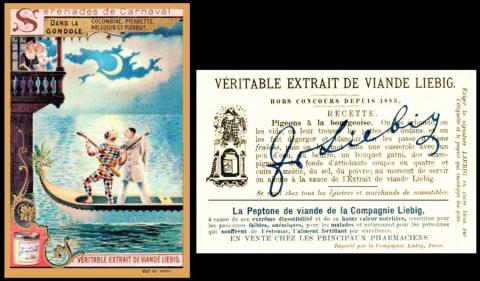
Liebig [trade ; meat extract : O/S - South America] "Serenades de Carnaval" (1898) S.549
If you had been around, in London, in the year 1716, on this day, I wonder if you would have been interested in nipping along to Lincoln's Inn Theatre, and watching what is sometimes said to be the first pantomime ?
Actually it was not the first pantomime, something made obvious by the fact that the word is Latin, formed of the word for all (panto), and the word for dance (mimos). It did not mean lots of people dancing though - when this form of entertainment began, in ancient Rome, it was one man playing all the parts, with the help of masks, and costume changes.
It is said that this spread to England with the Romans, and was copied by local people. However, these local performances are not known until the middle ages, some time after the Romans had left. Also the early tales were morality tales, like St. George and the Dragon, not the fun, music, and dance we connect with panto today.
We do know that back in Italy, the home of the Romans, the use of masks and costumes developed into a kind of musical theatre, and that this formed an offshoot called commedia dell'arte. Almost immediately this paid its actors, making it awhilst profession, as well as an entertainment. It was humour, but also had strict rules and defined characters - a rich, older man, his servant, a pair of lovers, and a braggart. The rich old man would come to be called Pantalone, or Pantaloon - and he had one servant who provided the laughter, whose name was Clown, a name which would come to be connected with all funny characters, plus a more sensible servant called Arlecchino,or Harlequin. At first the lovers were separate characters, often married in real life, but slowly they stepped back and a new character, called Columbine, came along. She was the daughter of Pantaloon, and the love interest of Harlequin, though she was also allowing herself to be courted by a sad faced clown in white called Pierrot, heedless of the fact that he had a girlfriend, called Pierette, who was so in love with him that she mirrored his costume.
Our card shows all four of these people and all manner of tales could be told as to the outcome.
The set is one of the most beautiful of all the Liebigs, and has retained its colour. The cards are available in French (as ), German (as "Carnevals Serenaden"), and Italian (as "Serenate di Carnevale") names
- (G) An den Mond - Kapitan Fracassa, Harlekin, Polichinell u Pierrot
( I ) A La Luna - Capitan Fracassa, Arlechinno, Pulcinella e Pierrot, - (G) An Pierette - Polichinell, Pierette u Pierrot
( I ) A Pierette - Pulcinella, Pierrette e Pierrot - (G) Auf den Dachern - Pierrot a Pierette
( I ) Sui Tetti - Pierrot e Pierrette - (F) Aux Etoiles - Pierrot, Arlequin, Capitaine Fracasse et Polichinelle
(G) An Du Sterne - Pierrot, Harlekin, Kapitan Fracassa u Polichinell
( I ) Alle Sterre - Pierrot, Arlechinno, Capitan Fracassa e Pulcinella - (G) Im Schnee - Harlekin, Kapitan Fracassa u Columbine
( I ) Nella Neve - Arlecchino, Capitan Fracassa, e Colombine - (G) In Der Gondel - Columbine, Pierrette, Harlekin, u Pierrot
( I ) In Gondola - Colombine, Pierette, Arlecchino, e Pierrot
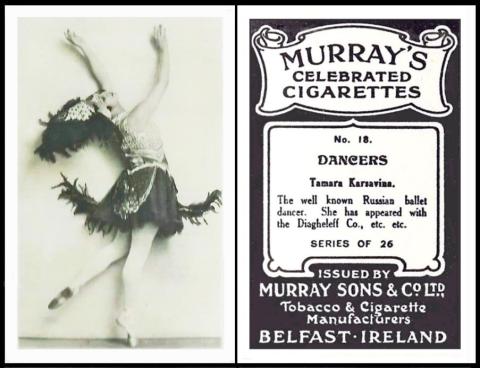
MURRAY Sons & Co. Ltd [tobacco : UK - Belfast, Ireland] "Dancers" (1929) 18/26 - M970-635 : M164-45
Today in 1773 the Moscow State Academy of Choreography was founded, and became the school of dancing for the Bolshoi - which at that time was not a ballet company at all, it was an orphanage, founded by order of Catherine the Second ten years before.
However this was not the oldest ballet school in Russia, that honour goes to the Imperial Ballet School at St. Petersburg, founded in 1738 by Empress Anna.
The first dancing master at our school was the Italian Filippo Beccari, a shadowy figure. We do not know when he was born, or how he got to Russia, only that he came to our school from the Imperial Ballet School at St. Petersburg, along with his wife, a ballerina. They were there from 1773 until 1778 and then he was replaced by a French teacher called Leonard Paradise - and I have found nothing about him at all.
Our lady, Tamara Platonovna Karsavina, was born on the ninth of March 1885 in St. Petersburg, and was a principal artist of the Imperial Russian Ballet. From 1910 she was part of the famed Ballet Russes, run by Sergei Diaghilev (whose name is spelt wrong on this card, and others - as Diagheleff - rather a strange error for a set devoted to dancers).
In 1904 the choreographer and dancer Mikhail Fokine asked her to marry him. Her mother said it was not a good idea, and Ms. Karsavina reluctantly agreed. However it led to much ill feeling between the two, which even affected her career. Her mother then got involved again and told her to marry someone else, a civil servant, which she did, but they were not happy, and divorced in 1917. Then she ignored her mother, and married the British Diplomat Henry Bruce. They had one son, Nikita, who was born in 1916.
The new family moved to England, setting up home in Hampstead, quite close to Anna Pavlova, who had been a fellow student, and quite a rival, at both the Imperial Russian Ballet and the Ballet Russes. Both also knew Mikhail Fokine. It is not certain if this rivalry was ever settled.
We do know that our lady continued to be involved with ballet, and that later in life helped to set up the Royal Ballet and the Royal Academy of Dance. And this is not her only appearance in the set for she can be found as number 24 as well.
Sadly we know much less about our set, and I have not even managed a full list yet...
- Greta Fayse
- Elisia Alanova
- Violet Dunn
- Enid Stamp Taylor
- Vera Bryer
- Greta Fayse
- Violet Dunn
- Billee Maye
- Elisia Alanova
- Enid Stamp Taylor
- Violet Dunn
- Billee Maye
- Tamara Karsavina
- Joan Pickering
- Greta Fayse
- Anton Dolin and Partner
- Billee Maye
- Zoe Palmer
- Tamara Karsavina
All we have is the very scant description in our original World Tobacco Issues Index, which is :
- DANCERS. Sm. 63 x 40. Black and white photos. Nd. (26) ... M164-44
And this exact text appears in our updated version, save a new card code of M970-635
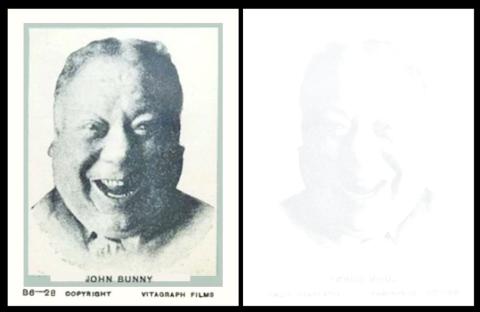
Themans Ltd. [tobacco : UK - Manchester] "Film Stars" - B6 (1914) 28/??
Tonight, in 1818, the Christmas song "Stille Nacht" (or Silent Night) was first performed, at the parish church of Oberndorf in Austria.
This is a tale of twists and circumstances, for the words had been written two years earlier, by Joseph Mohr, who had arrived in the town just a year before. The words may have sat in his desk forever, and never been set to music, but for the fact there had been a flood, which had damaged the church and rendered the organ unplayable. It would not be Christmas Eve without music, so the priest and the organist, Franz Xaver Gruber, got together and tried to think of entertainments. Then the priest wondered if his words might not be set to music, so that a variety of instruments could be used. And the result was the tune we celebrate tonight.
Joseph Mohr was born in Salzburg on the eleventh of December 1792. His mother did sewing and embroidery, and his father had been a soldier, but had deserted, and was on the run. He ran from the child too, and left before he was born.
Sadly some of his father`s inability to settle rubbed off on to our man, and he left Obersdorf in 1819. We know that he served as priest at many churches, and travelled light. And that any salary he was given was either handed to a charity, or used to start one - for abandoned children, to send poor children to school, and for the elderly who had fallen on hard times. And on the fourth of December, 1848 he died, of respiratory disease.
I have gone off on a bit of a tangent here and gone for a silent film star. This is John Bunny and he ought to be better known than he is, if only because he was the first actor to play Charles Dickens` eponymous Mr. Pickwick on the big screen.
He was born in Brooklyn, New York, on September the twenty-first, 1863 and started out working in a general store. For a bit of much needed fun he joined a minstrel show, and he liked that, a lot more than the general store, so he went on the stage.
Then in 1910 he joined the Vitagraph Film Studios, and would go on to make over a hundred and fifty films, many of them with a lady called Flora Finch, who film-goers believed was his wife, but was not - his wife was called Clara Scanlan, but she chose to stay out of the limelight, and the papers, and raise their two children at home.
The Pickwick Papers was released in 1913, in three parts, each a separate part of the book - "The Adventure of the Honourable Event", "The Adventure at the Westgate Seminary", and "The Adventure of the Shooting Party". Sadly the last section no longer exists. It was billed as an authentic recreation of the novel, and was filmed on location in Kent, something that it appears Mr. Bunny had suggested.
The filming was not without incident and huge crowds gathered to watch. This was quite unusual for the time, and Mr. Bunny became quite the fan favourite, with filming frequently being stopped so that he could sign autographs.
However when the film was released in America it was not a great success, mainly because it was more serious than his former knockabout comedies. Sadly, not too long after this Mr Bunny started suffering from kidney trouble, and he died, of Bright`s Disease, on April the twenty-sixth, 1915 .
Themans issued two sets of silk film stars, but neither appear with their listing in our original World Tobacco Issues Index, there is only a note in the header to say "For Anonymous Silks probably issued by the firm see ZP3-1". And actually they are not there either, though the wording which appears, under "Anonymous Issues (4) - Silks" and sub section "1.B - Plain Backed Silks" does explain our numbering - and is as follows.
- B PLAIN BACKINGS. This grouping covers silks which were actually issued with plain backing. Many silks are found with plain backings of various kinds added by collectors.
(a) SILKS WITH BLUE BORDER. Thick board backins. Specimens seen are mostly remainders. Believed to have been issued by Themans about 1912-1917, reported as existing also with firm`s name rubber stamped on backing.
MISCELLANEOUS SUBJECTS (A). See Ha.500. Numbered in series ... ZP3-1
1. Series B.1. Flags. Md. 96 x 50 (? 8)
2. Series B.3 Regimental Badges. Md. 66 x 50. (? 12)
[ our series, B.6 would fit in here ]
3. Series C.1. Flags. Lg. 65 x 55. (? 2)
4. Series C.2. Flags. Lg. 70 x 65 (? 1)
5. Series C.3 Regimental Badges. Lg.. 77 x 64. (? 4)
6. Series C.4 Crests of Warships Lg.. 77 x 64. (? 2)
7. Series D.1 Royal Standard. Extra Lg. 138 x 89 (? 1)
8. Series D.2 Shield of Flags. Extra Lg. 138 x 89 (? 1)
9. Series D.3 Regimental Badges. Extra Lg.. 138 x 89. (? 1)
These all appear in our updated World Tobacco Issues Index, but have now been relocated to Themans, beneath a header which reads "Silk Issues. Plain paper backed silks with Firm`s name rubber stamped. See H.500. Numbered in series. Series seen indicated with * ". These series are B.1, C.1, C.2, D.1, and D.2 . Our set is still not amongst the list. It then directs you to the back of the book again, where a table appears of all the sets, again not ours, though this does prove that there have been some discoveries of new cards, and even sets, for it reads :
- (a) SILKS WITH BLUE BORDER. Thick board backings. Specimens seen are mostly remainders. Believed to have been issued by Themans about 1912-1917, reported as existing also with firm`s name rubber stamped on backing.
1. Series B.1. Flags. Md. 96 x 50 (? 12)
2. Series B.2 Flags. Md. 50 x 66 (? 12)
3. Series B.3 Regimental Badges. Md. 66 x 50. (? 12)
4. Series B.4 Ships Badges. Md. 66 x 50 (? 12)
[ our series, B.6 would fit in here ]
5. Series C.1. Flags. Lg. 65 x 55. (? 12)
6. Series C.2. Flags. Lg. 70 x 65 (? 4)
7. Series C.3 Regimental Badges. Lg.. 77 x 64. (? 4)
8. Series C.4 Crests of Warships Lg.. 77 x 64. (? 4)
9. Series D.1 Royal Standard. Extra Lg. 138 x 89 (? 2)
10. Series D.2 Shield of Flags. Extra Lg. 138 x 89 (? 1)
11. Series D.3 Regimental Badges. Extra Lg.. 138 x 89. (? 1)
Our set is the smaller sized one and is called the "B" series, taken from the prefix to the numbers. The other is a larger, postcard sized set, called the "D" series, for the same reason.
Our set contains these and possibly more :
- B6-2 Chrissie White
- B6-3 Alma Taylor
- B6-9 Pimple
- B6-16 Cleo Madison
- B6-18 Nell Craig
- B6-21 Thomas Santschi
- B6-23 Baby Lilian Wade
- B6-25 Mabel Normand
- B6-26 Leo Delaney
- B6-27 Rose E. Tapley
- B6-28 John Bunny
- B6-34 Mabel Normand
- B6-35 Mabel Normand
- B6-37 Chaplin As He Really Is
- B6-39 Gertrude McCoy
- B6-40 Miriam Nesbitt
- B6-43 Charlie Chaplin
- B6-44 Charlie Chaplin And His Girl
- B6-45 Anna Little
- B6-46 Mary Pickford
- B6-48 Gaby Deslys
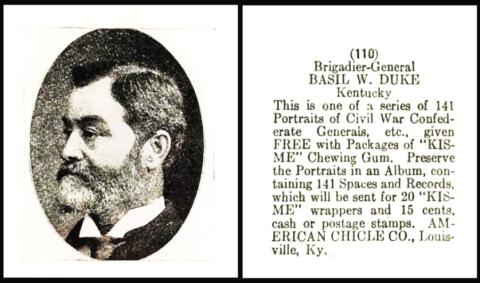
AMERICAN Chicle Co [trade : "Kisme" chewing gum : O/S - Louisville, Kentucky, USA] "Portraits of Civil War Confederate Generals" (1890) 110/141
This is a very unusual Christmas tale, but today in 1868 President Johnson gave out a very special present, when he pardoned all Confederate veterans.
Strangely, article two of the American Constitution does give the President the power to pardon anyone who commits an offense, even one against his country. The only exception is in the case of impeachment. And so President Johnson was able to pardon thousands of former Confederate troops in one sitting.
However the story is more interesting than that, because there had been lots of pardons since the end of the American Civil War in 1865 - and one even a few days before the surrender. There was a codicil though, that the former soldier had to promise never to go to War against the American nation again, and that they had to free any slaves that they owned.
There was a list of exceptions to this though, and he would not pardon anyone who had been at military school, former governors and high ranking officials, or anyone with property valued at over twenty thousand dollars unless they filed a petition with the President himself.
Many of these had gained their pardons, in a series of amnesties between 1864 and 1867, but there was still a core of those former governors and high ranking officials who were holding out, and who did not care if they were pardoned or not. In fact, in many cases, they got quite a bit of pleasure from knowing that they were still outlaws. And they also knew that it would be quite a show trial if they were tried for treason. In effect, they were getting away with it.
This much rankled the President. Then either he, or someone else brilliant, came up with a plan. And that was to pardon all surviving veterans at once, with the statement that he did "declare unconditionally and without reservation, to all and to every person who, directly or indirectly, participated in the late insurrection or rebellion a full pardon and amnesty for the offense of treason against the United States or of adhering to their enemies during the late civil war, with restoration of all rights, privileges, and immunities under the Constitution and the laws which have been made in pursuance thereof".
This did mean that technically the hardcore rebels got away with it, but it made him look magnanimous, and, more importantly, their bragging rights as outlaws were no more.
Our man, Basil Wilson Duke, was born on the twenty-eighth of May, 1838, in Georgetown, Kentucky, the son of a Naval Officer. Both his parents died before he was twelve, and he was sent to college, after which he started to practise law.
Three years later the American Civil War began. Almost immediately our man was involved, starting with drafting the plans for Missouri leaving the United States. He also founded The Minute Men and took on the leadership. He also attempted to take over the arsenal in St. Louis. And all the time he was picking fights, starting fires. He was charged with arson, treason, you name it, but escaped, and set up home in Kentucky.
Even marriage did not settle him, but then his bride was sister to Confederate general John Hunt Morgan. And by 1861 the two were fighting together in the same unit, Morgan`s Raiders.
Our man was wounded, thought missing, presumed killed, captured by the Union, imprisoned, and every time returned to the war. After Morgan was killed in 1864, our man took full control. Then his luck ran out, and he surrendered on May the tenth, 1865.
After the war was over he went back to practising law. He also wrote many books on the American Civil War, including one on Morgan`s Cavalry - and it is due to him that the Shiloh and Corinth battlefields are now preserved as National Memorials . But he was always feisty, and there is strong support for him being involved in some way with the assassination of William Goebel in 1900.
When our man died, on September the sixteenth, 1916, (almost thirty years after this set was issued) he was one of the last Confederate officers still left alive. But his last few years were plagued with ill health, his blood circulation was poor, almost certainly why his right leg was amputated in stages, the last operation being just a few days before he died.
These cards are quite small, just an inch by an inch and a quarter.They were designed to fit in a twelve page album measuring 10" high x 7.5" wide, which is actually titled "Confederate Portrait Album", which had squares in which to stick the cards, beneath which was the information on each card.
The portraits were issued with the gum, but if you could also send in a hundred wrappers and twenty-five cents in cash, and you would receive a complete set in exchange.

TOPPS [trade/commercial : cards : O/S - USA] "Holiday" (22 October 2025) 41/200
To close our celebrations, today is #NationalCandy Cane Day.
This toothsome treat is more an American tradition than it is in Great Britain, but for the uninitiated, a candy cane is a hard sweet, in the shape of a walking stick with a curved end.
Or that is how it is now, for reportedly the first candy cane was just like a long thin stick of striped "seaside rock". That reputedly appeared in 1844, though it was later revealed that it was only the striping that had been added, the stick of hard candy had been around for some time.
And if you look outside America, you will discover that a similar long stick shaped hard boiled sweet was known in Germany and neighbouring countries as far back as the seventeenth century.
Despite that there is no mention of candy canes in books or magazines until 1866, and the Christmas connection only happened in 1874.
Today the shape of the candy cane is reproduced as ornamentation - to hang on trees, much enlarged to push in the ground along the path to your house, and even illuminated ones.
They are not quite so popular yet as they are in America though, so we have chosen an American card for today. This is a really recent set, only issued in the last month, and it is cards from Topps 2025 Baseball set enhanced by the addition of festive frames, and even parts of the picture being given a Christmas twist.
Look at the bat on our card, and you will see it is candy-cane striped. His sleeve is also coloured in a blue festive design. And the frame is certainly Christmassy. But if you look even closer, he is playing on a field of snowflakes...
Our man is Peter "Pete" Crow Armstrong, of the Chicago Cubs. And according to the Trading Card Database, he first appeared on a card in 2017, and now appears on over four thousand....
However he only started his Major League Baseball career in 2023 - the earlier cards are from the junior leagues, in which he started playing in 2014, with the Under-12s.
Another thing we must point out is that his first season in the minor leagues, with the New York Mets, saw him hit not a single ball on the field of play - the season being cancelled by covid,
This week's Cards of the Day...
continued on from last week, looking at another of the unsung heroes of the Christmas story, and this week we have the ox. He is often quoted as being the actual inhabitant of the stable, and he was joined by the donkey only when Mary and Joseph arrived.
However, just like the donkey, if you read the Gospels, you will not find an ox mentioned as being part of the nativity. And there are questions as to why an ox would have been stabled in Bethlehem at all, when they were primarily used on farms to pull ploughs and carts.
The first mention of oxen being used as beasts of burden comes in 4,000 B.C. As to what oxen are, well they are, to put it politely, emasculated bulls - a process which calms them down and allows them to be tamed enough to perform their work, as well as not to have their heads turned by lady cows if any should saunter by. As a young man they are called steers, they only become oxen after they are four years old.
They are usually used for their strength, in jobs which involve pulling and tugging. And depending on what they are being asked to pull, they can be used as a single ox, or harnessed together in pairs or even teams.
Saturday, 13th December 2025
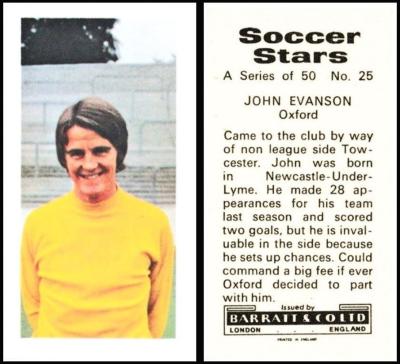
Now you probably thought that this card was an easy one, because it said "Ox"ford United - but that was not the main reason for its choice, because the crest of that team actually shows an ox in a yellow shield.
And that relates to the fact that the city of Oxford derives its name from the fact that oxen and other bovines used to cross the River Isis nearby to attend the much renowned cattle market.
As for our man, John Michael Evanson, he was born in the north of England, at Newcastle-Under;Lyme, on the tenth of May 1947, but the much more southerly side of Oxford United gave him his first gig, when he joined them in 1966. In fact his first appearance in a match was on the twentieth of August, against Bournemouth. That was a 1-1 draw.
The problem with this is that our card tells us he "Came to the club by way of non-league side Towcester". A look at the history of that club says that he started there as an amateur in 1964. Finding any information about that team is not easy though as they folded in 1993. The current team is a brand new one that only started in 2014. However the original team seems to have started around the year 1890, as the Towcester Thursday Football Club, something which suggests they were an offshoot of a cricket club, and they kept that name into the early years of the twentieth century. They only joined the Northamptonshire League in 1929, and left in 1931. After that there is no record of which league they played for, until 1967-68, when they joined the South Midlands League.
And Towcester has another cattle connection, as its Roman name was Lactodrum, or town of dairy farmers....
Anyway, our man stayed at Oxford until 1974, when he turned up at Blackpool, swapping his yellow Oxford strip for an orange one. Then, in 1976, he went to Florida, and played for the Miami Toros (and Toros also means "bull"), but only for a summer, because in late 1976 he came back to England and started a three year stint at Fulham Football Club.
In 1979, he moved down to Bournemouth, and joined the team against whom he had played his first ever match. he played over fifty games with them and then left, for Poole Town. It appears that this was a quasi managerial role, but I can find no proof, though it could well be out there, and someone may be able to assist.
According to the Trading Card Database, this is the only cartophilic appearance of our man - but it is not, for he appears on the set of Daily Mirror "My Club" plain backed postcards, part of card 62, which shows Oxford United. According to the names in the lower border he is that one in the middle of the bottom row, who his sporting long and blonder hair. However these were issued in 1971, so maybe the spirit of the sixties had moved him towards a bit of experimentation with a more "Hippie" look...
If this is our man, then he also appears on another Daily Mirror set, of standard card size, called "Star Soccer Sides", and also issued in 1971.
Our set is first catalogued in part three of our British Trade Index, as :
- Soccer Stars 65 x 35. Nd. (50). ... BAR-129
However it does not appear in the updated version because that only covers cards issued prior to 1970.
Strangely, the set appears to have been a rolling issue, as several of the cards can be found in two versions, the second having new text, in order to reflect the move of that player to a new team - and there is a list of those at the Football Cartophilic Exchange/BSS.
Sunday, 14th December 2025
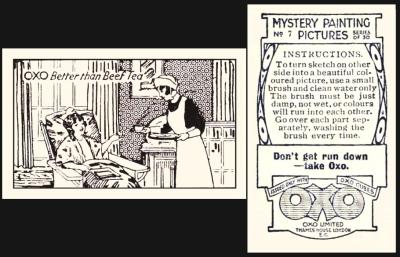
This card was chosen because it was issued by OXO, and also because the wording on the card says "OXO Better than Beef tea".
Sadly, when an ox gets to be about seven years old , it is deemed to be at the end of its working life, And despite the sterling service it has performed, it is fit for nothing more than becoming beef.
The reverse of these cards are descriptive, but only in as much as describing what to do with them, namely to slightly moisten a paintbrush with water and touch each section with it, very gently, washing the brush out after each dab so as not to run the colours together. However, as the painters were children, you can imagine these instructions were seldom followed with the strictness that was intended....
Our card, unusually, is still unpainted, and that makes it quite a rarity.
Now before we gallop on, do note there is a football card in this set, number ten. And also other sports - golf at card 22, and boxing at card 27.
The set is described in our original British Trade Index as :
- MYSTERY PAINTING PICTURES. Min 56 x 34. Nd. (30) ... OXO-7
However, in our updated version when you look at Oxo it says "OXO Ltd., London - See Liebig Oxo".
You do get a much better description there though, namely :
- MYSTERY PAINTING PICTURES. (O) 1928. 56 x 34. B&W, for colouring. Nd. (30) . Back "Brush with damp brush", when colours are revealed. Vari-backed, 5 adverts, each on 6 cards... LIE-190
The different backs are in the box above the “OXO” – and they are
- An OXO a day Keeps illness at bay (2, 10, 15, 20, 25)
- Don’t get run down – take OXO (7, 27)
- For the children`s breakfast a porringer of OXO and milk with bread or toast sippets (3, 19)
- OXO and milk is a splendid nightcap (10, 26)
- Oxo sandwiches make a nice school lunch (4, 8, 13, 18)
As for the cards in the set, they are :
- OXO is refreshing when Fatigued
- OXO gives the Best of Health
- OXO vitality
- OXO Better than Beef Tea
- OXO suits all ages
- An OXO kick
- OXO Sandwiches
- Ma Mither winna gie me any mair OXO it maks me grow out o` ma claes
- OXO makes me grow “nearly as tall as Mother”
- OXO My Nightcap
- OXO promotes a healthy race
- Tommy joined a golf club and since he OXO drinks
he is without exception quite the champion of the links - Quite well, Doctor, thanks to you and OXO
- Now when Sir Thomas Tomkins sits him down to sup,
six other (small) editions share the OXO cup - At cricket and at football, at boxing, hockey, too
he far excelled his schoolmates through training on OXO
Monday, 15th December 2025
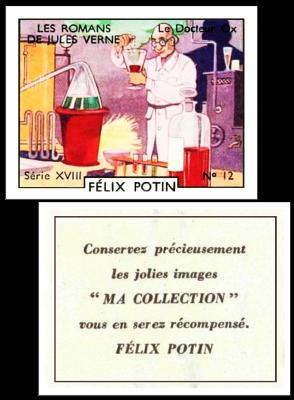
Here we have Doctor Ox, from the Jules Verne novel, "Le Docteur Ox". This is a gentle little tale, about a small town which is totally off the map, but somehow is suddenly seen as being a good place to test a new gas lighting system, designed by the eponymous Doctor. And if you would like to read it, over Christmas, it is online, as part of the Gutenberg project, and available in all kinds of formats for all kinds of computers and e-readers.
I have to say that this is a lovely colourful set, so unlike the early black and white portraits which are more associated with Felix Potin - though, strangely, one of those black and white cards does actually show Jules Verne.
The cards known, so far, from our set are :
- Voyage au Centre de la Terre ["Journey to the Centre of the Earth" - 1864]
- Un Capitaine de 15 ans ["Dick Sand, A Captain at Fifteen - 1878]
- La Maison a Vapeur ["The Steam House" - 1880]
- 5 semaines en ballon ["Five Weeks in a Balloon" - 1863]
- Keraban le Tetu ["Keraban the Inflexible" - 1883]
- Le chateau des Carpathes ["The Carpathian Castle" - 1892]
- De la Terre a la Lune ["From the Earth to the Moon" - 1865]
- Le Pilote du Danube ["The Danube Pilot" - 1908]
- 20,000 lieues sous les mers ["Twenty Thousand Leagues Under the Seas" - 1869]
- Le Docteur Ox ["Doctor Ox" - 1874]
This is quite a mixture, including some of his most famous works, and others which are probably not even known of by modern readers.
However it seems likely that one of the missing ones is one of his best loved books, "Le Tour du monde en quatre-vingts jour" [or "Around the World in Eighty Days", written in 1872.]
Tuesday, 16th December 2025

This is a new issuer for us, so I am most grateful to the reader who supplied it.
You may not realise this, but India has a long connection with smoking - it was almost certainly their first true industry, and today they are the second largest producer in the world..
As for historical references, smoking is mentioned in the Atharveda, for medicinal purposes, and that was written about 1200 B.C. However tobacco was only brought to India in the seventeenth century - before that they smoked cannabis.
The Star Tobacco Co., of Bombay, India was established in 1888 , but did not start to issue cards until 1895-1905. It issued lots of cards of what we call "Beauties" and two sets of cards with playing cards inset, like ours, the other one showing heroes of the Transvaal War.
I have to say that its star is remarkably similar to the logo used on the back of W.D & H.O, Wills` "Star Cigarettes", and maybe that is why their issuing was curtailed.
Our set is described in our original World Tobacco Issues Index as :
- INDIAN NATIVE CHARACTERS. (A). Sm. 62 x 36. Front 2, with playing card inset. Back 4. (52).. Illustrated in "N. & N.", Vol.7, No.4 ... S114-3
The text in our updated version is a little different as it deletes the reference to "N. & N." - it just reads :
- INDIAN NATIVE CHARACTERS. (A). Sm. 62 x 36. Front 2, with playing card inset. Back 4. (52). ... S762-400
Both these have photos, and I will see which scans best. The reference to "N. & N." is not much help to me finding the original photo, as that refers not to our "Notes and News" but to the "Cameric Notes and News", and my copies do not go up that far yet...
Wednesday, 17th December 2025
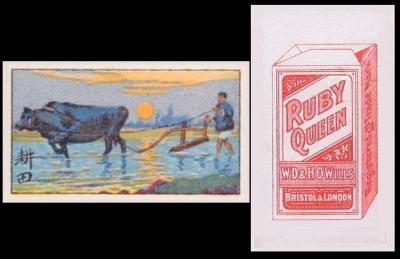
Here we have an ox, in water, pulling a plough, which may seem odd to British eyes, but not when the crop is rice. For rice fields are ploughed, when wet, in just this way, by oxen or buffalo.
This set is first described in our original Wills reference book, part five, or, more correctly, "Cartophilic Reference Book - No.19 : The Cigarette Card Issues of W.D. & H.O. Wills Parts I to IV (revised) and Part V - An Official Checklist Compiled by A Committee of the Cartophilic Society of Great Britain Limited" (or RB.19), which was published in 1951. The entry reads:
- 370. CHINESE TRANSPORT (adopted title). Size 63 x 37 m/m. Unnumbered. Fronts lithographed in colour, captions in Chinese characters. Backs in pink, with illustration of closes `Ruby Queen` packet. There are at least two printings, one with detail more distinct than the other. `Ruby Queen` issue, February, 1914, 41 subjects seen, divided into groups below for ease of listing
Ships and other Water Craft (see also No.45)
1. BAMBOO RAFT in canal, driven by two coolies with poles
2. DRAGON BOAT - long ceremonial rowing vessel with flags, in port
3. FERRY RAFT approaching shore , white coated boatmen and passengers
4. FISHERMEN`S BOAT, half covered, three figures at end, ricks in foreground
5. FISHERMEN`S BOAT, open, with two fishermen and cormorants aboard
6. HABITATION BOAT at anchor, washing hanging at end, small boat at side.
7. JUNK AT SEA, with three sails , small sailing boat in background
8. JUNK IN BACKWATER, one large sail, small open boat at side
9. JUNK IN MOONLIGHT, two sails, reflected in moonlight in water
10.JUNK ON BEACH, two masts, sails folded. two figures in foreground
11. PADDLE STEAMER, white vessel with red flag, black funnel
12. SAMPANS, one empty, one with boatman
13. WARSHIP, white vessel with two funnels, red flag
Mechanically propelled vehicles
14. MOTOR CAR on road
15. TRAIN emerging from tunnel
16. TRAM in city street
Transport with Animals (see also Nos. 42-44 and 46)
17. CAMELS - convoy of camels on outside of city wall.
18. CARRIAGE in street, drawn by two white horses, two drivers in yellow
19. CART - open cart with two passengers and goods, drawn by white horse
20. DONKEYS - two riderless donkeys with saddles, two attendants
21. HORSE, ridden by Chinese, with saddle baskets on either side
22. HORSES, one white, one brown, ridden by ladies in blue
23. HORSES - two horses, laden on both sides with bales of boards
24. OX - by waterside, ridden by coolie
25. WAGON - closed wagon drawn by two brown horses in tandem.
Others (see also No.47)
26. COOLIE in street, carrying large white sack on back
27. COOLIES - two coolies each carrying timber on backs
28. COOLIES - two coolies carrying large packing case suspended on pole
29. PLOUGH - in water, drawn by ox, in morning sunlight
30. RICKSHAW - with two passengers, drawn by barefooted Chinese
31. SEDAN BOX, carried by two coolies
32. SEDAN CHAIR, carried by four coolies
33. STONE ROLLER in street, pulled by four coolies
34. STREET VENDOR carrying long pole with blue suspended baskets
35. STREET VENDOR carrying two baskets of ducks on pole
36. STREET VENDOR with portable stall, two children in background
37. WATER CARRIERS - two coolies, each with two suspended baskets, in river
38. WHEELBARROW with two passengers, pushed by coolie
39. WHEELBARROW with woman with red sunshade, pushed by coolie
40. WHEELBARROWS - two wheelbarrows, first with two packing cases, pushed by coolies
41. WOMAN on road carrying child on back
Similar series issued by African Tobacco Manufacturers, Cape Town (with caption and brief text on back) and by the British Cigarette Co. Ltd., China (blue backs, pictures facing in reverse direction). Anonymous plain-backed cards are known
The following additional subjects are known in the African Tobacco Manufacturers issue, and may later come to light in the `Ruby Queen` issue : -
42. CAMELS - convoy of camels inside of city wall
43. COVERED CART - definitely open on card; three passengers on horse and one ox in tandem; white horse, red saddle
44. COVERED CART - drawn by brown horse, one passenger, driver on foot
45. FERRY BOAT - with packing cases and people. One person on shore.
46. OX CART - black ox, driver in white shirt, blue pants, cart laden
47. RICKSHAW - pulled by coolie; one passenger in white; lady and child in background
48. WATER OX - rider in blue sitting far back on yellow cloth; young one following
The curious thing about this set is that it was printed in London, then shipped out for issue, and we know that because it appears in the list that was first published in the Wills "Works Magazine", then incorporated in our Wills books when they were all reprinted together under hard cover.
By the time of our original World Tobacco Issues Index the set appears as :
- CHINESE TRANSPORT (A). Sm. Unnd. (49 known) See RB.21/200.370.C. Backs 3 and 4 seen ... W62-330
And in our updated volume even more has been discovered. That entry therefore reads :
- CHINESE TRANSPORT (A). Sm. Unnd. (41 known) Backs 2, 3 and 4. Several printings ... W675-472
1. Series of 33, issued in China. All known in back 4, some in backs 2 and 3
2. 8 additional subjects. Only known in back 3.
Thursday, 18th December 2025
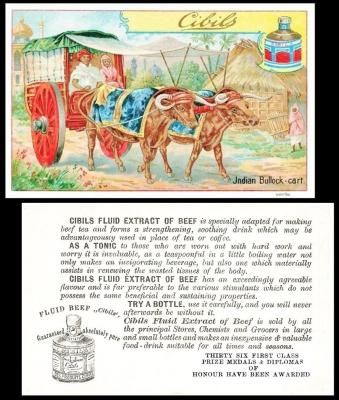
Here we still have an ox, but it is called a bullock, a word for exactly the same animal. but which is used more commonly in the United Kingdom, Australia, and India, as well as several other former colonies, dependencies, and dominions.
Now if you look between the two cart cards we used this week you will see that the wheel size varies considerably -
Tuesday`s card has smaller wheels, and they are much lighter by way of construction, as is the one or two passenger cart. Also the oxen are also different on Tuesday`s card, for they have humps on their backs. That is because these are a different breed, called a Zebu, a strange creature which is a direct descendent of the Indian Aurochs, an extinct species from which we almost certainly derive the name of "ox"
Today`s card shows a more traditional form of oxen, and a cart with much heavier, thicker constructed, and larger wheels. The cart is also more substantial, but that is necessarily why the wheels are larger, for the construction varies widely, depending on the terrain and the degree of sticky mud that the cart may need to push through.
And it seems very likely that Tuesday`s cart is a light run about for town use, whilst today`s is a more rural construction, in a region more affected by flooding. The backdrop on our card, with its thatched roof dwelling, also supports that. very well
The most curious thing about this card, though, is the title, look again and you will see that instead of "Indian" it starts with the letter "J". That is presumed to be a typesetter`s error, perhaps easily explained by the process of type setting, during which the single letter blocks are extracted from their individual compartments and firmed into place to make the word. It may even have been a simple lapse when the words were broken up and put back into the compartments, one "j" falling in amonsgst the "i"s. It is easy enough to do that. However it does not explain why such an error passed right through the printing process without being picked up.
Cibils is proving hard to research. I wonder if we have any specialists reading who would like to supply us with a note about them ?
All I know is that the product was billed as "Fluid Beef Extract - or Concentrated Beef Tea" - and that advertising mentions something rather curious, that being that it is "rich in the egg-white matters, while at the same time it is wholly free from glue."
It was also a prize winner at several International Exhibitions - the South American Continental Exhibition at Buenos Aires (March to July, 1882), the Berlin Exhibition of Hygiene (1882-1883), the International Colonial and Export Exhibition in Amsterdam (May to October 1883), The London International Universal Exhibition (1884) and the World`s Industrial and Cotton Centennial Exposition in New Orleans (December 1884 to June 1885).
Like Liebig`s, the beef came from South America, which could point to why the exhibition in Buenos Aires was their first.
And it was sold by chemists, in small bottles, as a medicine would have been.
Friday, 19th December 2025
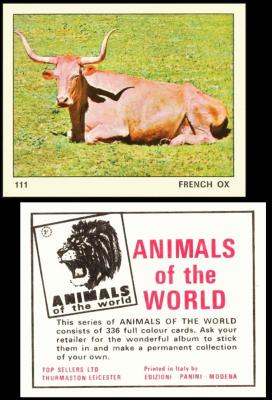
This card may say it shows a "French Ox", but I was at a loss to identify it. I can find cattle with long horns like this but not this light colour, or light coloured cattle with thicker straighter horns. In fact I asked if anyone had any ideas, and I was delighted to hear from Malcolm Thompson who tells us it is a Bearnaise, a French breed of domestic beef cattle named after the area in which it originates, that being the province of Bearn, in the northern Pyrenees, in south-west France.
It seems to have been a good doer, as they say of horses, easy to look after, and not requiring much in the way of special food nor handling. It was also general purpose, the males giving meat, the females milk, and both being used to pull carts and toil about the farmyard when machinery was still more seen in towns.
In fact our picture is almost certainly a manufactured cow, for in the 1920s a great deal of cross breeding went on, merges between the Bearnaise, Basquiase, and Race, to create a light coloured animal called the Blonde des Pyrenees, then the offspring of those cattle being bred with another light coloured breed, Blonde de Quercy. Finally a little bit of Garonnaise was sprinkled into the mixture to create the Blonde d`Aquitaine, but quite some time later, in 1962
For a while it was thought that the original Bearnaise had become extinct, as had the Basquiase, but some of the Bearnaise were found alive in the Aspe Valley, and it was decided to revive it, perhaps because of those really unusually shaped horns. This soon bore fruit, and a new breed standard and herd book was opened in 1982 Just over ten years later a breeder`s association formed, and the breed started coming back. A hundred new animals were bred between 2010 and 2014,
The back of this card quotes "Top Sellers Ltd. Thurmaston, Leicester", but also says it was "Printed in Italy by Edizione Panini Modena".
We know that there were several versions of this set.
One was retailed in America and Canada and the album shows a brown bear and cub to the front, with tiger cubs on the back cover. The album cost fifty-nine cents, in either country. The stickers cost thirty cents a packet, and contained six stickers, but they did not contain gum. And these sets both begin with cards of prehistoric animals. However, in America, and only in America, which seems odd for an album which was sold in Canada too, the inside back cover offered a sticker exchange, a straight swap, one you did want for one you did not - or you could just buy your missing cards for ten cents each. However in both of these cases you needed to send a dollar to cover postage. And you were limited to swapping or buying a maximum of thirty stickers at a time - which had to be different numbers. The address was Panini U.S.A. Inc., P.O. Box 5308, Dept. AOW, FDR Station, New York, N.Y. 1050-5308.
In Italy it was called "Animali Del Mondo", and though the front cover is the same (with the Italian wording overprinted in red within the yellow box, top left which said "sticker album" on the American and Canadian versions) the reverse shows a shelf unit shaped llike an ark into which you could place plastic figures - these were given in exchange for a completed album. The album in Italy cost a thousand lira. The stickers also differ as their album does not start with the prehistoric animals, it goes straight in to animals of North America