
Saturday has come, and much quicker than I imagined it would, but look, we are okay, and we have a newsletter - albeit in some cases not with the card I wanted.
Website News
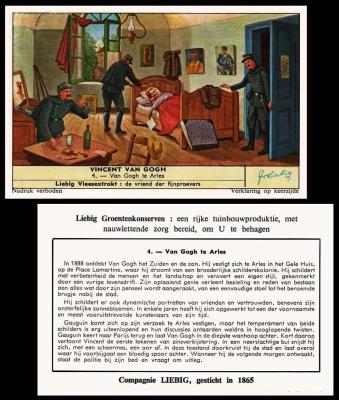
I cracked on with the back issuing this week and added the cards from the newsletters of the 25th of March 2023, the 1st of April 2023, the 7th of April 2023, the 15th of April 2023, the 22nd of April 2023 and the 29th of April 2023. And that`s forty-two more diary date cards!
The only card I had to change in all of those was the one for Thursday, the 30th March 2023, showing here, where I had a card of a generic sunflower whilst the day revolved around the sunflowers by Van Gogh. I am pleased, therefore, to be able to announce that with a little perseverance, and a lot of assistance, we now have a Liebig card of Vincent Van Gogh - and it shows him at Arles, where that particular world record breaking painting was done. Even better, if you look closely between the two men on the left hand side of the card, you can even glimpse a "Sunflower" painting, standing against the wall.
What`s On This Week
Our regular reminder of branch and club meetings.
And remember this is only a portion; the full calendar being found at https://csgb.co.uk/house-of-cards/events-diary
- Sunday the 12th of July : Hants & Surrey - All Day Quarterly Fair, from 10 am until 4 pm., at Normandy Village Hall, Manor Fruit Farm, Glaziers Lane, Normandy, GU3 2DD. Free entry to all collectors
- Saturday the 18th of July : East Anglia - general meeting, from 8.30 a.m. to 3.30 p.m. - with auction at 11 p.m, at Roydon Village Hall, High Road, Roydon, Diss, Norfolk IP22 5RB. EACC members free with annual subscription, visitors pay £3 admission each time.
Do take note that as we approach the autumn, can branch and club secretaries please let us have their 2027 dates as soon as they can, as well as any plans for Christmas celebrations, so that we can allow them plenty of advance publicity?
Thank you all very much.
So on to this week`s newsletter, and its cast of characters, which are ....... a Commemorative Choo-Choo, a Stock Safeguard, a Royal Residence, a Measuring Marvel. a Beneficial Berry, a Country Coach, and a Flemish Festival.....
Lets start with ...
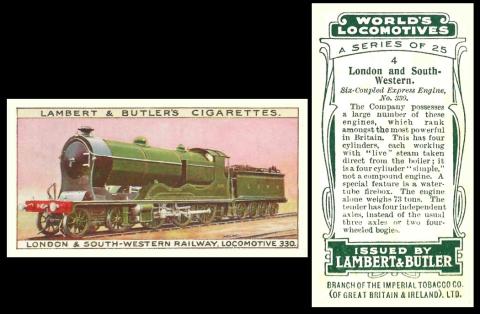
LAMBERT & Butler [tobacco : UK] "World`s Locomotives" (1912) 4/25 - L073-280 : L8-31.1.A
This "Commemorative Choo Choo" is actually not, but it is a tale of tracks and traces, for today in 1848 Waterloo Station was opened.
There are lots of myths about the station and its connection to the Battle of Waterloo, and most of them are incorrect. Lets start with the date, because that is the biggest myth of all. You see the station was not opened two years to the day after the battle had been fought, because the battle was on Sunday the 18th of June, 1815. However, some people will tell you that the station was originally planned to be opened on the 18th, albeit of July, but it was brought forward by a week because of the Derby. But that`s wrong too, as the 1848 Derby was held on Wednesday, May 24th.
As for the station being named after the battle, that`s more complex, and we need to go back to 1809 to start that story, which also starts with an untruth, as you will often read that in that year a bridge, called Strand Bridge, was opened. That`s not true, because the bridge was designed by the great John Rennie in 1809–10 for the Company of Proprietors of The Strand Bridge, who built it privately and intended to get their money back by charging tolls. However by the time it was finally built, in 1817, the Battle of Waterloo had taken place, and the bridge was renamed to The Waterloo Bridge. Now when the station was opened, the area was well known as Waterloo Bridge, and so the station was named after the bridge. Though I suppose it is true to say that in a roundabout way it was named after the battle, even if indirectly.
The third misconception is that the "Victory Arch", or "Waterloo Arch" commemorates those lost at the Battle of Waterloo. Again this is wrong, for it actually remembers the staff of the London and South Western Railway, and the Southern Railway, who were killed in the First World War. It was added in 1922, and a plaque to the six hundred and twenty six staff lost to the Second World War was later erected.
I didnt realise how hard it would be to get a card for this subject, there are plenty of cartophilic references to the battle but the station, no. However, and eventually, I came across this, which although it does not mention the station is one of the London and South Western Railway.trains that would have pulled in and out in 1912, a pivotal year for Waterloo station, because what became known as "The Great Transformation" began to take place, nine years after it had been decided it was needed. The problem was that the original station was built at a time when travelling by train was quite a novel thing to do, but it had since become commonplace, and in order to accommodate the extra traffic, of both trains and passengers, it had expanded, wherever it could, leaving the platform numbering so confusing that getting on the right train was a minor miracle - ten of the platforms being unnumbered, and several of the numbered ones having the same number.
The train on our card, numbered as a 330, was a goods train, not a passenger one, and it was more commonly known as a "saddleback", because of an upside down u-shaped tank that sat on top of the boiler, to carry extra water. But by the time of our card they were elderly, the first one being ordered in 1875, and construction beginning the year after, with the final one, the twentieth, being made in 1882. Ours, numbered as 330, was made in 1876 and was one of the first six to take to the tracks, operating out of what was then Nine Elms, that would serve as the first London railway terminus, before the line was extended to Waterloo in 1848.
Our "330" train stayed with the railway even after it became the Southern Railway, in 1923. but it was withdrawn from service shortly after and scrapped.
This set may be called "World Locomotives" but there are British trains there too, starting with our card, number four, of the London and South-Western Railway. Then it goes on through the North British Railway (No.5), the Great Eastern (No.6), the Midland (No.7), the Great Central (No.8), the Great Northern (No.9), the Great Western (No.10), the London, Brighton and South coast (No.11), the Great Northern (No.12), and the North Eastern (No.13). But for some reason there is a second card of the Great Western down the line as number 24. Not sure why.
Now it turns out that there was actually a group of these issues. which are listed individually in our original Lambert and Butler reference book RB.9, first issued in 1948. Those entries read :
- 102. WORLD`S LOCOMOTIVES. A Series of 25. Fronts printed by letterpress, 4-colour half-tone process. Backs in green, with descriptions. 1912.
- 103. WORLD`S LOCOMOTIVES. A Series of 50. First 25 cards identical to (102), but with 25 subjects added. 1913
- 104. WORLD`S LOCOMOTIVES. An additional Series of 25. Numbered 1A to 25A.Similar format to (102), but different subjects. 1914.
By the time of our original World Tobacco Issues Index they are described as a group. in an entry reading :
- WORLD`S LOCOMOTIVES. Sm. Nd. ... L8-31
1. Cards numbered 1/25 and 1/50
(A) "A Series of 25"
(B) "A Series of 50"
2. "An Additional Series of 25". Nd. 1A/25A
And this text remains the same in our updated volume, with just a new card code, of L073-280
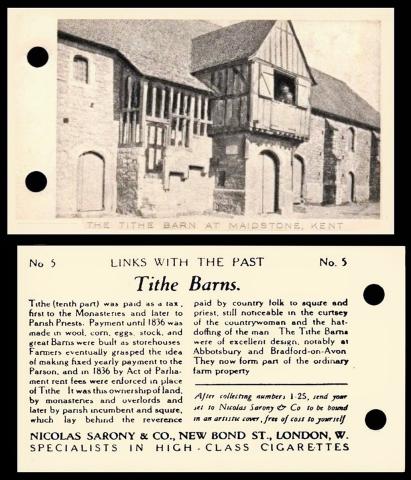
Nicolas SARONY [tobacco : UK] "Links With The Past" - series 1 - small size (1925) 13/25 - S111-350.1.A : S26-11.1.A
Our "Stock Safeguard" brings us to the basic reason for today`s celebration, and that is #BarnDay. For today, and every second Sunday in July, we celebrate , and take some time to ponder on, the true heart of the farmyard.
The barn has a much longer story than the farmyard, though, dating back almost to the first domestication of a beast of burden, about ten thousand years ago, simply because if a man took the time to catch and train an animal it made sense to keep them indoors so it could not wander off or be enticed off by another man who wanted a trained helpmate without having to do any work. And slowly it was realised that the barn gave shelter and protection to tools and harnesses and the animal food as well - and on a wet day you could stay inside and still do some of the tasks like mending, and simple crop sowing.
This multi purpose structure then seemed to disappear, at least in England, where even the word "barn" denoted a place that grain was stored, especially the tithes that the church collected in the middle ages. It was only later that these structures started to be built on farms for the protection of animals, and later still that the characteristic large double doors were added, simply to allow the wagons to come inside, to drop off the harvest, and be stored safely overnight.
The end for the traditional wooden barn was almost entirely due to the fact that hay can spontaneously combust through a combination of moisture and heat, and put the barns and contents at risk. The barn remained, but it was slowly changed to constructions of galvanised steel, and even the return of stone.
This card is from a very confusing set, listed in our original World Tobacco Issues index as :
- LINKS WITH THE PAST. Sm. and Lg. Grey black gravures. Special artistic covers issued for binding sets through holes punched in left hand margins. ... S26-11
1. First 25 subjects. Nd. 1/25. Home issue.
A. Small, 71 x 42
B. Large, 78 x 63
2. Second 25 subjects. Sm. 69 x 40, Lg 78 x 63.
A. Advertisement issue, Lg., without holes punched. Back in blue, with advertisement for set and Sarony Cigarettes. Hand-outs. Unnd.
B. Home issue. Nd. 26/50. Back in black. Size (a) small (b) large
C. Sydney and Melbourne issue. Nd. 1/25. Back in blue. Size (a) small (b) large
D. Christchurch (New Zealand) issue. Nd/ 1/25. Back in blue. Size (a) small (b) large
It`s exactly the same wording in our updated World Tobacco Issues index. but the card code is changed to S111-350.
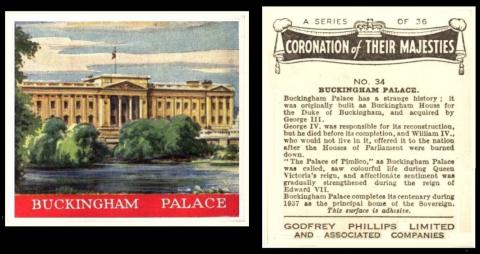
Godfrey PHILLIPS [tobacco : UK] “Coronation of Their Majesties” (1937) 34/50 - P521-430.B : P50-102.B : Ph/57.B [RB.13/57.B]
Many people might be surprised, but today in 1837 Queen Victoria moved into our "Royal Residence", Buckingham Palace. That statement makes it seem rather idyllic, but hold it right there, because it was anything but. She was only eighteen, unmarried, and had been on the throne just three weeks, whilst the house was unfinished, over-run by mice, and most of the fixtures did not work. That had not mattered to her uncle, King George IV, who had started to convert the palace but never finished it, nor his successor, her uncle, King William IV, who decided to stay well away at Clarence House. But she was made of strong stuff, and she was also desperate to get away from her family. And straight away she loved it, and so did her dog, a Cavalier King Charles Spaniel, called Dash.
Her moving in was not just the beginning of her new life, it was the start of modern monarchy, for she became the first permanent royal resident of the palace. However she freely admitted that it only came to life when she married her first cousin, Albert. They had met before, several times, but when she took over the palace he became a sounding board for her plans, and the two grew ever closer. Perhaps, even, without the palace, their futures may have been different. But on the tenth of February, 1840, they were wed, and would go on to see nine children and many dogs fill the palace with joy and laughter.
We picked this card, which is the medium sized version, simply because of the reverse, for it runs along the same lines as what I had already written, speaking of the palace having "a strange history; it was originally built as Buckingham House for the Duke of Buckingham, and acquired by George III. George IV was responsible for its reconstruction, but he died before its completion, and William IV, who would not live in it, offered it to the nation after the Houses of Parliament were burned down. "The Palace of Pimlico", as Buckingham Palace was called, saw colourful life during Queen Victoria`s reign, and affectionate sentiment was gradually strengthened during the reign of Edward VII. Buckingham Palace completes its tercentenary during 1937 as the principal house of the Sovereign."
This set is one of a group of four versions, which have a home page with our Card of the Day for the 23rd of March, 2022. This page is only concerned with the second version, in this squarish medium size, which first appears in our original Godfrey Phillips reference booklet, issued in 1949, as :
B. Series of 36. Medium cards, size 61 x 53 m/m. Backs in brown, with descriptive text, adhesive.
- 57. CORONATION OF THEIR MAJESTIES. Fronts printed by letterpress in colour. Home and export issue, 1937, in three sizes :-
Our original World Tobacco Issues Index records it as simply :
- CORONATION OF THEIR MAJESTIES. Sm. Special album issued. ...P50-102
B. Medium (36)
The 1955 London Cigarette Card Catalogue, issued at the same time as that book, gives us the contemporary retail prices for all the sets, and that for our version was a penny each for odds and two shillings for a complete set
By the time of our most recent World Tobacco Issues Index something really startling had been found out about the small sized set, and that was that it had not originally been planned to be issued for George VI`s Coronation at all. You can read more about that on our home page for this set, with our Card of the Day for the 23rd of March, 2022. Our set is recorded in the updated World Tobacco Issues as follows :
- CORONATION OF THEIR MAJESTIES.
B. Medium (36)
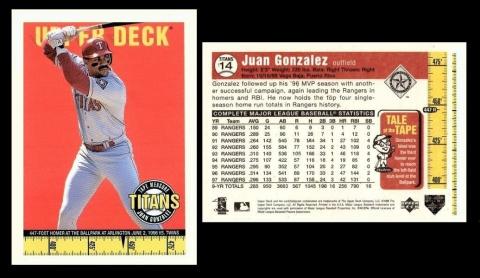
UPPER Deck [trade/commercial : cards : O/S] "Tape Measure Titans" - base set (1998) 14/30
I`m not sure why but sometimes, or maybe even often, I come across an event, and start writing about it, but all the time I`m knowing that cards might be a little hard to find...
And so it was for our "Measuring Marvel", though in the back of my mind I imagined something along the lines of a tailor with a tape measure around their neck, and there are a few of those but the tape measure is rather indistinct. However I was then offered the card we have today, which fits the bill really well, and also shows the tape measure to great effect.
So this is Upper Deck`s "Tape Measure Titans" and it celebrates people whose record breaking hits were recorded by tape measure - for example, this man, Juan Gonzalez, hit a 447 foot home run at the ballpark at Arlington on June the second, 1996 when his team, the Texas Rangers, was playing against the Minnesota Twins.
Juan Alberto Gonzalez Vazquez was born on October the twentieth, 1969 in Puerto Rica. He played sixteen seasons in Major League Baseball and played for four teams, starting with our team. the Texas Rangers, the team that he was most connected with, for he joined them in 1986 aged just sixteen, and remained with, moving to the senior team in 1989 and then staying with until 1999. He would probably have stayed longer, but he was traded - though he returned to them, in 2002, for a further year.
He may have had an even longer career than that, for during his time with the Puerto Rican youth leagues, his friend was given the chance to go to America and play for the New York Yankees, and the idea was that maybe our man would go too, but our man could not afford it and only enough funding was available for one, so his friend, Bernabe Williams Figueroa Jr., went alone, to become famous as Bernie Williams, and be on four World Series championship winning teams with the New York Yankees.
He was traded to the Detroit Tigers, but started the season plagued by injury, and they moved him on to the Cleveland Indians in 2001, after he had repeatedly refused their original intention of moving him to the New York Yankees., for the Kansas City Royals in 2004 and back to the Cleveland Indians in 2005.
Now this card comes in two formats, our base set, of thirty cards, and a gold set, which has a white strip across the front with a pair of limited edition numbers, the first being the number of that particular card, which varies on every card,.and the second being 2,667, which is the same on every card, and is the total number of gold version cards of each player.
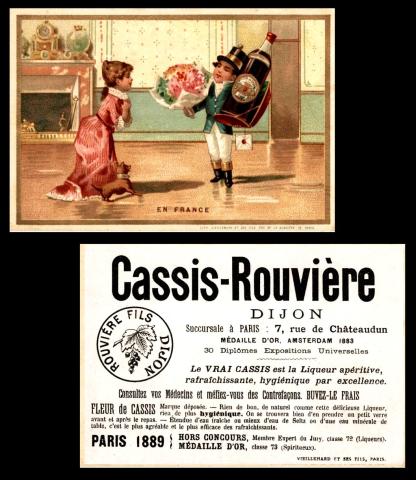
Paul ROUVIERE & Co. [trade : blackberry liqueur : O/S - Dijon, France] "Salutations du Monde" (1889?) un/??
The "Beneficial Berry", of course, is blackcurrant, a deciduous shrub which has small round black berries. And today is it`s day, #BlackcurrantDay, because it is now that they begin to be harvested - though I have to say that, like any fruit, this is subject to the vagaries of the weather, which may advance or retard the growth of the fruit, and that makes me question the fact why this day is fixed to July the 15th, every year.
It`a actually a very new day, too, only starting in 2021; I`ve been writing this newsletter for longer!
As for what you can do with your crop, in the United Kingdom we mainly make jam or Ribena, the drink which swallows up some 90% of the UK crop. Jam is also, and often, home grown and home made, but taking off the stalks and spikes, aka "topping and tailing", is not a fun job and its awfully messy. Easier, by far, to buy a jar.
However, in France, they make their blackcurrants into a drink, called Creme de Cassis, using at least fifteen per cent of alcohol and four hundred grams of sugar. It was supposedly first made in Dijon, in 1841, by a man called Auguste-Denis Lagoute, but this is not strictly true, without inserting the word "commercially", as the area, and many other areas of France, had been mixing the blackcurrants with a variety of brandies and other liqueurs for centuries. What Monsieur Lagoute actually did was to formulate a standard recipe, setting down a set ratio of alcohol, sugars and blackcurrants, so that every bottle was the same.
We know that Rouviere were prolific medal winners - Paris 1882. Amsterdam 1883, Barcelona 1886, Lyon 1894. Paris 1889, Paris 1900, Hanoi 1902, St. Louis 1904, London 1908, Copenhagen 1923, Paris 1931. Our card only mentions Amsterdam 1883 and Paris 1889, but it does say that they had already won thirty diplomas at universal expositions.
In the 1980s the company was acquired by Gabriel Bouier, who, rather charmingly, continue to sell the creme de Cassis as "Paul Rouviere (Crème de Cassis de Dijon)"
This set appears to show greetings of the world, as each bears the front title of a country. So far we know of
- Aux Indes
- En Amerique (Native Americans bowing to a bottle)
- En France (a man presenting a bottle and bouquet to a lady)
- En Russie (Russians at a table)
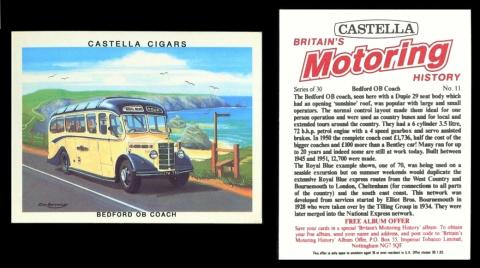
W.D. & H.O. Wills [tobacco : UK] "Britain`s Motoring History"- Castella brand (1993) 11/30 - W675-257.A
Our "Country Coach" brings us to something that Londoners, and other town dwellers, take for granted, and never really think about. You see, today is #RuralTransitDay. and it`s really an American celebration, which, once more, is a relatively recent addition to the awareness day calendar, only coming along in 2019. However, for all our differences as continents, rural transit is common to both, connecting small villages with slightly larger ones, where out-of-towners can go shopping, visit the doctor etc, and meet up with friends that they have not seen in some time.
One of the most famous of these rural route runners is Green Line, which is now owned by Arriva but started out as the outer environs of the London General Omnibus Company. It was run purely as supplementary income, because it was far less profitable than the inner London routes, having fewer passengers and having to travel further distances. This may have been why, on the 9th of July 1930, it was split off and made a separate entity, and differentiated from the red buses by making the vehicles green, simply because some of their routes still ran into London.
In 1970, the Greater London Council became responsible for London Transport, and they split it still further, handing control over to a new organisation called London Country Bus Services. But at that time the rural services were really beginning to lose money, mainly due to the rise in car ownership, which was not only faster but took the driver from door to door, often by a much straighter route
Our card is not a Green Line bus, it is a coach, a Bedford OB. To explain the "OB", in 1939 Bedford introduced a new lorry chassis, called the "O", and it had a version designed for coaches known as "OB". I can`t track down any official records of what those initials stood for, but believe them to be "Ordinary" and "Bus". However, the date is important, because only about seventy coaches were made before the start of the Second World War, at which time most vehicle manufacturers were almost forcibly changed over to making military trucks, tanks, and armoured cars for the war effort. They also made the coaches, but to ferry men from base to base.
Once the war was over, production resumed. And most of them did end up going to local bus companies where they served as rural transport, so maybe this is not such a bad card as I thought. You see, the one on our card was being operated by "Royal Blue", which, as well as being used for special summer seaside excursions, ran a regular route from London and Cheltenham to the West Country and the South Coast, especially Bournemouth - though we should actually be saying that they ran out of Bournemouth, which was the true home of the "Royal Blue" network, which was started there by the Elliott Brothers in 1928.
This card does not appear in our original Wills booklets, nor in our original World Tobacco Issues Index, for all of those were long gone, save in the hands of collectors, by the time this set was produced. So it only appears in our updated World Tobacco Issues Index, as :
3.A CASTELLA CIGARS ISSUES in the 1990s. Special albums issued for Md. size cards.
- BRITAIN`S MOTORING HISTORY ... W675-257.
A. Md. 74 x 57. Nd. (30)
B. Ex. Lg. 149 x 104, postcard format. No series title. Unnd. (6)
This does not mention the fact that the excellent artwork was by Eric Bottomley G.R.A., who was born in Oldham, in Lancashire in 1948. He studied design, art, and crafts at Oldham School of Art, leaving in 1964 to work as a commercial artist in Manchester. However circumstances took him to Dorset in 1974, where he decided not to bind himself that tightly to a single company and instead become a freelance artist. he soon developed one of his great loves into his typical style, and that was trains. And just five years later he was accepted as a member of the Guild of Railway Artists.
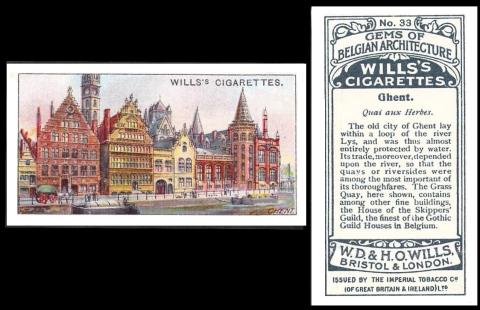
W.D. & H.O. WILLS [tobacco : UK] "Gems of Belgian Architecture" (August 1915) 33/50 - W675-116 : W62-83 : W/70
Let us end the week with our "Flemish Festival", which was a pure guess, but by luck the city we are about to chat about is in the East Flanders province of the Flemish Region of Belgium. And that event is the Gentse Feesten, which takes over the town of Ghent, in Belgium, from today until the 26th of July.
This event is primarily an annual music and theatre festival, but it has evolved to welcome street entertainment such as buskers, amateur musicians, poets, and mime artists, something that was never imagined at its inception, in 1969. Yet as it has expanded, so has its popularity, and today upwards of a million and a half tourists turn up to enjoy it.
As for the date, it seems to have been pure coincidence at first that the National Day of Belgium, the 21st of July, fell within the time of the festival, but in more recent times it has been added as a codicil, to ensure that the date is now included within the ten days of revelry.
The Gentse Feesten, or Ghent Festival, has three very separate stories.
The first was a medieval celebration, more like a harvest festival, which reportedly began to get a little rowdy, and was frowned on by the church, who managed to have it removed from the calendar, though they still expected to share in the harvest.
The celebrations were revived in 1843, as a municipal event, and began on June the 24th with the ringing of the bells. It was primarily for the richer echelons of Ghent, who joined together for horse racing and soirees, but there was also a different kind of celebration, with games and competitions that anyone could try their hand at, at which food was also distributed to those in need, almost certainly continuing the idea of it being a harvest festival. It was supposed to follow strict time guidelines, but local businesses and eateries started opening later and staying open until the morning, for why turn away the customers, and this was agreed to. It is recorded that about four hundred people attended, but I think that was the upper classes, simply because recording all comers would have been a lot harder.
What killed this timeline was the First World War and the invasion of Belgium, during which Ghent was occupied by the Germans. They arrived on October the twelfth, 1914, and put the city under strict military rule.Our card was issued the following year, and is a kind of subtle propaganda, showing the buildings and cities across Belgium which had fallen into enemy hands and ran the risk of being destroyed. Ghent actually became the capital of ‘Etappengebiet IV’ under the authority of the Fourth German Army Corps, but the quays, including ours, were often used at night for smuggling food in and out, right under the noses of the Germans. The city was controlled by the Germans right until November the tenth, 1918, when the Belgian army arrived and took the city back. And the following day the Armistice was signed.
It took a long time to return things to normal, almost a year, and many of the treasures of the city had been looted or destroyed. But in the summer of 1919 there were suddenly posters for a festival, as before, which also remembered the people that had been lost during the war, both in action, and through hunger and deprivation in the city of Ghent - with a peace procession, and the planting of trees. This was not such a segregated affair, and everyone was included, but there was not much money, and so home grown entertainment was the order of the day, puppet shows, local musicians and dancers, and for a few years it continued, but it slowly died away as the 1920s moved on,
Ghent was again occupied by German forces in May 1940 and remained under their control until September the tenth, 1944, when it was liberated by the British 7th Armoured Division, aka the Desert Rats, and a group of local resistance fighters. In 1943 it would have been the centenary of the original festival, but that had to come and go without a word.
The 1950s were again spent in rebuilding the town once more, but in the mid 1960s, with the approach of the hundred and twenty-fifth anniversary of that original festival, there was a rumbling to celebrate it. This gained a figurehead with a local singer, and sculptor, called Walter De Buck, who was involved with an arts centre called Trefpunt. And Ghent did indeed celebrate that anniversary but in a very subdued way, at which the highlight is said to have been a contest for singing finches. That completely misses the fact that Walter De Buck was there with several companions, and they walked through the city singing, dancing, raising funds, and also raising support for a better festival. They repeated this the following year, and though not everyone supported their ideals, the young of Ghent were coming on board and big time.
The following year they still walked through the town, but the parade was growing, and there was now a stage, near Saint James' Church, for anyone who wished to take their turn and perform. That is the true beginning of the modern Ghent Festival, which now has many stages, right across the city, supplemented by locals and tourists giving impromptu performances of all sorts of music, dance and spoken word. And it is currently ranked as the third biggest city festival in the world attracting approximately two million visitors a year.
This was the first "Gems Of...", then there was a fairly substantial gap before "Gems of Russian Architecture" in February 1917, and "Gems of French Architecture" followed fairly quickly along in the November of that year.
Our set is first described in the third part of our original four part Wills reference books as;
- 70. GEMS OF BELGIAN ARCHITECTURE. Fronts lithographed in colour; backs in grey with descriptive text. Home issue, 1915.
This is shortened in our original World Tobacco Issues Index, to simply
- GEMS OF BELGIAN ARCHITECTURE. Sm.Nd. (50) ...W62-83
And that text remains the same in our updated version, save a new card code of W675-116
This week's Cards of the Day...
saw another tie-in with philately, to mark the latest Royal Mail Commemorative stamps, to be released on the 9th of July - and which have just been unveiled.
Unusually this time there are five second class stamps (the emperor moth, the puss moth, the broad-bordered bee hawk moth, the dark bordered beauty moth and the December moth) and five first class stamps (the dark crimson underwing, the scarce crimson and gold, the swallow tailed moth, the hedge beauty, and the buff-tip).
As always we started with some cunning clues, but my moth detecting powers failed me, as none of mine turned out to be moths that appeared on the stamps...
Saturday, 4th July 2026
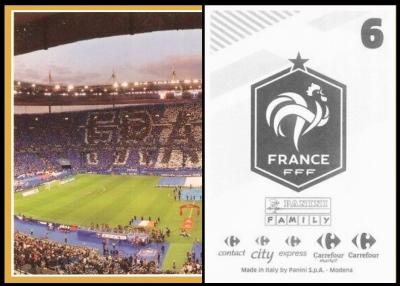
We started our week with this stadium, the Stade de France, because of a rather bizarre incident , for it was the site of a notable moth mobbing during Euro 2016, in which a swarm of hundreds of moths flew around the stands, all over the pitch, and even landed on the players and officials, most notably Cristiano Ronaldo, who sat bemoaning the fact he had been forced to leave the pitch due to injury.
To this day nobody knows what caused the moths to gather. Some say it was the heat, some the fact that the stadium lights had been left on the night before and it had confused them.
We do know what sort of moths they were though - they were "Silver Y", which were a continental species, but one which is becoming a more common visitor to Britain as our climate changes, and, who knows, they may one day decide to live here permanently, for they are already the most common non-resident moth seen in the United Kingdom.
Look out for them on nettles, as well as peas and cabbages. You will easily spot them because they are named from a "Y" shaped mark on their forewings, in a kind of metallic silver, and they are around from summer into autumn, until the temperatures start to dip.
As for the Stade de France, that is in Saint Denis, and it is not just a football stadium, it also accommodates rugby and athletics, plus other non-sporting events, including concerts. It was built between 1995 and 1998, and its "Rookie" card is a sticker, number one of Diamond`s "World Cup", issued in 1998 - though it also features on card two.
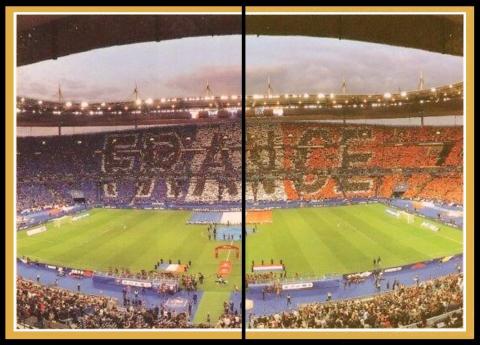
Our card is another sticker, from a set called "Fiers d`etre Bleus" - but it was issued twenty years after the Diamond set.
As for what "Fiers d`etre Bleus" means, it literally translates to proud to be blue, but in popular parlance it has come to mean proud to be French, probably even more than proud of their national team, which wear blue strips.
It has a companion, the other half, which you can find on card seven. And to save you hunting if you put them together you will get this image. I will say that, as demonstrated here, there seems to be rather a shift in colouration between the cards, but I suppose only the purist cares.
Sunday, 5th July 2026

Our second clue was to the name of a moth, one of the largest in the world, called the Atlas Moth, whose wingspan can reach twelve inches, with a surface area of twenty five inches. It is generally regarded as the largest simply because its rivals are the White Witch Moth and the Attacus Caesar, which each have a larger span but a smaller surface area, and by the Hercules Moth which has a larger surface area but a smaller wingspan.
But here we have "Atlas", the mythological being, in the process of being petrified, or turned to stone, by Perseus, in this set which recounts six of the latter man`s feats. I have to say that this card makes Atlas look quite benign, and it seems that he was more hard done by than evil.
His first shaurie was with, of all people, Zeus, the King of the Gods, and that wasn`t really even his fault, he was just singled out as being the best of all the Titan warriors who had fought a war with Zeus, but as a result of that Atlas was made to carry the weight of the heavens on his shoulders. It was never, as often shown, that he had to carry the earthly realms. .
He was busy doing that when Perseus popped by and asked for rest and food, but because he was a bit slow offering it (possibly because he was busy with the heavens) Perseus gave Atlas Medusa`s head in a bag and told him to unwrap it. On doing that, Atlas was immediately turned to stone, forming the Atlas Mountains in Morocco.
However there was another side to Atlas, for he was a philosopher, mathematician, and astronomer, who taught man how to navigate by the stars with a self-invented celestial sphere, and all about farming and gardening. And from him we get the Atlantic Ocean, the lost Kingdom of Atlantis, and even an Atlas of maps, which was named in his honour by Mercator.
The strange thing about this set is that each card has a different advertisement at the top, namely :
- Persee suprend les trois Grees - "Liebig ameliore les soupes fades, corse le bouillon ordinaire, releve le gout de tous les mets"
- Persee recoit l`armature magique - "Cubes OXO donnent immediament un bon bouillon; ameliorent les potages"
- Mort de la Meduse - "Bouillon OXO l`equivalent du pot-au-feu"
- Persee petrifie Atlas - "Compagnie Liebig"
- Persee delivre Andromede - Cubes OXO economisent les legumes et la viande dans les potages"
- Noces d`Andromede - "le force du boeuf, l`arome des herbese potageres"
Monday, 6th July 2026

Here we have a different form of "moth", a de Havilland "Tiger Moth".
Mr. Geoffrey de Havilland named a lot of his aeroplanes after moths, and other insects, and with good reasons - firstly he was a very keen entomologist, and secondly, he knew that though the butterfly wins the beauty contests, the moth is resilient and built for strength, as long as many other qualities that are to be valued in the construction of aeroplanes.
This is not the original "Tiger Moth", that was coded DH.71. It was a single seater, and it was a test piece, built in 1927, to research the possibilities of high-speed aviation, and also as a trialling aircraft for a new engine to replace one called the "Cirrus", which was built out of surplus parts acquired through a company called the Aircraft Disposal Company,. Now the A.D.C. were a British company, set up to make money and also dispose of aeroplanes left over from the First World War, some of which were flyable, but most of which were parts, and a lot of those being parts removed from otherwise damaged aircraft.
Only two DH.71s were ever built, and both were entered for the 1927 King`s Cup race, however one had to scratch beforehand, and the other retired mid race. However the one that was withdrawn went on to set the speed record for Class three light aircraft the same year (at 186.47 m.p.h.) and it was also flown successfully to almost break the altitude record, but "only" made it to 19,191 feet. Sadly neither of these aeroplanes survive - the record breaker was exported to Australia where it crashed during practise for a race, with the loss of the pilot, and the other one was destroyed during an air raid on the deHavilland factory at Hatfield in 1940, which killed twenty-one people and injured seventy others. .
Our aeroplane was a DH.82, which were first flown in October 1931, and were one of the primary training craft for the Royal Air Force, plus air forces of other countries too, though during the Second World War it was pressed into service in many ways, even as light bombers. And it remained in the Royal Air Force until the early 1950s. Today it remains popular with the military and civilian fliers, especially with flying schools, who were the top buyer when military need ceased.
Our craft seems to have been built in 1941, and served with the Royal Air Force, and then was re-numbered and privately sold. The card identifies that buyer as John McRitchie, but he actually bought it a Derek Wilcox who was the original post Air-Force buyer, in August 1970. Mr. McRitchie bought it in the same year, though by the time of this card he had sold it on, to a Robin Alexander, who owned it from May 1974 right until 1989, when it shows up as an asset of the Ulster Tiger Group. It remained with them until 2011, and then was bought by a Ninian Stewart-Richardson. At time of typing it looks like he sold it on, and it is now in South America, but it is reportedly still flying.
This set is too late for our original World Tobacco Issues Index part one, but they do appear in part four - and I keep telling myself that maybe when I have added all of the cards in all of the newsletters to the card index and gallery my present for the effort might just be parts two, three, and four of that work, even though I have absolutely nowhere to put them.
It is described in our updated World Tobacco Issues Index, though, as :
- THE DONCELLA GOLDEN AGE OF FLYING. Nd. (24) and unnumbered Set Completion Offer card, offer expiring
(a) 31st December 1978
(b) 31st December 1979
This was not, as generally supposed, the first John Player set since 1939, for there was a raft of unissued sets, and also an actual set, of five cards, known as "The Jubilee Issue" and released in 1960.
It was not even the first `Doncella` branded set, that honour going to the 1975 set, "The Golden Age of Motoring". That was followed by "The Golden Age of Steam" in 1976, and then in 1977 came our set. And it was followed by "The Golden Age of Sail" in 1978, which makes it rather curious that the set completion offer for our set was reprinted in the same year.
Now this set was also issued, in 1979 by Sharman Newspapers, still as "Golden Age of Flying" - and they also issued the "Motoring" and the "Steam" set . They are listed in our original British Trade Index, and that also gives the cross references to the Player`s set, which is how I know the reference book code above. So that reads, for our set, as "Golden Age of Flying. 89 x 50. Nd. (24). As Player Set P72-265-3 in World Index IV ... SGS-1"
Tuesday, 7th July 2026

Here we have an actual Atlas Moth, part of the Saturniidae family, which consists of about two thousand three hundred known species. They tend to be large, but not as large as our moth, and all have heavy and often hairy bodies, though in actual fact the covering is scales, not individual hairs. They also have much smaller mouths. And there is also something else important because they have two separate wings on each side of their bodies, a front and a back, though they have evolved with time, bringing the rear wings up over the edge of the front ones in order to make this weak spot harder for predators to see.
There is also a connection with our card from Monday, because the Atlas moth was actually named (by Carl Linnaeus, in 1758) after Atlas the mythological Titan, simply because both were exceptionally large.
This will be the home page for the many printings of this set, which includes double cards and stickers, as well as an Irish issue - eight printings in all.
The set first appears in our original British Trade Index part three, which I used to find quite unreadable, but has become much easier with the arrival of my new glasses. So I can rattle through the fact that it reads :
- Incredible Creatures. Nd. (40). Issued 1985. ... BRM-50
A. Back in brown. Last line of address at base
(a) "Walton-on-Thames, Surrey...."
(b) "Sheen Lane, London".
Also issued in joined pairs
B. Back in green, address at base "Dublin, 18"
Now this volume was prepared at the end of 1985 and published in 1986, so we can excuse the fact that the above information is inaccurate. But it was not even partially corrected in a reference book until our original British Trade Index part four, which omits any mention of the set title and simply has the following entry :
- BRM-50.A (a) There are two editions of the "Walton-on-Thames" issue, with last line of text
A. "P.O. Box 86, "Walton-on-Thames, Sussey [sic], KT12 1AB"
B, "Walton-on-Thames, Surrey, KT12 1AB"
Nowhere does this mention that the order of issue was actually
- single cards - Sheen Lane address (1985)
- double cards - Sheen Lane address (1985)
- single cards - Walton on Thames address, with "Picture Card Dept" (1986)
- double cards - Walton on Thames address, with "Picture Card Dept" (1986)
- single cards - Walton on Thames address, with 'Dept IC' (1986)
- single stickers - Walton on Thames address, with 'Dept IC' (1986)
- double cards - Walton on Thames address, with 'Dept IC' (1986)
- single cards - green back, issued in Ireland
There was no album issued for this set either, only a set of four wallcharts, each with spaces for ten cards. They were named "Under the Ground" (for cards 1-10), "In the Sea" (for cards 11-20), "On the Land" (for cards 21-30) and "In the Air" (for the final ten, cards 31-40).
Wednesday, 8th July 2026
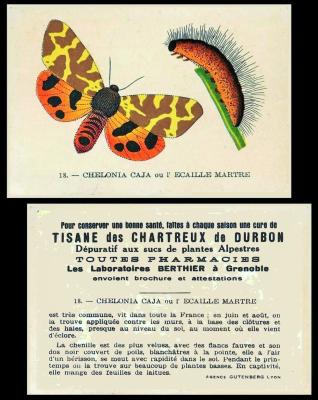
This fine creature is an actual Tiger Moth and you can see why it was so named, though that is not its latin name, which is Arctia Caja, and was granted it by Linnaeus in 1758.
Those stripes and patterns are not just for beauty though, they act as a warning, and a safeguard, because this moth`s bodily fluids are poisonous, with sometimes deadly effect on the central nervous systems and brains of any other species daring to defy the heed. Humans, especially small ones, can also be affected with rashes, contact dermatitis, stinging, or even allergic reactions. And it also has an audible warning system for bats and other night hunters.
Strangely every tiger moth has a slightly different stripe and spot design, and the colour of their hairy bodies also vary. But they do look basically the same to the untrained eye. Its caterpillars look much the same as each other, big and furry, hence their nickname of "woolly bears"
They live in America, Asia, Canada and Europe, but prefer the colder areas, so as our temperatures continue to rise, one day it may well desert our shores. Relocation is possible as it has no firm needs it can eat any plants and sup on any form of nectar, and it is also not fussy about where its eggs are laid, though there is an intriguing link with the fact that many of the plants it chooses to deposit those eggs with are poisonous, and we are not yet sure if this is simply for protection, or whether it is a means of getting the poison into their bodily fluids from the time they begin to start to eat. What we do know is that the caterpillars are already toxic to the touch pretty much from the time they emerge.
There are a lot of words on this back and it`s hard to find the maker. The top section translates to "To maintain good health do a course of treatment each season with / Durbon brand Chartreux herbal tea / a purifier made of Alpine plants / [Available at] all pharmacies / [from] the Laboratories of [Monsieur] Berthier of Grenoble."
The bottom part is all about the butterfly or moth.
This is quite an elusive set but we have a small list which we hope to expand, with your help! So far we know of
- Papilio Machaon ou Machaon ou Grande Porte-Queue
- Parnassius Apollo ou Apollon
- Le Bombyx du Pin ou Gastropacha Pini
- Papillon Blanc (Pieris brassicae brassicae)
- Le Grand Mars ou l`Iris Changeant (Apatura Iris)
- L`Oeil de Paon ou Paon du Jpour (Vanessa Io)
- Citron de Provence (Rhodocera Cleopatra)
- Le Sylvandre (Satyrus hermione)
- Sphinx du Tuthymale (Deilephila euphorbiae)
- Vanessa Cardiu ou La Belle Dame
- Sphinx Ligustri ou Sphinx du Troene
- Charaxes Jasius ou vulgairement Jasius
- Saturnia Pyri ou Grand Paon de Nuit
- Amphidasis Betularia ou appele vulgairement La Phalene du Bouleau
- Liparius Monacha, vulgairment la Nonne
- Cestodes Tenia ou Ver a Soie
- Chelonia Caja ou L`Ecaille Martre
- Limenitis Populi ou Grand Sylvain
- Aglia Tau ou la Hachette
- Abraxas Grossulariata ou Zerene du Grosseillier ou Phalene Mouchetee
- Catocala Sponsa ou la Fiancee
- Vanessa Atalante ou L`Amiral
- Vanessa Antiopa ou Morio
- Deilephila Nerii ou le Sphinx de Laurier Rose
- Papilio Podalirus ou le Flambe
- Phalera Bucephala
- Gastropacha Quercifolia ou Feuille Morte
- Argynnis Aglaia ou Le Grand Nacré
Thursday, 9th July 2026
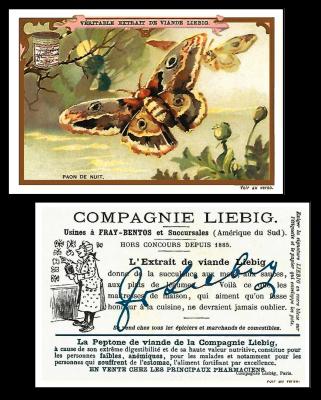
If we look at the presentation pack of the stamps, top left we have the Emperor moth, or Saturnia pavonia. They are easy to spot, and they do fly in the daytime, but only the males, for the females prefer to fly at night - though they are always available, hidden in long grass, should any males pick up their scent and fancy dropping in...
These moths prefer slightly unkempt surroundings, heaths and scrublands, where they can use their colour to blend in all the better. However their caterpillars are green, and often edging towards the lurid end of green-ness.
The reason why we have another French card is because of a curious fact, and that is that in France the Emperor moth is called la Paon du Nuit, or the Peacock of the night. This is not only because they think it resembles the Peacock butterfly of the day, but because in general moths are consided as the butterflies of the night, a much more romantic and pleasing thought, don`t you think, than our tendency to think of the beautiful butterfly and the mediocre moth.
And, as I hope to show you this week, moths can indeed be just as beautiful as butterflies.
This card comes from one of the lesser known Liebig sets. Our example is in French but you can also find it in Italian. There is a difference of opinion between the Fada and the Sanguinetti cataloguing system though, as Fada has "Butterflies of Central Europe" as F.516 and our set as F.517, whilst Sanguinetti has the "Butterflies of Central Europe" s S.518 and our set as S.519. But both agree that both sets were issued in 1897.
The cards in our set are :
- Atlas Blue
French - Polyommate - Atlante
Italian - Multicolore - Atalante
- Brimstone
French - Citron - Pieride
Italian - Citronea - Liride
- Heliconius Doris
French - Eliconia - Doris (Bresil)
Italian - Eliconia - Dorica (Brasile)
- Peacock Butterfly
French - Paon De Jour
Italian - Pavone Diurno - Papilio Hyale
- Peacock Moth
French - Paon De Nuit
Italian - Pavone Nottorno
- Red Admiral
French - Le Vulcain -
Italian - Volcano - Argo
Friday, 10th July 2026
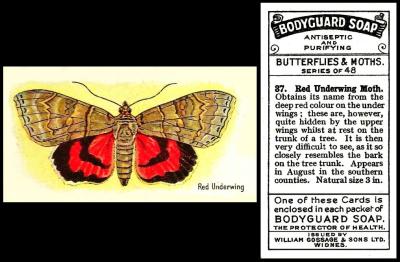
Now I thought I would close with the last moth on the sheet of six stamps, the Buff Tip Moth, but I could not find a card. So what I have done is go for the first first class stamp on the sheet, which is the Dark Crimson Underwing. And then I was shown this card, but puzzlingly it was called the Red Underwing Moth. Further investigation found that there are lots of Underwing Moths, a whole genus of them, two hundred and fifty species, formally known as Catocala, and discovered by Franz von Paula Schrank in 1802.
Our particular moth, the red underwing, or Catocala nupta was actually described by Carl Linnaeus in 1767. It has a wingspan of eighty millimetres and is mainly out and about in August and September.
This set first appears in our original British Trade Index as
William GOSSAGE & Sons, Ltd.,Widnes
- BUTTERFLIES & MOTHS. Sm. 67 x 36. Nd. (48)... GPC-2
That is reduced still more in our updated version, to :
William GOSSAGE & Sons, Ltd.,Widnes
- BUTTERFLIES & MOTHS. 67 x 36. Nd. (48)... GOS-090
That was a bit of a rush at the end and there are a few things still missing, but mostly the gen from the reference books which I will add in over the weekend. The main reason for my tardiness is that today was my first day of volunteering. It was fun, and I`m going back again next Friday, which means that I will have to crack on with next week`s edition a lot earlier.
Wherever you are going over the weekend, I hope that you have a great time. It is, thankfully, not going to be so hot for the next few days, so enjoy that whilst you can.
And I`ll be back again next week, with another newsletter