
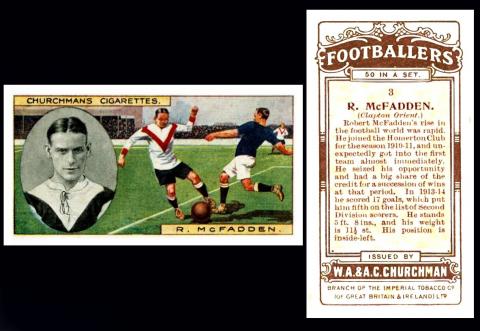
Today we tell the tale of Richard McFadden, born in 1889, but not credited with a month or a date, only with a place, Cambuslang, in Lanarkshire, Scotland.
To football historians, he is best known as being Clapton Orient`s top goal scorer between 1911 and 1915. But he moved, when quite young, to Northumberland, and played for Blyth from November 1910. He then transferred to Wallsend Park Villa, for the transfer fee of two pounds - and first took the pitch in a Clapton Orient strip on the second of September 1911, and scored a goal, though he had joined them four months before.
In 1912 he hit the headlines for another reason, for he saved a young boy from drowning in the River Lea, for which he was given an award, a medal, from the Mayor of Hackney, and before he had joined Clapton Orient he had also saved a man and a child from two separate house fires.
It was only natural that he would volunteer at the outbreak of the First World War, and he joined the 17th Battalion of the Middlesex Regiment. That actually had another name, the Footballers Battalion, because it was specially formed from footballers, staff, and supporters from right across the leagues. And Richard McFadden`s team, Clapton Orient, was one of the most successful at recruiting, supplying the largest contingent of men of any of the football clubs.
In July 1916 he was badly affected by seeing the death of his childhood friend, and Orient teammate, William Jonas, and it is said that he was still in shock when he was himself injured a few weeks later. However he was determined to return to the front lines. However on the twenty-second of October he was killed, by an exploding shell, near the village of Serre les Puisieux. He died the following day, in a field hospital nearby, and was buried at the British Cemetery at Couin, with the rank of Sergeant Major and with "M.M." after his name, denoting he had been awarded the Military Medal, though I cannot find that he had been given it before he died.
He was twenty-seven years old, and left behind a wife, who lived in Blackburn.
A spot of Cartophilic confusion here for in our reference works there are two Churchman sets called "Footballers", and both were issued in 1914. The first set showed portraits of footballers, but there was no set title on the cards; so as one had to be found so they could be recorded, they went down as “Footballers” (A), the (A) standing for adopted title. Then in November 1914 along comes this set, titled “Footballers”. Luckily the fronts on these were not just portraits, so we were able to tack on an extra bit and say this set is either “incidents in play with inset of player” or “coloured action portraits with black and white portrait inset”. And how we know that this set came second is quite simply that we would have straight away called the untitled set something else other than “Footballers” all over again.
Some dealers do this already, using "Portraits" and "Incidents in Play".
More curious facts. Our “action” set is definitely recorded to have been printed by Mardon, Son and Hall, yet there is no record of the printer of the “portrait” set. Also, though most of the sets listed in our original RB.10 Churchman Reference Book do have months of issue, these being actually supplied by Churchman themselves from their own records, the "portrait" set is one of the few that does not. The telling thing is that these records were a combination, of Churchman`s own, and from Mardon, Son and Hall - which proves that the “portrait” set was almost certainly not printed by Mardon, Son and Hall. But who it was printed by remains a complete mystery.