
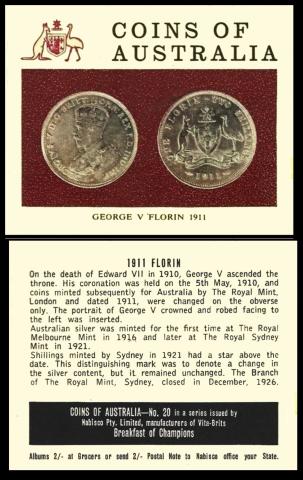
Here we have the Florin, and a non-British version of the coin, which is very apt because originally the Florin was an Italian currency called a fiorino d`oro. It got that name because it had a picture of the fleur de lis on the back, and fiore is Italian for flower, but obviously somewhere along the line the `fi` became corrupted to an `fl`. That coin was made of gold, and it was in circulation for almost three hundred years, from 1252 until 1533.
About half way through those years lots of countries started to make a similar coin, often using a similar name; the one that lasted longest was the forint, of Hungary, from 1325 right until today, though there were some gaps in that.
The British florin was worth two-shillings, or a tenth of a pound, and it has quite a short story because it was only minted from 1849 until 1967, though there was a special edition in 1970. However, the first, 1849, version, which was the first coin for over two hundred years to show a reigning monarch, got off to a really bad start, because it left off the Latin inscriptions for Defender of the Faith and By The Grace of God, so it was called the Godless Florin. In 1852, after much ridicule, a new version was struck which had those phrases. That stayed the same right until 1887, for Queen Victoria`s Golden Jubilee, at which time her portrait was updated to show her as a more stately, elder lady, and the back had sceptres added to the shields, with the Star of the Garter between them.
The next change came with a new Monarch, Edward VII, in 1901, not just the new King`s portrait, but a brand new reverse, showing Britannia. However when George V took the throne in 1911 he ousted Britannia and put the shields and sceptres back. I am not sure if he actually realised that although the Florin was used in Australia, only the portrait side was ever changed - for, as our card shows us, their other side showed a shield held up by an emu and a kangaroo, though it is one of the "new" florins, as it is dated for 1911.
The final British florins left the Royal Mint in 1967, but they were replaced on a like for like basis with a coin saying “Ten New Pence”, the last of three new "decimal" coins which were actually introduced prior to decimalisation proper in 1971 - the others were the five pence, introduced in 1968, and the fifty pence, introduced in 1969.