
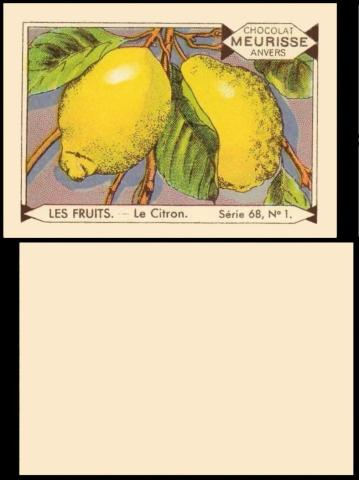
To close our week of iced tea we have something that most people associate with that drink as a natural accompaniment, and that is lemon. Today a lot of us tend to use it because the lemon acts as a sweetener and you do not add sugar - and it also gains favour for flavour in black tea, perhaps, given the absence of milk, to cool it.
The association of iced tea and lemon is a lengthy one. Tea was first grown in America by the British colonists, in the seventeenth century, whilst the first printed recipe for iced tea appeared in 1839, and contained an extra ingredient to recipes of today, that being a hefty swig of alcohol. The next time it was published in a cook book, called "Housekeeping in Old Virginia", was in 1879 and the lemon was as a garnish, a slice of it, rather than a squirt inside the cup. At this time the lemon was also in addition to, not instead of the sugar
America is still the home of iced tea today - possibly because it is a much warmer climate than the British Isles where hot tea reigns supreme. However it was not until the 1904 Louisiana Purchase Exposition that the drink grew in popularity with the general public, and for that we must thank a man called Richard Blechynden, who, despite his name, was of British stock. He was born on the fifth of May, 1857, in India, and he was a tea merchant and a government official, and he took some tea to that exposition to promote his company. However the exposition was held during a very hot spell of weather, and sales were suffering - so, on the spur of the moment, he decided that offering a cold drink would be better accepted, and hit on the idea of adding ice cubes to the tea. And from that humble beginning it became an instant hit.
Not much more is known of Mr. Blechynden, except that he died in the Isle of Wight, on the 26th of July 1940, aged eighty-three. He never married and had no children.
As for our card, it is one of a series of twelve, all with brightly coloured backgrounds, but completely plain backs. The set comprises :
- Le Citron (lemon)
- L`Abricot (apricot)
- La Fraise (strawberry)
- La Noix (nut)
- La Cerise (cherry)
- Le Raisin (grape)
- La Poire (pear)
- La Banane (banana)
- La Nefle (medlar)
- La Prune (plum)
- La Pomme (apple)
- Le Coing (quince)